South African rand dodged a bullet


South Africa’s low inflation, combined with positive investor sentiment from mid-2024 onwards, has allowed the rand to experience a less severe impact from the Middle East war than it would have otherwise.
The Reserve Bank’s conservative approach to monetary policy has also allowed the rand and South Africa’s bond market to avoid the worst-case scenario from this conflict.
Investec chief economist Annabel Bishop explained that all of these factors combined put South Africa in a stronger place, particularly from an inflation perspective.
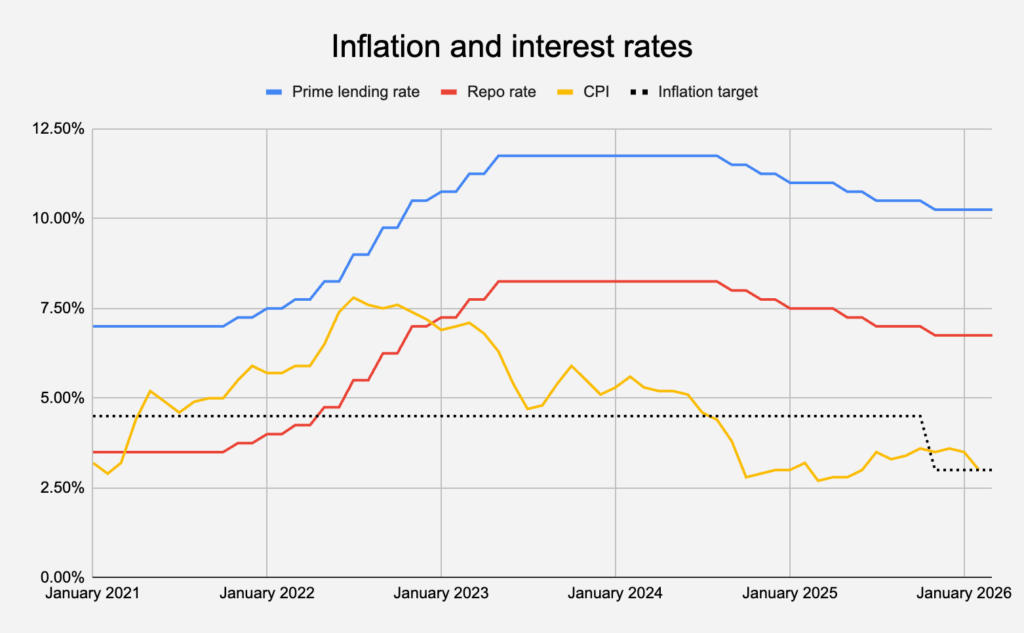
She explained that, prior to the outbreak of the US/Israel-Iran war, South Africa’s CPI inflation was at a historic low, coming in at 3% in February.
February’s inflation print was the latest in a string of low inflation outcomes over the past few months, with CPI having been close to the Reserve Bank’s target since September 2024.
This persistently low inflation can be attributed to the central bank’s highly conservative approach to monetary policy over the past few years.
The Reserve Bank began hiking South Africa’s interest rates in November 2021, anticipating high inflation following the Covid-19 pandemic.
This hiking cycle continued until May 2023, with the Monetary Policy Committee (MPC) implementing a cumulative 475 basis points worth of hikes. This brought South Africa’s interest rates to a 15-year high.
Interest rates would remain unchanged at this high level from March 2023 to September 2024, when the MPC finally announced its first rate cut since 2020.
While painful for consumers, the Reserve Bank’s conservative approach brought South Africa’s high, sticky inflation under control and positioned the country to better absorb shocks like the Middle East war.
Now, South Africa’s inflation is expected to accelerate sharply in March and the months to come due to the impact of the war, with higher fuel prices set to be a significant driver.
However, Bishop explained that the low base inflation in February and the months before will limit the impact of hefty month-to-month price changes on the year-on-year outcome for that month.
In other words, significant inflation spikes in a single month due to the war will essentially be averaged out against the very low inflation numbers from the previous year.
“For South Africa, monetary policy conservatism has allowed for a more robust environment better able to withstand shocks,” she said.
South Africa is stronger
Bishop added that the improvement in South Africa’s investor climate over the last 18 months has also set the country up to better absorb shocks.
After the May 2024 national elections, which led to the formation of the Government of National Unity, investor sentiment towards South Africa improved significantly.
Combined with a commodity rally in 2025, boosting local mining stocks, the JSE had one of its best performances on record last year.
This, Bishop said, has benefitted both the rand and South Africa’s bond market, which have seen a less severe impact from the Middle East war than would have occurred if the country were still in the same investor climate of early 2024.
It should be noted that this does not mean the rand and bond markets have not suffered due to the effects of the war.
The rand has been around 8% weaker against the United States dollar over the past month, as investors have flocked to the greenback as a safe-haven asset amid heightened uncertainty.
Bloomberg recently reported that the JSE All Share Index (ALSI) is heading for its worst month in almost two decades, set to reach declines last seen during the height of the 2008 global financial crisis.
This comes as the ALSI is reeling from a double hit – the Iran war, which is sapping demand for emerging-market assets, and plunging precious-metal prices, which are weighing on South African miners.
However, according to Bishop, the impact of the Middle East war could have had a far worse effect had South Africa not been in a stronger position than it was two years ago.




Comments