Government is running out of time


South Africa has run out of options, with the only way out of its current decline being significantly faster economic growth.
While the National Treasury’s hard work has improved the state’s financial health, this has to be coupled with faster growth in the near future for government debt to be meaningfully addressed.
Furthermore, to tackle South Africa’s unemployment crisis, economic growth has to outstrip the country’s population growth of 1.4% by a much wider margin.
The only way the government can do this is by increasing the private sector’s participation in the economy by deregulating key sectors, as the state no longer has the balance sheet to invest adequately in infrastructure and growth.
This is feedback from Stanlib chief economist Kevin Lings, who said that the one issue he had with the Finance Minister’s Budget Speech was the lack of focus on driving faster economic growth.
“If I look at all of these fiscal measures and budgeting totals, you would conclude that this is a good Budget and a commitment to fiscal discipline,” Lings said.
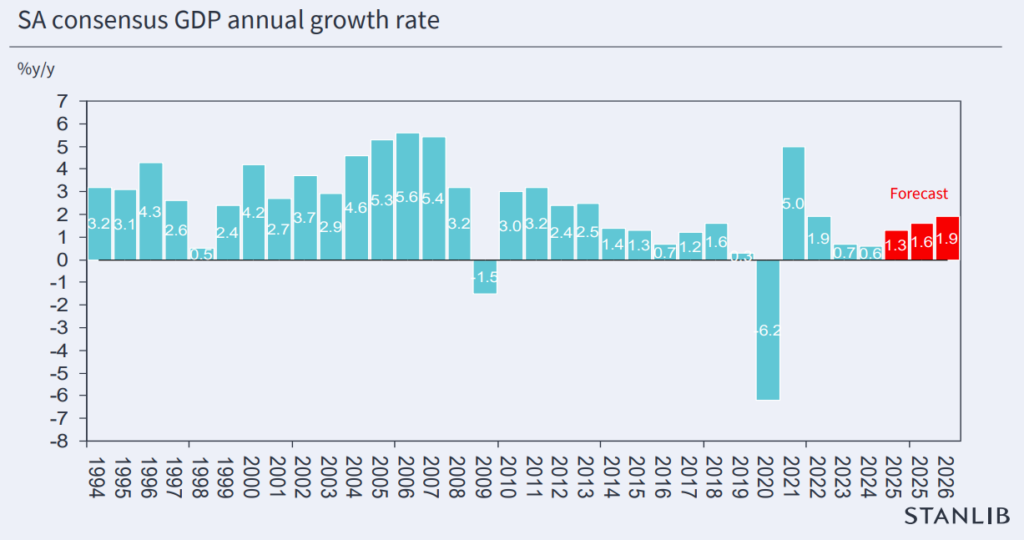
“But, where is the focus on economic growth? If I look at the government’s overall forecasts on GDP over the next three or four years, they still do not have South Africa growing at more than 2%.”
This is simply not good enough, Lings explained, with it being insufficient to address South Africa’s unemployment crisis or meaningfully improve the lives of citizens.
With regard to government finances, it is not fast enough to drive a meaningful increase in revenue and ease the state’s debt burden.
“It is simply not going to do it. The reason is that the population is growing at 1.4% per year, and we have a high level of unemployment. At these rates of growth, we are not going to add many jobs,” Lings said.
“In three or four years’ time, South Africa will be under serious pressure. We are going to have pressure on social support and service delivery. We are going to have pressure on crime and on the number of grant recipients.”
The current rate of economic growth, while improved, is not enough for South Africa to stave off a very serious reckoning in the future, as the math simply does not work.
Backs against the wall
This means that South Africa’s back is against the wall, with a narrowing range of levers to pull for it to avoid a full-blown crisis.
For Lings, the only option left for the government is to deregulate sectors of the economy and enable the private sector to play a larger role.
This is the aim of the government’s current reform agenda, with it set to increase private participation in the electricity and logistics sectors.
The state and its state-owned enterprises simply no longer have the balance sheet to invest heavily in upgrading infrastructure after 15 years of mismanagement.
While this reality is clear, Lings said that the reform agenda is not being executed with the urgency that is required.
“I certainly keep hoping that the government would get more urgent about how they lift the growth rate. Clearly, the government is endorsing public-private partnerships,” Lings said.
“But, this needs to be enhanced a lot more. There needs to be a higher degree of urgency about implementing some of these reforms and making it clear that the government is willing to deregulate and allow the private sector to participate more fully.”
Lings said the Finance Minister’s lack of attention to this was the blemish among the Budget, which was, on the whole, good.
“In terms of the expectations going into the Budget, this pretty much achieved all of the key goals and, I think, it was well accepted by most individuals that analysed it,” Lings said.
Previously, Lings has unpacked what is needed to drive faster economic growth in South Africa, with an intense focus on raising fixed investment in the economy.
“We would have to up the investment considerably more to result in capacity building or job creation in South Africa,” Lings said.
“The current investment level is mainly maintenance capex and kind of treading water, with companies waiting for a better environment.”
“Instead of deploying capital into growth or hiring, corporates are parking it in money market funds or call accounts.”
To get this capital, which is valued at around R1.8 trillion, off the sidelines and into the economy, the government has to focus on creating an enabling environment for private companies to invest.
“I would say that deregulation is your only option now. It is your only choice, and while you may not like it ideologically, it is your only option,” Lings said.
“You are out of options, and those options have been taken away because you took government debt from 26% to 77% of GDP. That increase meant you have taken away your option to use your own balance sheet.”
Lings said it would have been ideal for South Africa for the government to use its own balance sheet for infrastructure investment. However, this option is no longer available.
 Loading ...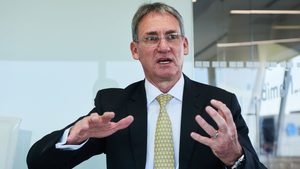



Comments