Reserve Bank Governor shares good news for South African households


A lower inflation target in South Africa will yield immense benefits for consumers, with increased buying power, easier financial conditions, and rising disposable incomes.
Structurally lower inflation will result in prices increasing at a significantly slower rate, reducing the erosion of purchasing power.
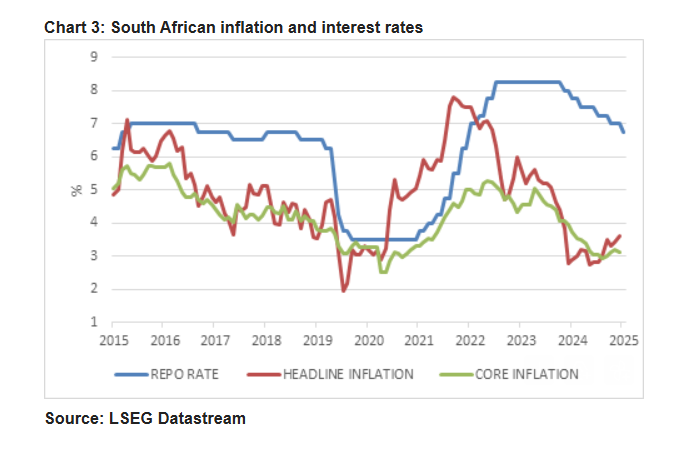
This lower inflation will also translate into reduced interest rates, ease financial conditions, and free up more disposable income to be spent or invested.
South African Reserve Bank Governor Lesetja Kganyago recently explained the benefits of a lower inflation target for ordinary citizens.
Much attention has been paid to the benefits for the government through reduced borrowing costs and faster economic growth after the Finance Minister officially shifted the inflation target to 3%.
Kganyago told Newzroom Afrika that the benefits for ordinary citizens are just as significant, with faster economic growth coming as a result of these improvements.
“Inflation is the rate at which prices in the economy change, and that matters immensely as it erodes the purchasing power of households and businesses,” Kganyago explained.
In the past, the Reserve Bank’s inflation target was a range between 3% and 6%, which is higher than South Africa’s peers and resulted in purchasing power being eroded at a faster rate.
“At 6% inflation, prices will double every 12 years. If you target 3%, prices only double every 24 years, greatly improving the purchasing power of individuals over time,” Kganyago said.
“Lower inflation means that the South African Reserve Bank has more room to lower its policy rate, making the cost of borrowing lower. Lower inflation leads to lower interest rates.”
This significantly loosens financial conditions in South Africa, making it cheaper to borrow money while also reducing current debt repayments.
This frees up spending from businesses, households, and the government, significantly boosting economic growth in South Africa.
Buying power
Much of the benefit of lower inflation and interest rates for ordinary individuals is the increased buying power they will have in the economy.
This comes as a result of higher disposable income, as debt repayments come down and wages grow faster than inflation.
“Remember that the mandate of the South African Reserve Bank is to protect the buying power of the income of South Africans,” Kganyago explained.
“What you have seen is that with the decline in inflation, disposable income is released and, as a result, people have more buying power.”
This is a result of a combination of prices rising at a slower rate and wages rising at a faster rate than those prices, increasing buying power.
“The maintenance of inflation at lower levels provides the Reserve Bank with room to relax its monetary policy, lowering borrowing costs and that has released income for South Africans,” Kganyago said.
This is slightly different for some individuals, with a reduction in interest rates reducing the repayments of individuals with debt.
For those with savings, it reduces the rate of return on money left in the bank, lowering the hurdle for individuals or companies to spend that money in the economy or invest it in more productive assets.
This is particularly critical for businesses, with South African companies sitting on over R1.8 trillion cash in the bank.
As interest rates come down, the return on these funds declines, pushing businesses to invest that capital in expanding operations.
Kganyago said South Africa is primarily a nation of borrowers, with regard to households, making the benefit come primarily in the form of reduced debt repayments.
Standard Bank has previously estimated that a 50-basis-point reduction in interest rates frees up around R8 billion in household spending, due to lower home loan repayments.
With regard to the government, the National Treasury estimates that a 100 basis points reduction in interest rates would save the state R20 billion in overall debt and interest payments.






Comments