South Africans worse off now than in 2015


South Africa’s real GDP per capita has declined by over 4% in the past decade, as low economic growth and rising unemployment are weighing on local households.
This “triple threat” of poverty, inequality and unemployment is eroding social trust, with only one in four South Africans believing that most people in the country can be trusted.
This manifests in many social challenges faced in South Africa, including elevated levels of crime and gender-based violence.
PwC recently outlined these challenges in its South Africa Economic Outlook for December 2025.
This report explained that South Africa’s weak economic growth has lagged that of other emerging markets since the global financial crisis of 2008 to 2009.
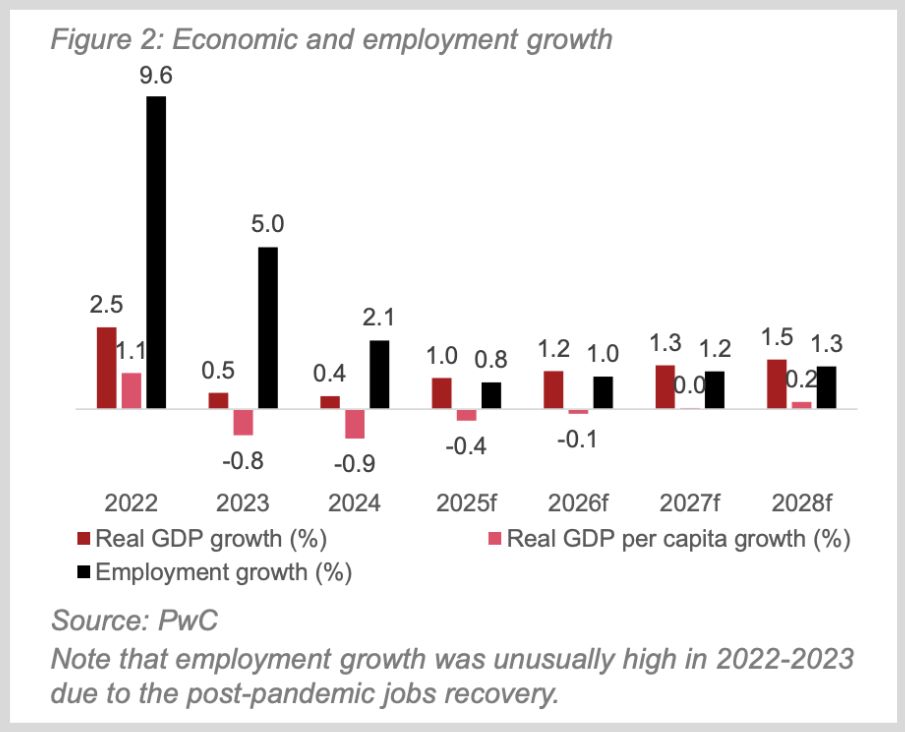
This trend continued into 2025, when emerging markets and developing economies are expected to grow by an average of more than 4.0%, while PwC forecasts only 1% real GDP growth for South Africa in 2025.
“The list of reasons for South Africa’s sedated growth is long and well-known. In alphabetical order, the list starts with ageing infrastructure, brain drain, corruption, debt burden (both public sector and households), energy insecurity, fiscal challenges, etc,” the report explained.
This slow economic growth has directly impacted South Africans, as population growth of around 1.4% per year has outpaced GDP growth.
This resulted in South Africa’s real GDP per capita declining for most of the past decade, falling by 4.2% on an inflation-adjusted basis over the past 10 years.
PwC forecasts suggest that this negative per-capita trend will continue in 2025 and 2026.
The firm explained that a decline in GDP per capita is generally associated with declining standards of living and economic instability, which South Africans are feeling the effects of.
PwC’s report explains that this instability and weak economic growth are placing severe pressure on South African households, leading to a breakdown in the country’s social fabric.
The graph below shows the decline in South Africa’s GDP per capita from 2022 to what is projected in 2028.
South Africa’s triple threat
PwC said South Africa’s triple challenges of poverty, inequality and unemployment are all at elevated levels due to weak economic and employment growth.
This results in many social challenges across the country, including crime and gender-based violence.
“For most communities, economic instability is associated with loss of household income, the closure of small enterprises, and a lack of quality public service delivery,” the firm said.
PwC further explained that these conditions adversely affect interpersonal trust within communities.
The firm’s August 2024 South Africa Economic Outlook noted that social trust is a deep determinant of economic progress, fostering cooperation, reducing transaction costs and encouraging investment and innovation.
“When individuals trust each other, they engage in mutually beneficial exchanges, leading to economic growth and development,” the firm explained.
However, according to the World Value Survey, only one in four (23.3%) South Africans believe that most people in the country can be trusted.
PwC noted that this is only one-third as strong as the top-performing countries globally.
Several experts have warned that South Africa is sitting on a ticking time bomb, as tensions in the country could reach a boiling point following a decade of economic stagnation and rising unemployment.
Former Goldman Sachs Sub-Saharan Africa CEO Colin Coleman recently warned that South Africa’s levels of dissatisfaction are similar to those seen in countries where widespread social unrest occurred.
As a result, he believes it is highly unlikely that the current government will survive to the next election, with a clear need for a general election within the next three years.
This would present a major problem for South Africa, as the country’s law enforcement agencies are increasingly unable to contain widespread organised crime and rising social instability.
In October 2025, the Centre for Risk Analysis (CRA) raised the alarm about a worrying trend of declining capacity within local law enforcement.
In particular, the CRA warned that the government’s declining capacity to contain organised crime creates space for malign actors to fill these vacuums.
The organisation said this may be exploited by the ANC’s extensive patronage networks to destabilise the country in the coming years.




Comments