Reserve Bank warns about South Africa’s infrastructure collapse


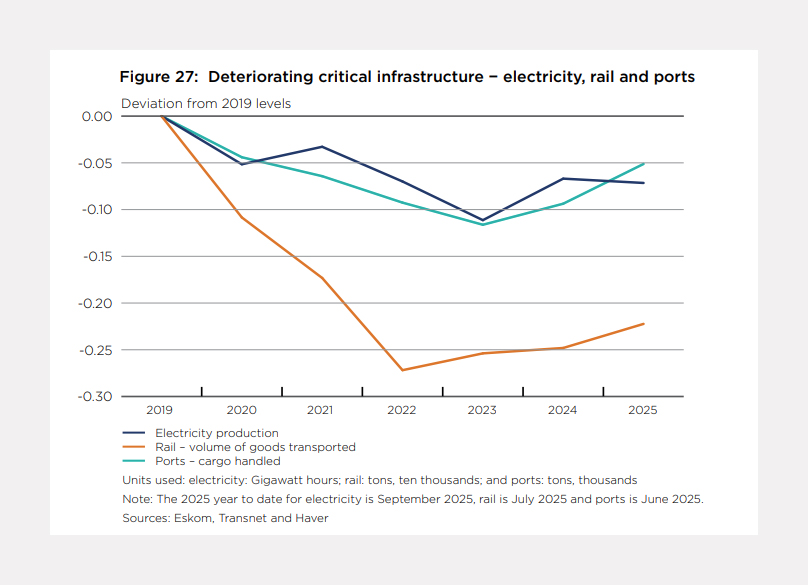
South Africa’s deteriorating infrastructure continues to limit economic growth, with the country producing less electricity and handling less cargo at its ports than it did in 2019.
The impact of this is not limited to slower economic growth but threatens to exaggerate other risks to the country’s stability, such as the rise in government debt.
This is feedback from the Reserve Bank, which outlined several risks to South Africa’s financial stability in its second Financial Stability Review for the year.
The review aims to outline these risks, their likelihood of destabilising the financial system, their potential impact, and how they are being mitigated.
They range from longer-term risks, such as climate change, all the way to newer risks, such as the rise in adoption of cryptocurrency in South Africa.
One of the relatively newer risks that has been added in recent years is South Africa’s deteriorating critical domestic infrastructure.
Despite some improvements in the electricity, logistics, and water sectors, the declining service delivery in these areas continues to limit economic growth, the Reserve Bank said.
South Africa currently produces less electricity, transports lower volumes of goods by rail, and handles less cargo at its ports than it did in 2019.
This presents a clear risk to the local financial system as slow growth impacts the value of its assets, its ability to lend, and makes it more vulnerable to external shocks.
However, deteriorating infrastructure is unique in that it exacerbates nearly all the other risks the Reserve Bank identified.
Inadequate infrastructure exaggerates the impact of climate change by worsening the impact of floods or fires, for example.
Its most severe impact on the local financial sector is the deterioration of public debt ratios as a result of low economic growth and poor revenue collection.
For example, for many municipalities, the revenue from electricity and water sold to ratepayers constitutes the bulk of their revenue.
If there is insufficient electricity supply to meet demand, immediate revenue is lost as well as future revenue from companies and households investing in alternative energy sources.
This reduces both municipal revenue and Eskom’s earnings, placing additional strain on the fiscus and the local financial sector.
Green shoots
The good news is that there has been some recovery in the electricity and logistics sectors over the past 18 months, mitigating this risk to some extent.
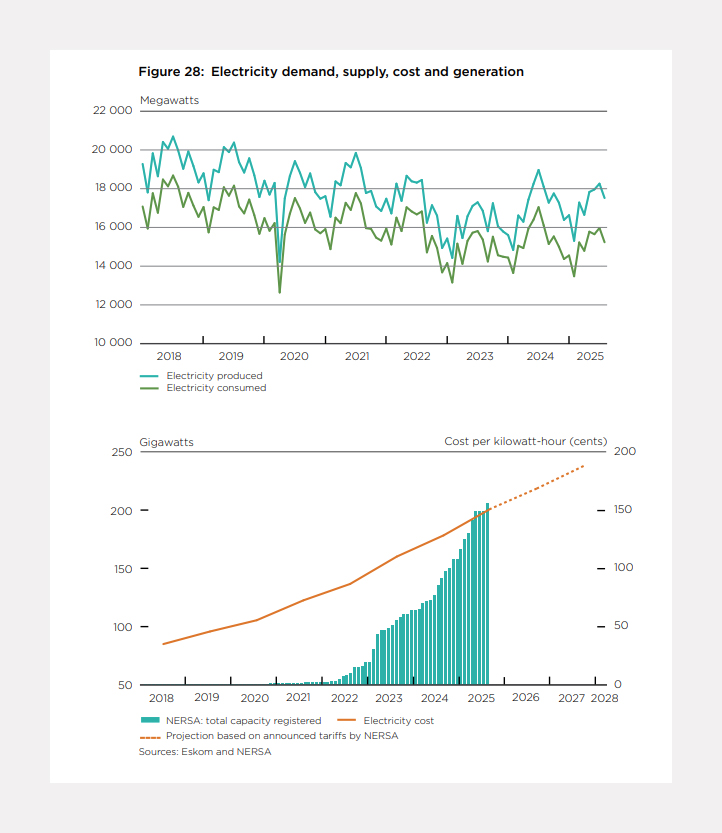
In particular, Eskom has achieved a significant turnaround, with its energy availability factor rising from 51% in January 2024 to 69% in September 2025.
This has resulted in a substantial reduction in load-shedding since April 2024, with it now largely being considered a thing of the past.
However, part of this recovery is due to a sustained rise in private renewable energy generation, which limits Eskom’s revenue and that of municipalities.
This means that despite Eskom’s turnaround, the risk to municipal and state revenue remains elevated.
The Reserve Bank also noted the deterioration in municipality-managed electricity distribution infrastructure, which limits economic growth, the addition of new generation capacity, and adds to their financial pressures.
It also pointed to the significant rise in electricity prices over the past 15 years as an area of concern, with above-inflation increases putting pressure on households and businesses.
The above inflation increases also make the Reserve Bank’s primary function, maintaining price stability, increasingly difficult.
South Africa’s rising electricity prices have pushed private players to continue investing heavily in alternative energy sources, despite Eskom’s improvement.
The Reserve Bank warned that should private electricity generation continue its current trend, Eskom’s longer-term profitability is likely to decline.
This will have spillover effects for municipalities generating income from on-selling Eskom electricity.
Municipal arrears to Eskom exceeded R100 billion as at March 2025, and the 12.6% tariff increase for the 2025/26 financial year could further strain the ability of both municipalities and Eskom’s direct customers to pay for electricity.
In addition to electricity arrears, municipalities’ arrears to water boards continue to grow, and service delivery remains uneven across regions.
While the government’s commitment to large-scale water infrastructure investment is a positive step, implementation delays and governance challenges continue to undermine progress.
The financial health of municipalities is deteriorating, with budgets heavily reliant on rates and user charges, yet revenue collection remains weak. Intergovernmental transfers, though helpful, are limited in scope and often tied to specific mandates.





Comments