Social grant scam warning for South Africa


The Department of Social Development has warned South Africans against a new scam circulating about a “National Family Support Allowance”.
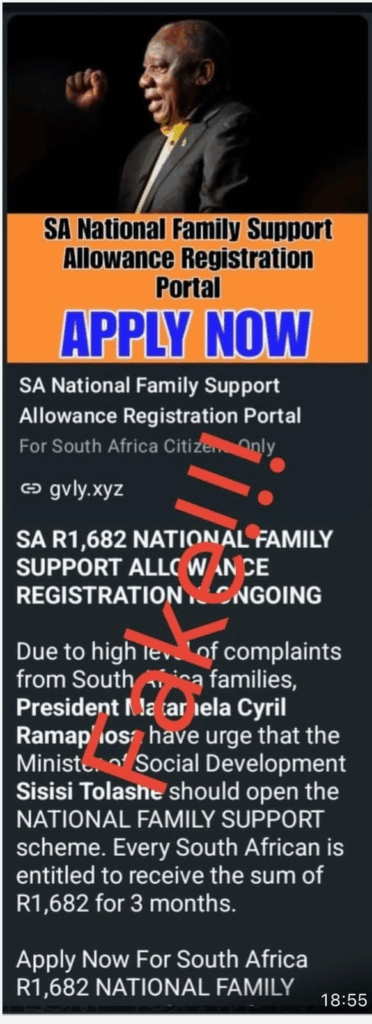
This scam, which is circulating on social media, claims that the government has opened registrations for this allowance, valued at R1,682 for three months.
The department’s warning comes as South Africa is seeing a boom in fraud cases, with scammers using social media, artificial intelligence (AI), and other technology to defraud South Africans.
In a statement released on Monday, 1 December, the Department of Social Development cautioned the public to be extremely vigilant about a fake message circulating on social media.
This message claims that, due to high levels of complaints from South African families, President Cyril Ramaphosa urged Social Development Minister Sisisi Tolashe to open the National Family Support Scheme.
The post further claims that every South African is entitled to receive a sum of R1,682 for three months, urging them to apply through an attached link.
In its statement, the Social Development Department categorically dismissed this information as “fake news”.
“There is no such programme, no new cash allowance, and no registration process linked to any ‘National Family Support Allowance’,” it said..
“The message is a scam designed to mislead the public and potentially steal personal information through fraudulent links.”
The department emphasised that all official announcements on social protection programmes are issued directly by the department, its entities, the South African Social Security Agency and the National Development Agency, or through verified government communication platforms.
The department urged members of the public not to click on suspicious links, not to share the false message, and to always verify information through official channels.
“The department remains committed to providing reliable and accurate information and urges communities to help stop the spread of misinformation,” it said.
The image below shows the fraudulent message circulating on social media.
Fraud boom in South Africa
Over the past year, South Africa has seen a signicant influx in fraud and scams, particularly on social media platforms.
Many of the country’s major banks have issued warnings about these scams, urging the public to be wary of what they see on their social media channels.
As early as March this year, PSG Financial Services’ COO of distribution, Johannes Theron, warned South African investors to be wary of investment scams run on social media.
Theron cautioned that tempting online adverts offering unrealistic investment returns have flooded social media in recent years, with so-called “finfluencers” playing a large role in promoting these scams.
“Many of these schemes operate without oversight, exploiting gaps in regulation to appeal to those desperate for rapid financial gain,” he said.
“Compounding this risk is the role of unqualified brand ambassadors and ‘finfluencers’, who promote these financial products as personal recommendations without any skin in the game.”
“This creates a dangerous dynamic, blurring the line between unbiased guidance and deceptive marketing.”
While this type of scame has become a global problem, South Africans are particularly vulnerable, with a 2025 study by forex broker BrokerChooser finding that South Africans are the most vulnerable to financial scams on Meta platforms.
The company scraped the Meta Ads Library and analysed more than 5,000 active finance-related ads to identify the countries where users are most susceptible to this growing wave of online financial deception.
The report found that thousands of fraudulent ads have been allowed to run on Meta platforms: Facebook, Instagram, Threads, Messenger and WhatsApp.
BrokerChooser’s research revealed that South Africa was the most exposed to dodgy financial ads on Meta, with a staggering 37.50% of ads flagged as outright scams and 62.50% identified as risky.
The broker explained that investment fraud on social media has surged dramatically over the past three years, finding that one in four people who lost money to fraud reported that it began on social media.
Instagram and Facebook were the most frequently reported platforms. However, TikTok and LinkedIn were linked to the highest average financial losses per victim.
BrokerChooser previously found that up to 80% of forex advice given out on TikTok from ‘influencers’ could be potentially misleading.
Their findings were alarming, as the videos lacked major disclaimers. A high volume of videos also focused solely on flaunting wealth and lifestyle, with little to no trading context.
The analysis found that a staggering 80% of forex advice on TikTok was potentially misleading. Only 6%, or 3 in 50 videos, encouraged viewers to do their own research.




Comments