South Africans ready for R3.3 billion spending spree


FNB expects another strong day of Black Friday spending in 2025, with overall transactions expected to exceed R3.3 billion.
Over the past few years, Black Friday has become a valuable gauge of the country’s economic momentum, providing a helpful indicator of the local economy’s underlying momentum.
In a statement released on Monday, 24 November, FNB explained that Black Friday spending in 2025 is expected to be driven by continued growth in digital payments, online shopping and overall transactions.
“Early signals across 2025 show consistent customer spending and sustained adoption of secure digital payment methods, positioning this year’s event for solid activity across both physical and online retail,” the bank said.
In 2024, overall transactions on FNB Speedpoint devices over Black Friday weekend totalled R5.4 billion.
The bank said eCommerce was a major driver of this activity, recording a 37% increase in transaction values and a 76% jump in transaction volumes.
In addition, virtual Card spend grew by 59% year-on-year, contributing more than R600 million to total Black Friday spend.
“Based on prior year’s performance and the bank’s year-to-date activity, FNB expects similar patterns this year,” the bank said.
“Digital wallets and virtual cards remain among the fastest-growing payment methods, while cash usage continues to decline across the market.”
“Online shopping is expected to accelerate further as more customers seek convenience, security and competitive promotions.”
FNB Credit Card Business Development Head Akshay Bhayroo said consumer behaviour in 2025 so far shows that South Africans are making deliberate choices about their spending.
This has included shifting their budgets towards essentials, prioritising discounts, and timing purchases to align with promotional periods.
For 2025, FNB expects earlier shopping behaviour to continue. Last year, spending from a week ahead of the main Black Friday event rose by 25% compared to 7% the year before, and retailers have again released promotions earlier than in previous years.
The bank said grocery, clothing and entertainment categories are likely to remain the most active, with tourism and apparel expected to show continued resilience.
An economic litmus test

Anchor Capital economist Casey Sprake explained that Black Friday is increasingly becoming a fixture in South Africa’s retail calendar and a surprisingly valuable gauge of the country’s economic momentum.
“While Black Friday is often viewed as a consumer spectacle of discounts and retail theatrics, it has evolved into a meaningful barometer of consumer sentiment, household resilience, and underlying demand conditions,” she said.
“Trends in spending volumes, the appetite for durable goods, the intensity of online activity, and transactional intensity collectively provide a remarkably clear snapshot of consumer sentiment, household financial resilience, and broader demand-side conditions.”
Sprake said Black Friday 2025 comes at an interesting time when many monthly consumer indicators have been “surprisingly robust”.
For example, real retail sales have rebounded, and nominal sales suggest that the improvement is demand-driven rather than simply a result of lower inflation.
This optimism is further buoyed by new passenger car sales, which have been trending higher throughout the year.
Sprake said this metric has been supported by lower interest rates, competitive import pricing, and pent-up demand after the persistent ageing of South Africa’s vehicle fleet.
“In parallel, personal income tax payments have remained firm – an indicator of stable formal-sector earnings,” she said.
“Together, these trends point to a relatively healthy consumer base heading into the spending-heavy November period.”
However, she said it is important to note that deeper structural pressures in the economy remain, which could impact Black Friday spending.
Sprake pointed out that the latest FNB/BER Consumer Confidence Index (CCI) reading, which slipped from -10 to -13 in the third quarter of 2025, is a clear signal that households remain cautious.
“Although sentiment is well off its earlier lows, the index continues to sit significantly below its long-term average of -1, reflecting ongoing anxiety about job security, rising costs, and the general economic outlook,” she said.
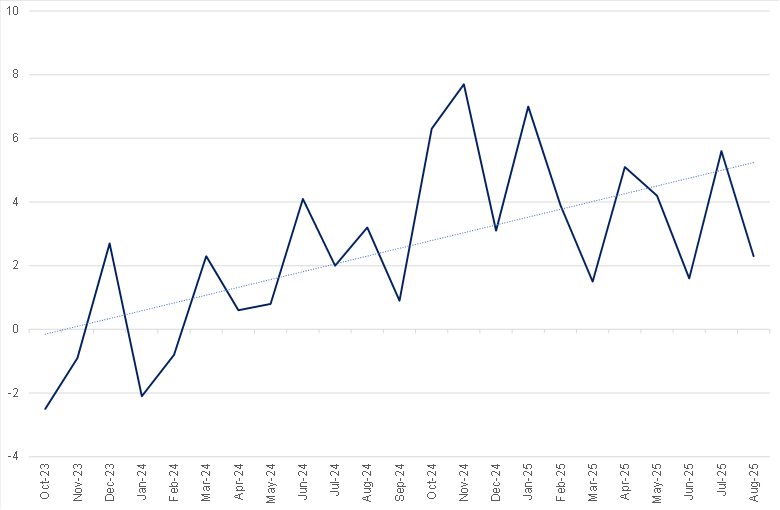
The graph below, courtesy of Sprake, shows South Africa’s year-on-year retail sales growth from October 2023 to August 2025.





Comments