Eskom’s saving grace is the private sector


The substantial reduction in load-shedding over the past 18 months is mainly due to the immense investment in renewable energy from the private sector.
This investment has resulted in a significant, permanent reduction in demand for electricity from Eskom, giving it the space to conduct intense maintenance and reduce load-shedding.
Eskom’s improved performance is also a key reason why load-shedding has been significantly reduced over the past two years.
However, the utility’s performance has not been enough to end load-shedding on its own. Its energy availability factor (EAF) is still well below historical averages, and the utility produces less electricity than it did a decade ago.
This is feedback from Nedbank’s latest Energy Tracker, which is compiled by its economics unit and tracks developments within South Africa’s electricity sector.
It shows that the improvements within the sector are largely due to a sustained decline in energy demand, with improvements from Eskom playing a smaller role.
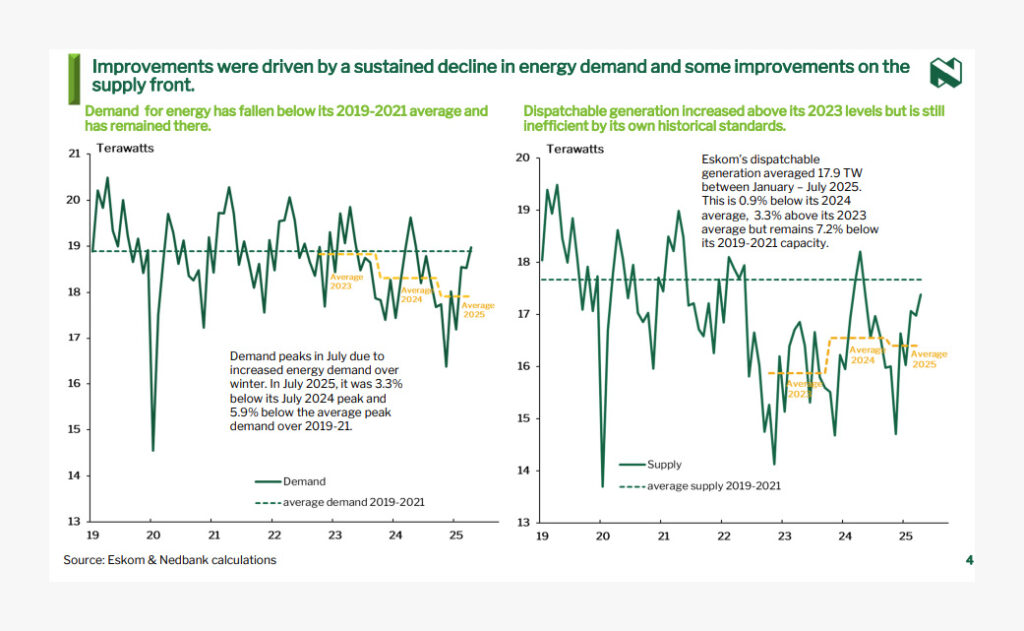
Nedbank’s data showed that energy demand has fallen below its 2019 to 2021 average and has remained there, with average demand in 2025 one terawatt (TW) below the historical average.
On the other hand, Eskom’s dispatchable generation has increased above its 2023 levels but remains well below historical averages.
The utility’s dispatchable generation averaged 17.9 TW between January and July 2025, nearly 1% below 2024 levels and 7.2% below Eskom’s 2019 to 2021 average.
This is an improvement, however, of 3.3% from 2023 when South Africa experienced the worst load-shedding on record.
Nedbank explained that this is due to the greater emphasis placed on maintenance by Eskom’s new management team, which is beginning to bear fruit.
Planned maintenance has been kept at around 12% of installed capacity on average in the first half of 2025, the second-highest average since 2019.
As a result, Eskom’s EAF has improved over the past two years, averaging 60% in 2024 and 59% in the first half of 2025.
The improvement can be seen in the graphs below, as well as how the demand continues to outstrip Eskom’s supply, which is below the utility’s 2019 to 2021 average.
Renewables to the rescue
Private sector investment in renewable energy has driven a permanent decline in demand for electricity from Eskom over the past two years.
Nedbank said this is the main reason behind the reduction in load-shedding, as households and companies have reduced their reliance on the utility.
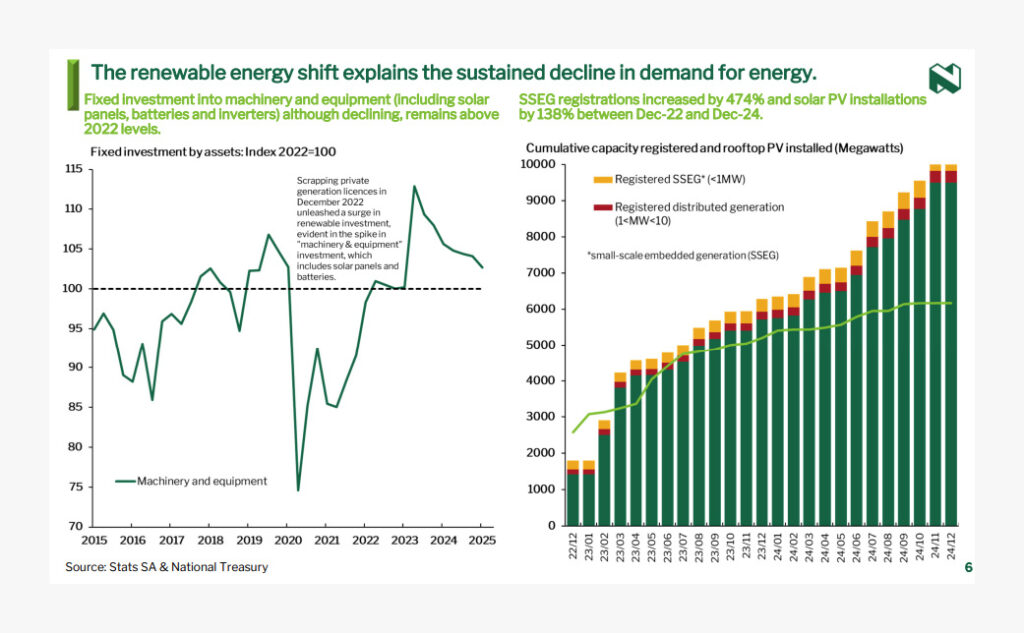
The bank’s data shows that fixed investment into machinery and equipment, including solar panels, batteries and inverters, remains above 2022 levels.
This is despite a decline over the past year, as load-shedding has improved and many investments into renewables have come online.
As a result, small-scale embedded generation (SSEG) registrations increased by 474% and solar installations by 138% between December 2022 and December 2024.
This trend is only set to continue as South Africans increasingly seek alternatives to minimise their exposure to the repeated above-inflation electricity price increases over the past few years.
South African companies and households are, in effect, looking for alternatives to Eskom to reduce the cost of electricity.
Companies are also increasingly investing in renewables to reduce their carbon footprint and minimise the potential impact of carbon border taxes from South Africa’s major trading partners, particularly the European Union.
According to Nedbank’s estimates, private rooftop solar capacity increased from around 1,500 MW at the end of 2022 to more than 9,000 MW. That excludes the larger registered SSEG systems.
The 7,500 MW difference is equal to the amount of demand Eskom shaves from the grid at stage 7 or stage 8 load-shedding.
Eskom’s own estimates show that “behind-the-meter” rooftop solar PV capacity has grown 211% from 2,265 MW to 7,040 MW over the last three years.
This has significantly reduced demand for electricity from Eskom, easing the burden on the utility and giving it the space to conduct additional maintenance at its plants.
The graphs below show the strong growth in renewable energy from the private sector, outlining the investment in renewables and the capacity of the projects installed.




Comments