Big petrol price cuts coming this week


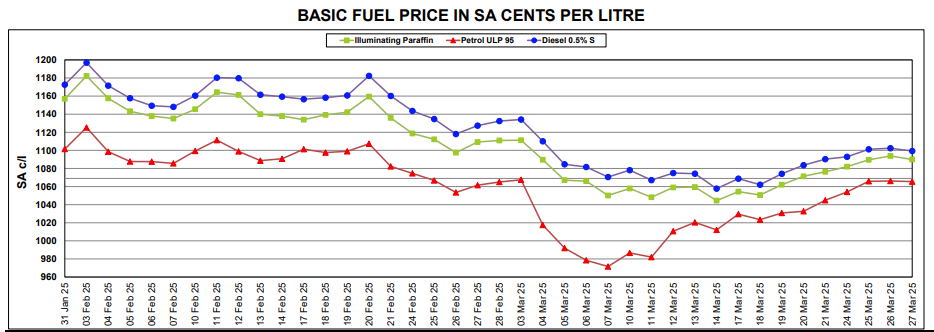
South African motorists are set to experience some relief at the fuel pumps this week, with forecasts indicating cuts to petrol of between 64 cents and 78 cents per liter, with diesel being slashed by over 90 cents.
This is largely due to the rand strengthening versus the dollar, while the price of oil has remained relatively flat over the past month.
However, the price of oil has gained some upward momentum in the past week as financial markets wait to see the extent of United States President Donald Trump’s tariffs, which are set to be imposed in the first week of April.
This threatens to disrupt global supply chains and push the price of oil higher.
The Central Energy Fund (CEF) tracks these changes and uses the monthly average exchange rate and oil price to forecast the expected price of various fuel types in South Africa.
Its latest data indicates the below changes for next week when fuel prices are adjusted in April –
- Petrol 93 – decrease of 64 cents per litre
- Petrol 95 – decrease of 78 cents per litre
- Diesel 0.05% – decrease of 90 cents per litre
- Diesel 0.005% – decrease of 93 cents per litre
These cuts are lower than those expected earlier in March as the price of oil rebounded and the rand’s strength tapered off amidst a standoff among members of the government regarding South Africa’s Budget.
However, the price of oil is set to remain under downward pressure throughout 2025, with Trump’s tariffs likely to set off a trade war that will limit global growth.
In particular, increased tariffs on China, which is expected to retaliate, will hit oil demand from the world’s largest importer.
Additional supply from major producers is also expected to come online, pushing many traders to bet on the price of oil to continue its downward trend.
Members of the Organisation for Petroleum Exporting Countries have voted to relax their production cuts to regain market share.
The organisation’s eight members subject to voluntary extra output cuts will begin increasing production in April and are expected to add 2.2 million barrels a day of supply.
This relaxation was only anticipated to come into effect in late 2025 and early 2026.
Amidst global uncertainty, the rand has held its own against the dollar, appreciating 1.4% against the greenback in the past month.
The rand has rallied strongly against the dollar over the past two months, going from R19.23/USD in mid-January to trading around R18.20/USD towards the end of March.
Investec chief economist Annabel Bishop explained that this is largely due to expected interest rate cuts in the United States.
US interest rate cuts positively affect emerging market currencies, boosting the rand as local financial assets become relatively more attractive to investors.
As a result, the rand also gained on the repo rate being left unchanged in South Africa in March, with the Reserve Bank‘s Monetary Policy Committee (MPC) not coming across as dovish, further bolstering the rand.
With the repo rate currently at 7.50%, the SARB’s “forecast sees rates stabilising at a neutral level of about 7.25%”, i.e., there will be only one more cut in the cycle.
The MPC’s cut is forecast for 2025, with the repo rate remaining at this rate until the end of 2027, close to the previous meeting’s end-2027 forecast. Flat to higher interest rates in South Africa tend to support the rand.




Comments