Big petrol price cuts for South Africa on the cards


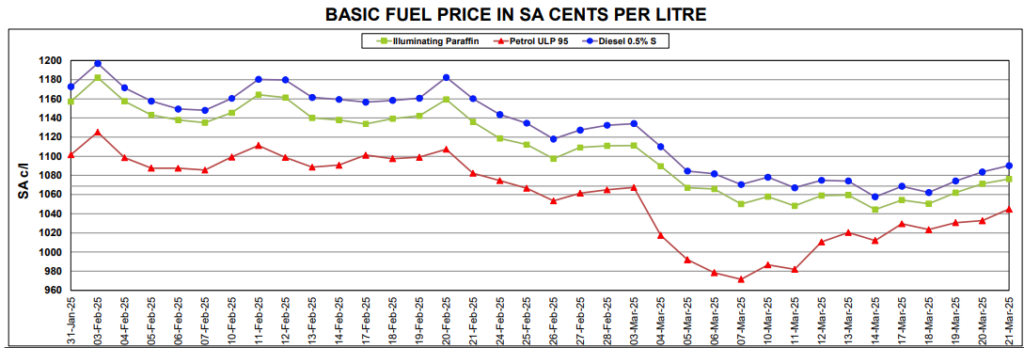
South African motorists are set for significant relief in April, with forecasts indicating the petrol price may decline by over 70 cents per litre while diesel prices will come down nearly R1.00.
This is due to declining oil prices and a strong rand, which has held its own against the dollar so far in 2025.
The price of oil has fallen by over 3% in the past month as fears of slow global economic growth due to a trade war rise.
Additional supply from major producers is also expected to come online, pushing many traders to bet on the price of oil to continue its downward trend.
The rand has held its own versus the dollar, strengthening by almost 1% versus the greenback over the past month.
South Africa’s Central Energy Fund tracks these changes to forecast the expected changes to the price of petrol and diesel in South Africa for the coming month.
Its latest data indicates the below changes for next week when fuel prices are adjusted in April –
- Petrol 93 – decrease of 74 cents per litre
- Petrol 95 – decrease of 88 cents per litre
- Diesel 0.05% – decrease of 94 cents per litre
- Diesel 0.005% – decrease of 96 cents per litre
The oil price has been relatively steady, considering the fallout in financial markets caused by US President Donald Trump’s trade policy.
Oil temporarily rebounded last week, rising by 2.2% to $72 per barrel as the US administration persuaded markets that reciprocal tariffs would be highly targeted and not a barrage.
However, these tariffs are still likely to limit global economic growth, particularly if other states retaliate with levies of their own. This will reduce demand for oil, putting downward pressure on prices.
While demand is coming under pressure, oil supply is set to be boosted as members of the Organisation for Petroleum Exporting Countries (OPEC) relax production cuts.
The organisation’s eight members subject to voluntary extra output cuts will begin increasing production in April and are expected to add 2.2 million barrels a day of supply.
This relaxation was only anticipated to come into effect in late 2025 and early 2026, but fears of declining market share pushed significant Middle Eastern producers to increase production.
The rand has also come to the party, holding its own against the dollar amid rising global tensions and policies widely expected to weaken emerging market currencies.
While the rand has taken several hits due to these tensions, the local currency has remained surprisingly strong, and the US dollar has weakened by over 3% against the rand this year to date.
Bureau for Economic Research senior economist Shannon Bold explained that this is, in part, due to local economic factors that are supporting the local currency.
For example, the country’s somewhat better-than-expected current account deficit in the fourth quarter of 2024 and South Africa’s monetary policy stance could support the rand.
“With a relatively high real interest rate, the rand remains an attractive currency for yield-seeking investors,” she said.
South Africa’s risk premium has also come down significantly since the formation of the Government of National Unity (GNU) in June 2024.
This has also encouraged foreign investors to return to the country’s bond market as South African government debt provides strong returns. These investors are yet to return to the country’s equity markets.





Comments