Motsepe-owned solar project scores big win over Renergen


The Mineral Resources Department has rejected Renergen’s suspension application, which would have suspended all construction work on South Africa’s largest solar plant.
This is according to the SOLA Group’s co-founder and executive director, Dr Chris Haw. Billionaire Patrice Motsepe became the single largest shareholder of SOLA Group when his company, African Rainbow Energy and Power, bought up a 40% stake in 2021.
This comes after Renergen recently disputed the construction of the Springbok Solar project, owned by Independent Power Producer SOLA Group, claiming that the project was in conflict with Renergen’s gas Production Rights.
In October this year, Renergen expressed concerns via a SENS announcement regarding the ongoing construction of the Springbok Solar project in an area designated for future natural gas extraction.
Renergen explained that it is the holder of a valid onshore petroleum Production Right granted in 2012 under the Mineral and Petroleum Resources Development Act (MPRDA).
According to the company, it is incumbent on new developments to obtain permission from the Petroleum Production Right holder under Section 53 ministerial consent of the MPRDA and to execute a co-existence agreement.
“In an egregious attempt to force the company into granting them such permission, the company noted an unrelated appeal by Springbok Solar challenging aspects of the Production Right, which has no bearing on the case at hand,” Renergen said.
“We believe the challenge by Springbok Solar lacks the substance to make changes to the company’s Production Rights and will likely take years before it reaches a court for a decision.”
“The company has attempted to engage in open and constructive dialogue with Springbok Solar to ensure we retain access to our gas-bearing structures in order for us to continue with our core business activities of exploration and production of natural gas.”
However, following Renergen’s announcement, SOLA told News24 that its Springbok project has obtained all necessary lawful authorisations to begin construction of its facility and insisted Renergen was consulted.
SOLA said Renergen has subsequently appealed several of the project’s approvals and initiated legal proceedings.
“In defence of these appeals, Springbok has become aware that Renergen’s claim to helium rights is, in fact, unlawful and has therefore commenced an appeal of the amendment to the production right, which was applied for on the basis of a material misrepresentation by Renergen,” News24 reported.

On Monday, 11 November, SOLA announced that the Mineral Resources Department has rejected Renergen’s suspension application, and the Springbok Project can continue construction.
“SOLA is a 100% South African company and has been constructing solar projects for more than 15 years,” Haw said.
“We are confident we have followed all legal processes, and we are happy that the department’s decision today confirms we have all lawful permits in place and may continue construction on the plant.”
Springbok Solar Project is a 195 MWp solar project that will add more than 435,000 MWh of clean energy to the South African grid.
“This equates to CO2 savings of over 370,000 tonnes per year,” Haw said. “The construction started in December 2023, is currently 70% complete and employs more than 400 people.”
The company said Renergen is attempting to use a technicality to appeal the department’s decision to issue Springbok Solar a Section 53 permit, claiming it was not properly consulted.
This permit provides ministerial consent to use the surface of the land in any way that may be contrary to the Mineral and Petroleum Resources Development Act (MPRDA).
SOLA said Springbok Solar submitted written evidence showing it consulted with Renergen on ten occasions over a two-year period, in writing and in person during the pre-construction phase, clearly providing Renergen with the layout maps and coordinates of the facility.
“These consultations were not only done through official prescribed processes as detailed in the National Environmental Management Act, but also done on a bilateral basis with information exclusively being sent to Renergen,” it said.
Haw said that Renergen raised no objection during any of these engagements, which led Springbok Solar to conclude that the construction of the solar project would have no impact on Renergen’s Production Rights and, therefore, would not be contrary to the objectives of the MPRDA.
“This view is shared by independent geologists and supported by Renergen’s published drilling plans, which show no evidence to permit or drill any wells on or within two kilometres of the solar facility footprint,” Haw said.
He further explained that the suspension of the permit risks over 400 jobs, billions of rands of local investment and significant commitments made to the local community in social economic development expenditure.
“SOLA notes that if the decision to grant the permit is overturned, all these benefits for both the local community and the environment will be lost,” Haw said.
He said Renergen, who initiated the dispute, has no current plans and no environmental or zoning permits to use the area on which the solar farm is built and would not suffer any immediate damages or consequences.
“The solar farm area represents less than 0.17% of the overall area of the Production Right and has been confirmed by independent experts to have no significance with respect to Renergen’s existing and future plans detailed on their production right,” he said.
“Renergen, however, appears intent to stop this project and has instituted a separate, unrelated appeal against Springbok’s environmental authorisation amendment and has applied to the Bloemfontein court for an interdict to stop construction.”
“Springbok Solar will continue to use all legal avenues to defend its rights and those of its employees, local community and shareholders.”
 Loading ...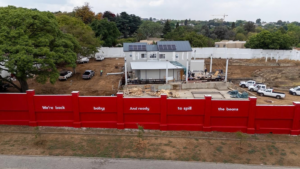


Comments