Eskom’s new company could be dead on arrival


Eskom plans to transfer its municipal debt burden to its new distribution company once its unbundling is complete.
Doing so would encumber the entity from day one, leaving the fledgling company with a substantial burden that will undermine its solvency and ability to fund necessary investments.
This is according to Impumelelo Growth Lab research fellow Dr Garth Greubel, who outlined why Eskom’s plan could see its distribution unit be essentially dead on arrival.
Greubel’s warning comes as Eskom is in the process of unwinding its 103-year-old monopoly over South Africa’s electricity market.
One of the key steps in this process is the state-owned utility’s unbundling, which refers to its structural separation into distinct, specialised entities.
Historically, Eskom has operated the generation, transmission, and distribution of electricity in South Africa through three internal divisions.
These internal divisions are all housed under one controlling entity, Eskom Holdings. The utility’s unbundling will result in the divisions becoming separate, stand-alone entities.
The transmission function will be housed in the National Transmission Company of South Africa (NTCSA).
The NTCSA will operate the national grid and incorporate Eskom’s System & Market Operators.
It will serve as an independent transmission system operator, opening grid access to all power producers, including Eskom.
Eskom’s generation function will remain in Eskom Holdings, retaining the utility’s existing fleet of power stations, along with a newly formed renewable energy subsidiary, Eskom Green.
Lastly, Eskom’s distribution function will go to the National Electricity Distribution Company of South Africa (NEDCSA).
Once formed, NEDCSA will manage the distribution grid, sub-transmission, and retail supply to end-users and municipalities.
NEDCSA, as a corporate entity, has already been formed, but the functional transfer from Eskom Distribution has not yet happened.
Splitting Eskom up into these three distinct state-owned enterprises will dismantle South Africa’s concentrated, vertically integrated electricity monopoly.
The current structure sees Eskom playing the dual role of grid owner and dominant generator, creating a conflict of interest that makes it nearly impossible for other players to compete effectively.
At the same time, this monopolistic structure has perpetuated Eskom’s reliance on above-inflation tariff hikes, trapping the utility in a death spiral of declining sales and rising costs.
Therefore, Eskom’s unbundling is expected to benefit both the utility and South African consumers.
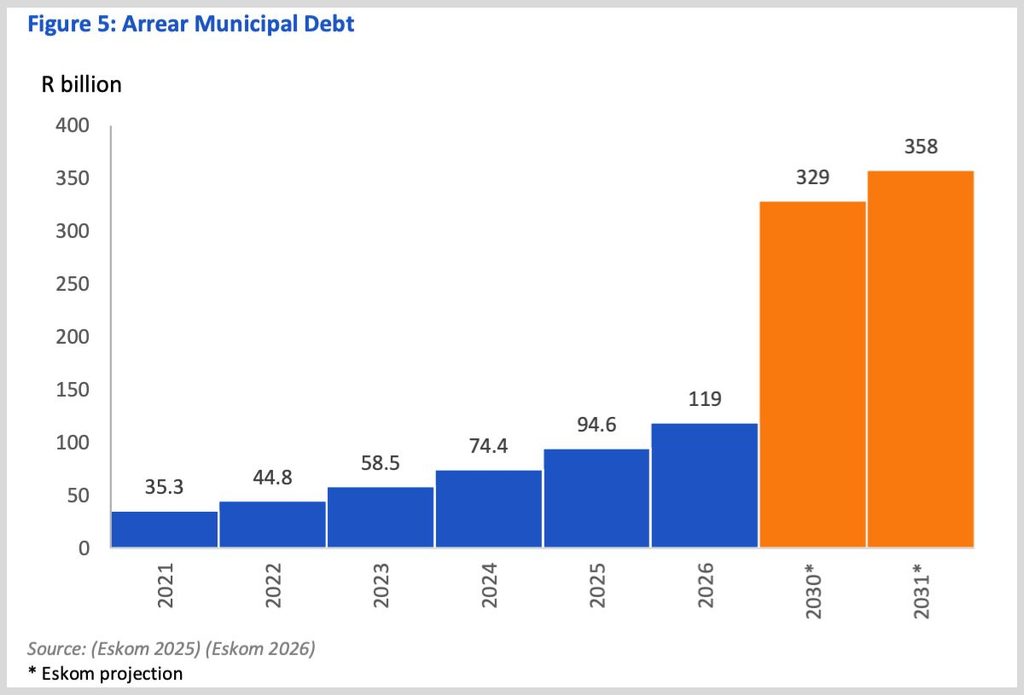
Eskom’s municipal arrears
One of the major threats to Eskom’s long-term sustainability is municipal arrears, which arose from bulk power supplied through the utility’s distribution division.
Years of non- or insufficient payments from municipalities have left the utility with a huge R119 billion debt pile, which is expected to grow to R300 billion by 2030 without urgent intervention.
While efforts are underway to address the problem, the question of Eskom’s unbundling remains: which entity will inherit the debt?
Currently, Eskom intends to transfer the municipal arrears receivable to NEDCSA once it is operational.
However, Greubel warned that would essentially render the distribution arm non-viable from day one.
He pointed out that, of the R119 billion in arrears, the vast majority is impaired or considered uncollectible. Eskom excluded R91.6 billion for failing collectability criteria in its 2026 financial year.
“Transferring the full amount to NEDCSA could impair the new distribution entity from inception,” he said.
However, leaving the debt under Eskom Holdings’ roof is also not a viable option, Greubel said.
“Leaving it in Eskom Holdings would strand a large, impaired receivable in the residual group,” he said.
Greubel explained that, once Eskom is unbundled, the holding company will no longer have the profitable, revenue-generating distribution assets and retail customer bases it once had.
This means Eskom Holdings will no longer retain the underlying municipal supply cash flows needed to absorb or manage the legacy balance-sheet hole of municipal arrears.
However, transferring the municipal arrears to NTCSA is also not an option, with Greubel warning that doing so would contaminate the transmission business with distribution credit risk.
It would undermine NTCSA’s creditworthiness exactly when it needs a strong balance sheet to raise the R440 billion required to expand South Africa’s national grid.
“The historic arrear debt is therefore not merely an accounting allocation issue; it is an intergovernmental fiscal problem requiring a central solution,” Greubel said.
“Do not simply transfer the full debt to NEDCSA or contaminate NTCSA with distribution credit risk.”
Login or register for unlimited free access.






Conversation
1 commentsLet Eskom keep their debt and sell Transmission business to Private enterprise.
Private sector will run Transmission profitably. Let them take over municipal grids too.
Then people don’t pay they will be cut off.
Ideology says people must get freebies , because “ag shame” then government pays that bill.
We may eventually see IPPs being the main customer for Transmission services