110 municipalities across South Africa owe Eskom R1 million each


As of 31 August 2026, 110 municipalities in South Africa had overdue debt to Eskom exceeding R1 million each.
None of these municipalities was paying their Eskom accounts in full and on time by that date.
The total owed by municipalities to Eskom reached R122.5 billion on 31 August 2026, with the utility concerned that this figure could reach R300 billion by 2030 if left unaddressed.
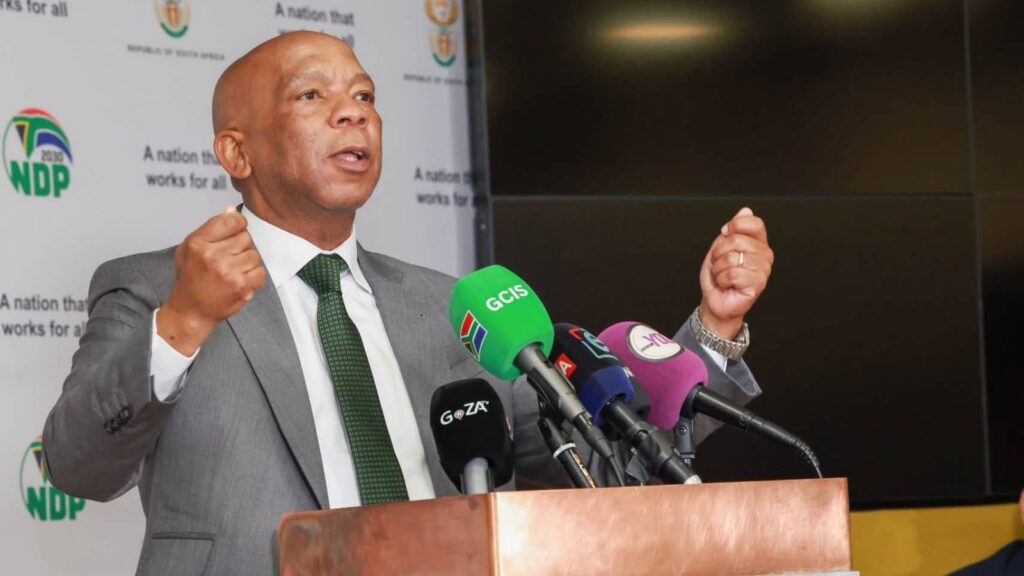
This was revealed by Electricity and Energy Minister Kgosientsho Ramokgopa in response to a Parliamentary question from MP Kevin Mileham.
Mileham asked the minister for the total number of municipalities that are currently not paying their Eskom accounts in full and on time.
He also asked for the total amount of arrears on municipal debt presently owed to Eskom.
In his response, Ramokgopa said that as at 31 August 2026, 110 municipalities had overdue debt exceeding R1 million each.
He added that, on the same date, total overdue municipal debt stood at R122.5 billion.
This is up R10.9 billion from the overdue municipal debt Eskom recorded at the end of its 2026 financial year in March.
At the current growth rate, Eskom projects that municipal debt owed to the utility will reach R300 billion by the 2030 financial year.
Municipal debt has emerged as one of the biggest threats to Eskom’s financial sustainability, with overdue payments having ballooned over the past few years.
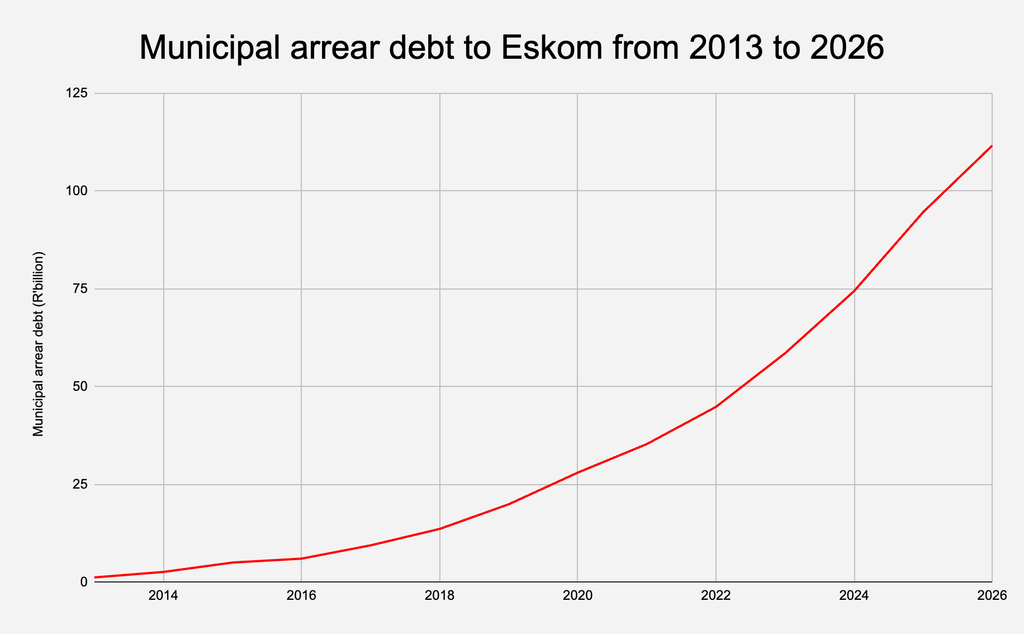
In the early 2010s, municipal debt owed to Eskom was still modest, standing at R2.6 billion in 2014.
At this time, municipal arrears were generally settled as soon as equitable share transfers from the National Treasury were disbursed.
However, from then on, overdue municipal debt escalated swiftly, going from R4.95 billion in 2015 to R19.9 billion in 2019.
The problem only worsened from there, with Eskom’s 2022 financial year seeing municipal debt reach R44.8 billion.
In its 2026 financial year, Eskom reported that municipal debt had climbed to R111.6 billion, despite interventions from the National Treasury.
A small number of municipalities owe a lot
One consistent trend in municipal debt owed to Eskom is that a small group of municipalities account for the vast majority of arrears.
Eskom revealed in its annual reports that the top 20 defaulting municipalities represent between 78% and 82% of total arrears.
These municipalities are also concentrated in the Free State, Mpumalanga, and Gauteng, with municipalities in these three provinces accounting for 76% of all municipal arrears.
Some of the most prominent defaulting municipalities include Emalahleni, Maluti-a-Phofung, Matjhabeng, Emfuleni, and Govan Mbeki.
In recent years, municipal debt owed to Eskom has begun spreading from rural municipalities to large metropolitan governments.
Historically, South Africa’s large metros paid on time and consistently, but this has now changed. The cities of Tshwane, Johannesburg, and Ekurhuleni are now among Eskom’s biggest debtors.
This is partly because municipal debt has, over time, outstripped the equitable share grants these metros receive from the National Treasury.
Therefore, many municipalities have opted to use their grants to cover other expenses rather than paying Eskom for bulk electricity supply.
Another contributing factor has been a growing culture of non-payment and non-technical losses across the country.
This has led to widespread electricity theft, illegal connections, meter tampering, and illicit prepaid token syndicates, undermining municipal electricity revenue.
While Eskom has attempted to negotiate payment plans and debt settlements, the vast majority have broken down, with only one or two municipalities honouring their agreements each year.
Even the National Treasury’s interventions have often fallen on deaf ears at South African municipalities.
In 2023, the Treasury launched its Municipal Debt Relief Programme, allowing qualifying municipalities to have their debt written off, with strict conditions.
This programme saw high participation in terms of debt volume, with 71 participating municipalities representing 95% of the targeted debt.
However, compliance was dismal. Between 80% and 90% of participating municipalities failed to pay their current accounts, making them ineligible for the debt write-off.



Conversation
3 commentsThat is simple math. Simple anything is not how headlines are worded.
Makes it sound like big municipalities and Metros “only” owe as much as small municipalities, which we all know is nonsense.
The smallest municipalities maybe “only: owe R1 million (even that is doubtful )