Eskom spent billions on diesel to keep the lights on


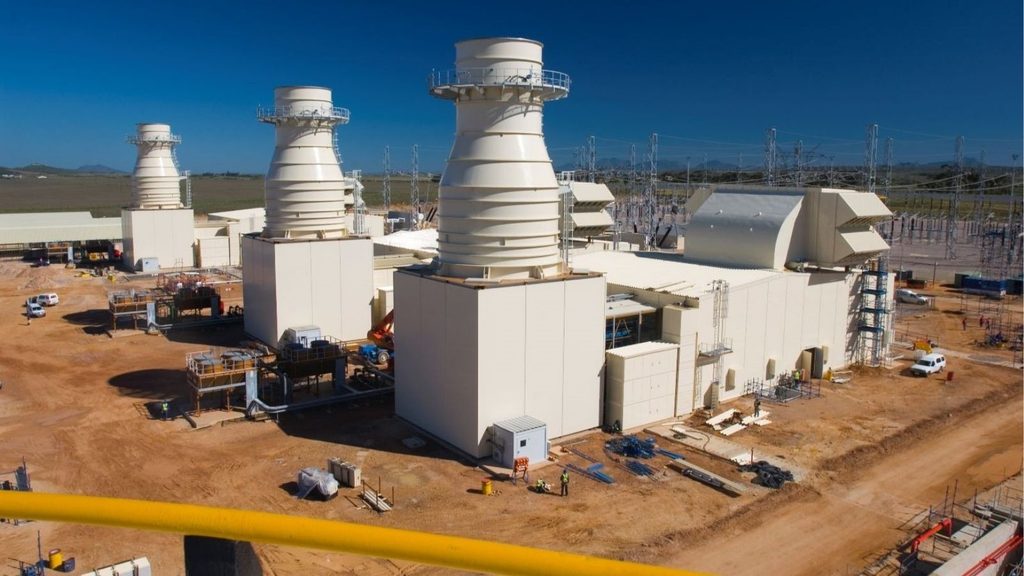
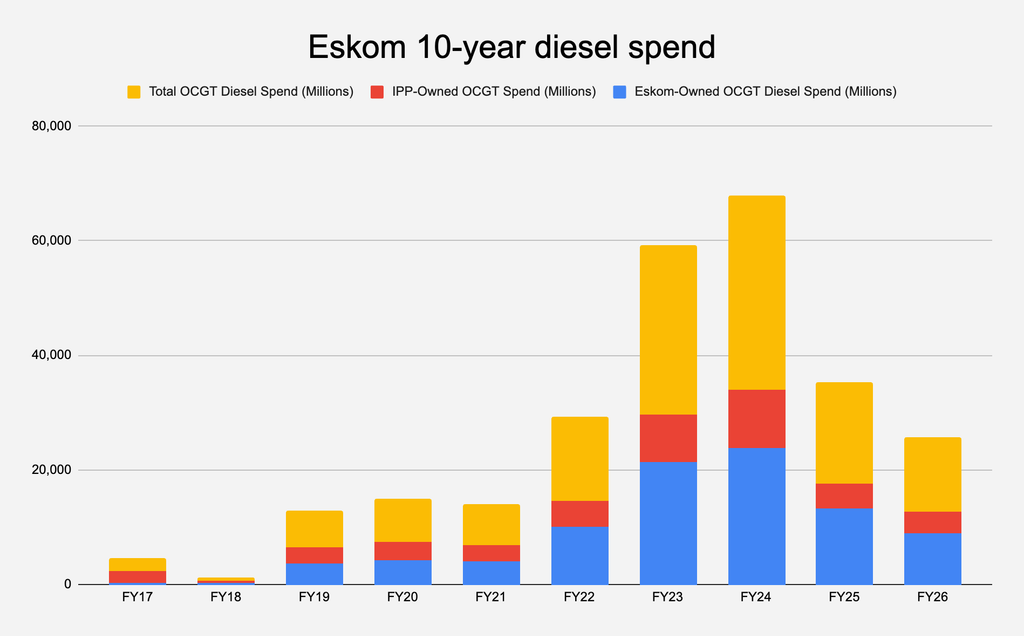
Eskom spent R12.81 billion on diesel for its and its Independent Power Producers’ (IPPs) open-cycle gas (OCGT) turbines in the 2026 financial year.
This marks a nearly R5 billion reduction from the previous year, but remains far above levels seen a decade ago.
This was revealed in Eskom’s results for the year through March 2026, released on Monday, 31 August.
These results showed a far more financially healthy Eskom than in previous years, with the group recording revenue of R354.72 billion and a profit of R30.35 billion.
One of the reasons for this improved financial performance was that the group spent R4.88 billion less on diesel in 2026 compared to 2025.
The group spent R9.03 billion on diesel for Eskom-owned OCGTs, while IPP-owned OCGT spent was R3.78 billion. This totals R12.81 billion, down 27.58% from 2025.
This is far lower than in 2025, with Eskom’s improved operational performance in 2026 allowing the utility to reduce reliance on its diesel-powered emergency stations.
Eskom reported that the estimated forecast purchases of diesel for its OCGT peaking power stations fell to 203,661 kilolitres in FY26, down from 431,680 kilolitres in FY25.
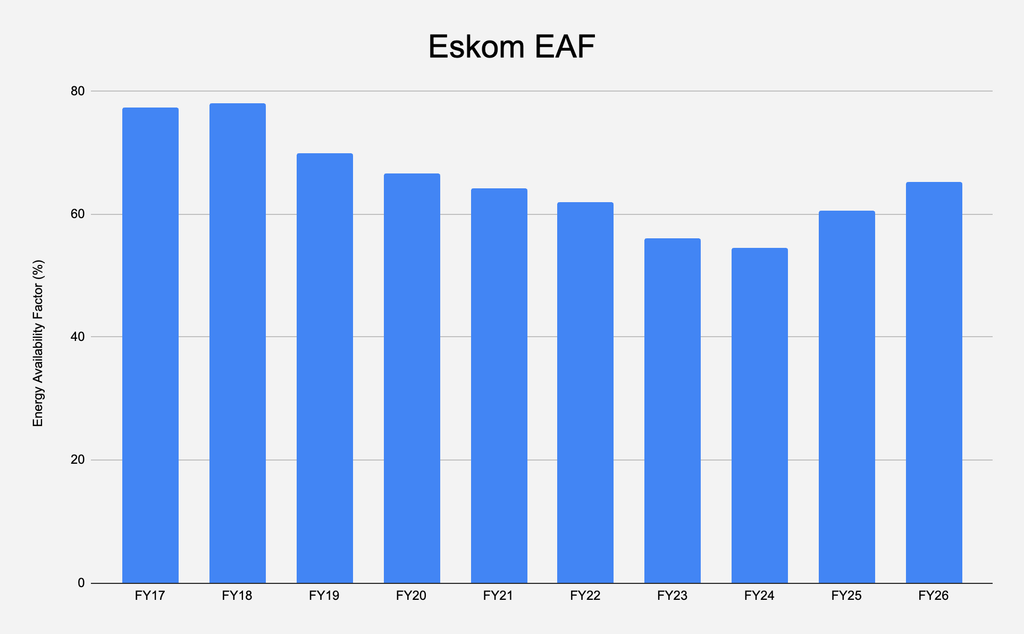
This was made possible by the recovery in baseline generation plant performance, which saw Eskom’s Energy Availability Factor (EAF) rise to 65.16%, up from 60.6% in 2025.
The group’s performance also benefited from lower electricity demand, particularly from power-intensive mining and industrial customers.
The combination of better coal fleet reliability and lower grid demand allowed Eskom to reduce its reliance on expensive OCGT peaking plants, running them at a reduced average load factor of 3%.
This lower diesel consumption, in turn, generated substantial primary energy cost savings, which directly contributed to a 10.82% increase in Eskom’s EBITDA to R108.6 billion.
While Eskom’s 2026 diesel spend marks a substantial reduction from 2025, the group is still spending far more on the fuel now than it did a decade ago.
Eskom’s missed EAF targets
Eskom’s persistently high diesel spend is due to the fact that, while the utility has improved its operational performance, it has yet to return its EAF to levels last seen five years ago.
In the 2017 financial year, Eskom reported an EAF of 77.3%, and this measure peaked in 2018 at 78%.
Since then, Eskom has reported a consistent decline in EAF, reaching a low of 54.56% in the 2024 financial year.
The metric has been on an improving trend since, rising to 60.6% in 2025 and now to 65.16% in 2026.
While an improvement, this remains well below Eskom’s stated goal of improving its EAF to 70%.
The state-owned utility previously said that, if it can reach the 70% EAF target, load-shedding would be a thing of the past in South Africa.
Eskom has set targets for an EAF of 60% by March 2023, 65% by March 2024, and 70% by March 2025. It has missed all three of these deadlines.
It should be noted that Eskom’s higher EAF, though still under target, meant the utility had few breakdowns.
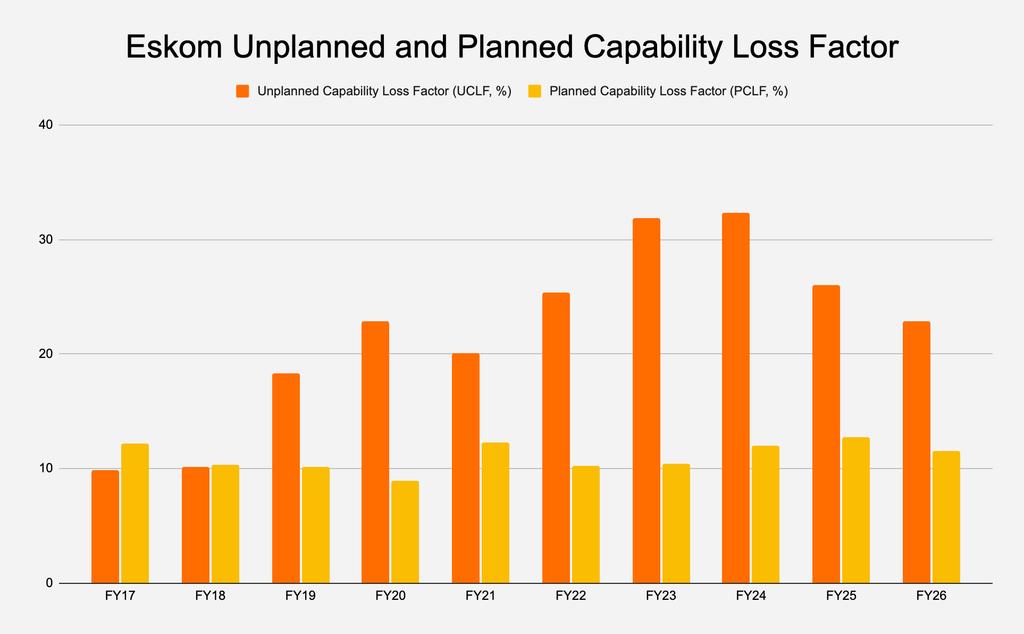
This, in turn, has led to a sustained decrease in Eskom’s Unplanned Capability Loss Factor (UCLF) over the past three years.
Eskom’s UCLF rose steadily over the past decade, peaking at 32.34% in 2024. Since then, it has reduced to 26.05% in 2025 and reached a six-year low of 22.88% in 2026.
The graphs below show how Eskom’s performance metrics have changed between the 2017 and 2026 financial years.






Comments