South Africa’s most important company is in serious trouble


Eskom is facing a period of severe pain, with the utility’s skyrocketing electricity prices resulting in demand destruction and the loss of customers.
This leaves it with a declining customer base from which it can recover its costs, which continue to grow, potentially pushing it into a downward spiral.
As prices continue to rise, the economic case for households and companies investing in alternative energy sources and battery storage only gets better.
Coupled with this is a fundamental shift in South Africa’s economy from energy-intensive mining and manufacturing towards less demanding services industries.
This has also contributed to declining demand for Eskom’s product, resulting in substantial financial challenges for the utility in the near future.
Energy expert and EE Business Intelligence managing director Chris Yelland explained this situation to the State of the Nation podcast.
Yelland explained that Eskom’s performance has improved dramatically over the past two years, with staff morale improving at the utility, and it is now increasingly confident in its ability to solve problems.
However, as it has improved its operational performance, attention is shifting towards the utility’s financial health and electricity prices, and the significant challenges it faces in those spaces.
The biggest challenge Eskom faces, Yelland explained, is the impact rising electricity prices have had on its customer base and demand for power.
“The price of electricity has caused demand destruction. For the last ten years, demand for Eskom electricity has progressively reduced and significantly so,” Yelland said.
“That has been very helpful in reducing load-shedding, because the demand for electricity is reduced and, as a result, less pressure is put on the existing power plants.”
While this has, inadvertently, helped Eskom resolve load-shedding, it also means that the utility’s sales are declining and it now has a smaller customer base from which it can recover its costs.
“The rapidly rising price of electricity has made the business case for alternative energy better and better every year,” Yelland said.
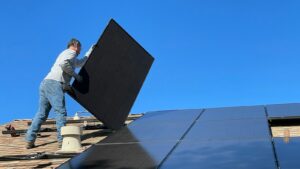
“People at the residential level are installing gas for cooking, gas for water heating, solar geysers, as well as rooftop solar and battery storage systems in a big way.”
This has been coupled with significant investment from South African companies in utility-scale renewable energy projects, further reducing reliance on Eskom for electricity.
These projects are substantial in scale, with some of them being capable of providing the majority of electricity used by industrial facilities, offices, and even entire neighbourhoods.
Yelland said a hidden driver of declining demand is also the desire for homeowners and companies to become more energy efficient.
“Energy efficiency has become a no-brainer. When the price of electricity is very low, it does not matter if you are inefficient. When the price of electricity is high, you start searching for wastage and where you can use less,” Yelland said.
“This applies to every single one of us. We are all thinking of how to use less electricity. We don’t run swimming pool pumps 24/7, we use LEDs, turn geysers off, use gas to cook, and use it to heat our homes.”
South Africa’s economy shifts gears

An underlying trend that has combined with the effect of electricity prices on demand for Eskom’s power is the changing nature of South Africa’s economy.
The local economy, once dominated by energy-intensive industries such as mining and manufacturing, has become increasingly services-oriented in recent years.
South Africa’s growth, albeit slow, has been driven by financial and business services alongside agriculture, which are significantly less energy-intensive.
This has resulted in a natural decline in energy demand, which has been exacerbated by the country’s economic stagnation.
“There is a fundamental change taking place in the South African economy as the price of electricity goes up,” Yelland said.
“That is what we call a reduction in the energy intensity of the South African economy. In years gone by, South Africa had a high energy intensity.”
This effectively means that South Africa used a lot of electricity to produce a unit of GDP. That is because it was built on industries that were energy-intensive.
“With the price of electricity going up, the services industries are growing, and the energy-intensive industries are declining,” Yelland explained.
“So, our energy intensity as a country and an economy is shifting from those old smoke-stack industries towards services, like banking, IT, insurance, and data centres.”
As a result, the amount of electricity used to generate a unit of GDP now is far less than it was a decade or two ago.
These trends show no sign of stopping as the price of electricity continues to rise in South Africa, with significant financial implications for Eskom.
“Declining demand actually pushes the price up because you are trying to recover a certain cost base off a declining sales base,” Yelland said.
“Whilst there has been a dramatic improvement in the reduction of load-shedding, one has to be concerned about the decline in demand.”
“What is really going on with the decline in demand and the rise in alternative energy sources does not paint a healthy picture for a monopoly utility. In fact, it indicates just the opposite.”
The financial implications of declining demand for Eskom’s product are coupled with a rise in municipal debt owed to the utility, which has created a dire outlook for its finances.
Eskom itself has described this as an existential threat to the utility, with CFO Calib Cassim forecasting it to reach R300 billion by 2030.
What makes this even more challenging for Eskom is that the crisis appears to be out of its control, with the utility unable to engage in typical credit control practices given the essential service it provides.




Comments