Eskom falling into Andre de Ruyter’s trap


Eskom is falling into the trap outlined by Andre de Ruyter at the end of 2023, when the former CEO pointed out that, on its current trajectory, the utility will be left with only poor and non-paying customers.
This would happen even if Eskom fixed load-shedding, with its rising electricity tariffs pushing customers who have the means, both businesses and households, to invest in alternative energy sources.
As a result, its richer clients are investing heavily in reducing their usage of Eskom’s product as it has become more economically beneficial to generate their own electricity.
This leaves Eskom in an extremely difficult situation, with higher electricity tariffs needed to cover its bloated cost base, while those rising prices push customers away and result in lower sales volumes.
Speaking to Oxford’s Saïd Business School, De Ruyter explained that Eskom is accelerating South Africa’s deindustrialisation through its push for higher electricity prices, which are a direct result of its inefficiencies.
“You have to think of electricity as your major input cost into the economy and the potential creator of a competitive advantage,” De Ruyter said.
Historically, South Africa leveraged its abundant coal resources to provide reliable electricity at some of the lowest prices in the world.
This resulted in significant investment in heavy industry, ranging from steelworks to aluminium to ferrochrome smelters.
These facilities use a tremendous amount of electricity and operate on thin margins, requiring a cheap and reliable supply to make their operations economically viable.
This equation has been fundamentally broken in South Africa, with rising electricity costs over the past 15 years making these industries globally uncompetitive.
As a result, a large share of the country’s smelters and heavy industry has shut down. These are some of Eskom’s biggest and most lucrative customers, which are impossible to replace.
Coupled with this has been a heavy investment from mining companies in making their operations more self-sufficient and cost-efficient.
“You can’t just increase electricity tariffs to the point where, as is happening now, the economy starts to deindustrialise because the tariffs are too high,” De Ruyter said.
As Eskom loses its biggest and most lucrative customers, its financial pressure is exacerbated, as it has to collect more and more revenue from a smaller, increasingly non-paying customer base.
Eskom is spiralling

Eskom appears stuck in this downward spiral, having to raise tariffs to cover rising costs, pushing an increasing number of customers away.
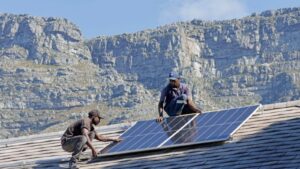
As electricity tariffs rise, it becomes increasingly cost-effective for households and businesses to invest in alternative energy sources.
This is the exact trap that De Ruyter outlined in an interview at the end of 2023, where he warned that Eskom was on an unsustainable path.
“If you extrapolate from current trends, Eskom will eventually be left with a customer base of people who cannot afford electricity and therefore don’t pay for it,” he warned.
While much of the shift towards alternative energy sources was driven by load-shedding, it has increasingly been driven by elevated electricity tariffs.
This is a result of Eskom being unable to produce electricity in a cost-effective manner, with its immense debt-servicing burden and bloated staff pushing its costs upwards.
Energy expert and EE Business Intelligence managing director Chris Yelland explained that Eskom, despite the improvements made in stabilising power supply, is in a very tricky situation.
“To talk about saving money and bringing prices down for customers in an environment where you are selling less because demand is declining is extremely difficult,” Yelland said.
This has been coupled with industrial demand declining significantly amid a stagnant economy and smelters being effectively priced out of operation.
“Declining demand actually pushes the price up because you are trying to recover a certain cost base off a declining sales base,” Yelland said.
“Whilst there has been a dramatic improvement in the reduction of load-shedding, one has to be concerned about the decline in demand.”
“What is really going on with the decline in demand and the rise in alternative energy sources does not paint a healthy picture for a monopoly utility. In fact, it indicates just the opposite.”
Declining demand is only one of the issues Eskom faces, with it also having to contend with rising municipal debt and the increased cost of environmental compliance.
These factors put the utility in a very difficult position if the current reform agenda takes its course and South Africa achieves a competitive electricity market.
In this market, Eskom will have to compete with private electricity producers for the first time in its history.
These private companies are unlikely to have the significant environmental compliance burden of Eskom, nor do they have to deal with billions in municipal debt.
“I would be very worried about demand, which is putting upward pressure on prices. This is one of many issues Eskom faces,” Yelland said.



Comments