Bad turn for petrol prices in South Africa


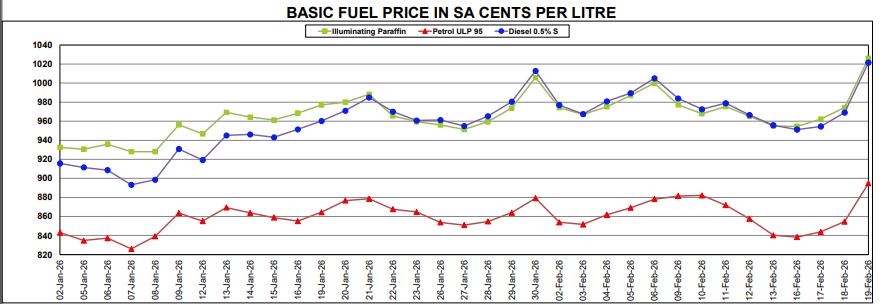
Petrol and diesel prices are set to rise next month in South Africa, despite earlier forecasts indicating small relief for motorists.
This comes largely on the back of a surging oil price as the United States gears up for military action in the Middle East, which could significantly disrupt oil supplies from the region.
The rand’s march stronger against the dollar also appears to be fading, with economists thinking the currency is now trading at around its fair value. This means that any further strength is unlikely to stick and be sustained.
South Africa’s Central Energy Fund (CEF) tracks international oil prices and the rand-dollar exchange rate to forecast changes to fuel prices in the country.
Its latest data indicates the following changes are on the card for March –
- Petrol 93 – increase of 3 cents per litre
- Petrol 95 – increase of 5 cents per litre
- Diesel 0.05% – increase of 46 cents per litre
- Diesel 0.005% – increase of 49 cents per litre
While the increases for petrol are not significant, they are likely to rise further as Brent Crude oil prices surge past $70 per barrel to reach their highest level in six months.
Oil prices have risen by over 12% in the past month amid a substantial buildup of US military equipment in the Middle East as war with Iran looms.
The strikes on Iran may take out a significant chunk of international oil supply, with the country producing over three million barrels per day. Much of this flows to China.
However, the largest threat to oil prices from a war between Iran and the United States comes from the potential closure of the Strait of Hormuz.
Around 20% of the world’s total oil supply, 21 million barrels, flows through the Strait on a daily basis, making any disruption significant for prices.
Iran has repeatedly threatened to close the Strait to container traffic and has conducted training exercises in the region.
The threats have ratcheted up as the United States assembles the most powerful military force in the region since 2003, when it invaded Iraq.
This has been coupled with a resurgent dollar, with the rand struggling to hold onto its gains from earlier in the year.
Over the past month, the rand has flirted with dipping further below R16 to the US dollar, but has more recently weakened to R16.14.
The US dollar has had its strongest week in four months as investors bet the Federal Reserve will hold interest rates, and geopolitical tension pushes money managers towards safe havens.
The Bloomberg Dollar Spot Index has climbed 0.9% this week, set for its biggest gain since October. Heightened inflation concerns and recent US economic data have clouded the outlook for Fed easing this year, buoying the US currency.
A continued buildup of US forces in the Persian Gulf has also burnished the appeal of the dollar, a popular destination during uncertain times.
While the dollar has been stronger, the rand has tried to hold its own, with Standard Bank chief economist Goolam Ballim saying the currency is trading at its fair value.
“At prevailing levels, with the rand below R16 to the US dollar at times, we do believe that it is trading at its fair value,” Ballim said.
“The fair value of the rand, by our calculations, is in the vicinity of R16 to the dollar and R16.50 to the dollar.”
This means the currency is unlikely to continue strengthening towards R15 to the dollar, with it hitting resistance at R16 to the dollar.
“We do think the currency can go stronger, particularly in the current environment of a weaker dollar and should two things happen,” Ballim said.
“These two things are commodity prices remaining elevated, and that confidence in South Africa’s reform process remains strong.”





Comments