Black mark against Andre de Ruyter’s name


Eskom’s latest data shows that load-shedding exploded under former chief executive Andre de Ruyter.
His tenure at the helm of the power utility was characterised by a rapid increase in the frequency and intensity of rolling blackouts in South Africa.
De Ruyter described this increase as a “black mark” on his legacy at Eskom on the Money Show with Bruce Whitfield.
The rapid rise of load-shedding under De Ruyter and the decline in 2024 and 2025 were shown in Eskom’s Medium-Term System Adequacy Outlook for 2026 to 2030.
This report, published by Eskom on 30 October 2025, provided an overview of the adequacy of South Africa’s generation system.
As part of the report, Eskom provided data on the System Operator’s instructed load-shedding for the calendar years 2017 to 2025.
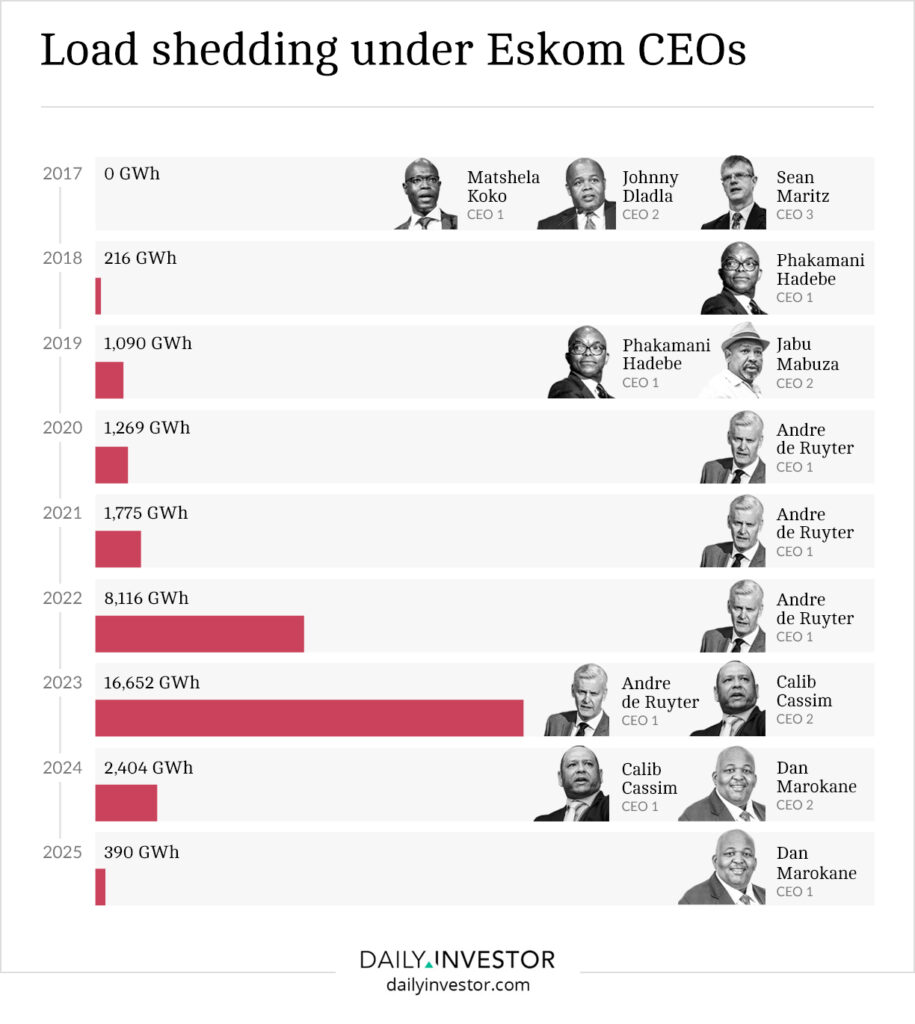
It showed that there was no load-shedding in 2017. This was a tumultuous time for Eskom leadership, with four CEOs in a year.
Matshela Koko served as acting CEO from January to May 2017, before Brian Molefe was reinstated as chief executive for a brief period.
Johnny Dladla served as acting CEO from June to October 2017, and Sean Maritz from October 2017 to January 2018.
Phakamani Hadebe served as Eskom’s chief executive between January 2018 and July 2019, during which load-shedding began to escalate.
Jabu Mabuza served as acting CEO from July 2019 until De Ruyter took the helm at the power utility in January 2020.
During De Ruyter’s tenure, load-shedding increased from 1,296 GWh in his first year to 16,652 GWh in the year he left.
Calib Cassim served as acting CEO from February 2023 to February 2024, during which Eskom experienced its worst load-shedding in history.
Dan Marokane took the helm at Eskom on 1 March 2024, which heralded in a new era of energy security in South Africa.
Under his leadership, load-shedding declined from 2,404 GWh in 2024 to 390 GWh in 2025. There has been no rolling blackout in South Africa for months.
The chart below shows load-shedding in South Africa over the last nine years and the Eskom CEOs in the hot seat during those years.
Andre de Ruyter’s tenure as Eskom CEO
When De Ruyter became Eskom CEO in 2020, he promised South Africans that load-shedding would be significantly reduced within 18 months.
However, this did not happen. Rolling blackouts intensified in frequency, and higher stages of load-shedding were implemented during his time at the helm.
De Ruyter argued that he inherited unreliable and ageing infrastructure that had been neglected for years.
He said the government’s ‘keep the lights on’ policy had historically forced Eskom to defer essential maintenance, leading to the catastrophic failures during his leadership.
To address this problem, he implemented reliability maintenance, which required taking units offline and temporarily worsening load-shedding to prevent a total grid collapse.
He claimed the crisis was 25 years in the making, citing the government’s failure to invest in new generation capacity since 1998.
He also made explosive allegations about criminal syndicates and sustained sabotage campaigns at power stations.
De Ruyter said corruption was siphoning off approximately R1 billion per month from Eskom, with criminals going to extremes to keep the money flowing.
In a 2023 interview with eNCA’s Annika Larsen, De Ruyter admitted that his biggest failure was the poor performance of Eskom’s coal-fired power plants.
He stated that he failed in the ‘readily measurable objectives’, specifically mentioning the high levels of load-shedding.
Since his departure, many government officials have criticised his tenure as Eskom CEO, dismissing his framing of the crisis.
Electricity Minister Kgosientsho Ramokgopa, for example, said De Ruyter’s appointment was a mistake due to a misalignment of skills for the technical demands of the role.
He further blamed De Ruyter for low staff morale, claiming the former CEO distrusted Eskom employees and created an unproductive environment.
Minister of Mineral Resources and Energy Gwede Mantashe went one step further, accusing De Ruyter of agitating for the overthrow of the state through load-shedding.
Mantashe also criticised him for making vague allegations without naming specific names, saying he must not “throw a stone in the bush and hope an animal will run out”.
 Loading ...



Comments