Eskom going backwards


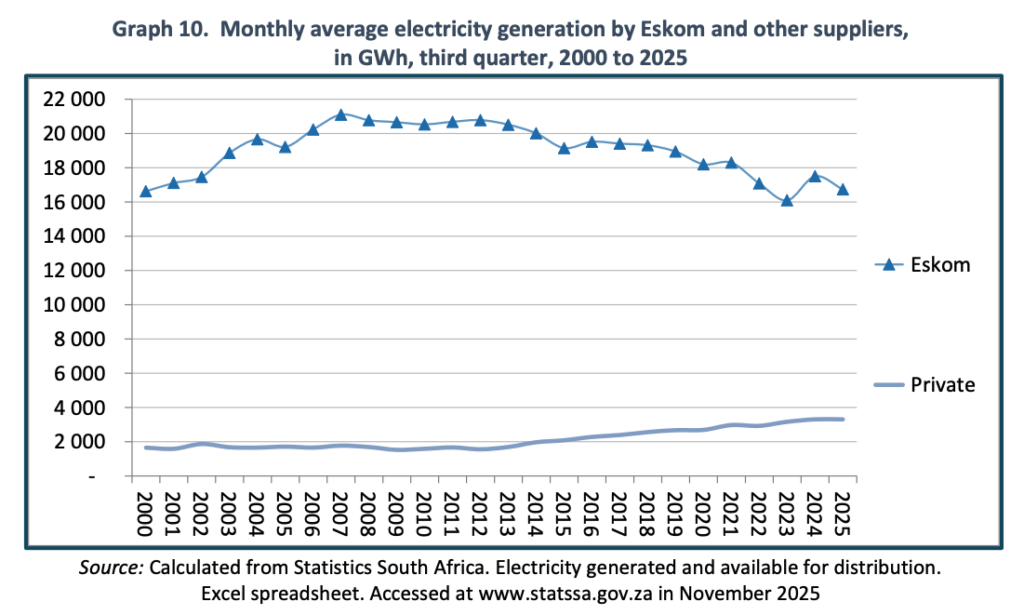
While Eskom has made substantial strides in improving its performance, the utility’s output remains far below levels seen in 2007, and even below what it achieved in 2024.
This means Eskom has effectively lost half of the substantial gains it made in 2024, as the combination of soaring tariffs and load-shedding has eroded the country’s electricity growth.
This is according to the Trade and Industrial Policy Strategies’ (TIPS) Real Economy Bulletin for the third quarter of 2025.
This report revealed that, in the year-to-date, Eskom saw a 4% decline in output. TIPS pointed out that, while the utility’s output in the third quarter of 2025 was 4% higher than in the third quarter of 2023, it remains below historic and even 2024’s levels.
TIPS said Eskom essentially lost half of the substantial gains it made in 2024, when the utility increased its output by 8%.
Concerningly, Eskom’s output in the third quarter of 2025 is close to 20% lower than at its third-quarter peak in 2007.
“The combination of soaring tariffs, combined with load-shedding and other restrictions on electricity use, has led to slower but also less electricity growth,” TIPS explained.
The organisation attributed this to greater efficiency in electricity use, the downsizing of energy-intensive production lines, and some migration away from the national grid.
In contrast to Eskom’s declining output, private generation in the third quarter of 2025 is around 86% higher than in 2007.
TIPS pointed out that the private contribution to grid electricity increased from under 10% before 2015 to 17% in the third quarter of 2025.
While private generation for the national grid dipped sharply at the start of 2025, it had almost recovered in the third quarter.
The first quarter’s decline was also largely due to a disagreement with Eskom around payment for new transmission lines, TIPS said.
The graph below, courtesy of TIPS, shows the decline in Eskom’s output, as well as the growth in private generation.
Eskom’s big challenges
These statistics show that, despite the strides Eskom has made in recent years, the utility continues to face significant challenges.
One of these challenges is the increasing adoption of alternative electricity sources, with South Africans continuously seeking alternatives to Eskom despite improvements at the utility.
A survey conducted by fund manager Jaltech, based on responses from over 2,000 South African solar users and potential adopters, found that rising electricity tariffs and significant financial savings are the primary drivers of solar adoption.
This marks a shift from just a few years ago, when Eskom’s frequent implementation of load-shedding drove many users toward alternatives.
“South Africa’s solar market has matured rapidly,” Jaltech partner Jonty Sacks said. “What began as a response to unreliable electricity supply has become a core financial decision.”
“Solar now represents cost stability, resilience and long-term savings for South Africans from day one.”
This presents a notable financial threat to the utility, as declining sales put pressure on its bottom line, necessitating even more tariff increases and perpetuating a vicious cycle.
In addition, Eskom faces a looming deficit of 8 GW of generation capacity due to plans to retire old plants, which will see the utility rely heavily on private developers to make up some of the shortfall.
This will require South Africa to open up its grid to an increasing number of private players, breaking Eskom’s monopoly over electricity generation in the country.
This will also require substantial investment in expanding South Africa’s electricity grid to accommodate all of these new players.
South Africa currently has plans for a R440 billion national power grid upgrade, with Eskom expecting to install 14,000 km of lines over the next decade.
However, there are some concerns about this plan’s feasibility, largely due to funding and capacity constraints.
At the same time, Eskom is looking to unbundle the utility into three separate units – generation, transmission and distribution. This is expected to help Eskom raise funding and improve the management of the utility’s debt and costs.
However, Eskom CEO Dan Marokane has warned that this would only happen when the utility solves its municipal debt problem.
Municipal debt owed to Eskom currently stands at R100 billion and is expected to continue growing in the coming years without urgent intervention.



Comments