South Africa at the mercy of one country


South Africa is extremely dependent on other countries for gas and oil, with consumption in the country dominated by imports.
South Africa imports most of its natural gas from Mozambique, with local chemicals giant Sasol playing a significant role.
Statistics South Africa recently released data on the country’s energy supply and use, which revealed how energy dependent South Africa is.
To measure this, Stats SA uses the energy dependency ratio, which shows how much a country relies on the international community to meet its energy needs.
The ratio is calculated by dividing the volume of imported energy products by local energy consumption, then expressing the result as a percentage.
A high energy dependency ratio reflects a strong reliance on energy imports to meet local energy demand.
“A country in this scenario has less control over its energy supply and is more vulnerable to geopolitical and economic risks,” Stats SA explained.
“On the flipside, a low energy dependency ratio indicates a degree of self-sufficiency or ‘energy sovereignty’.”
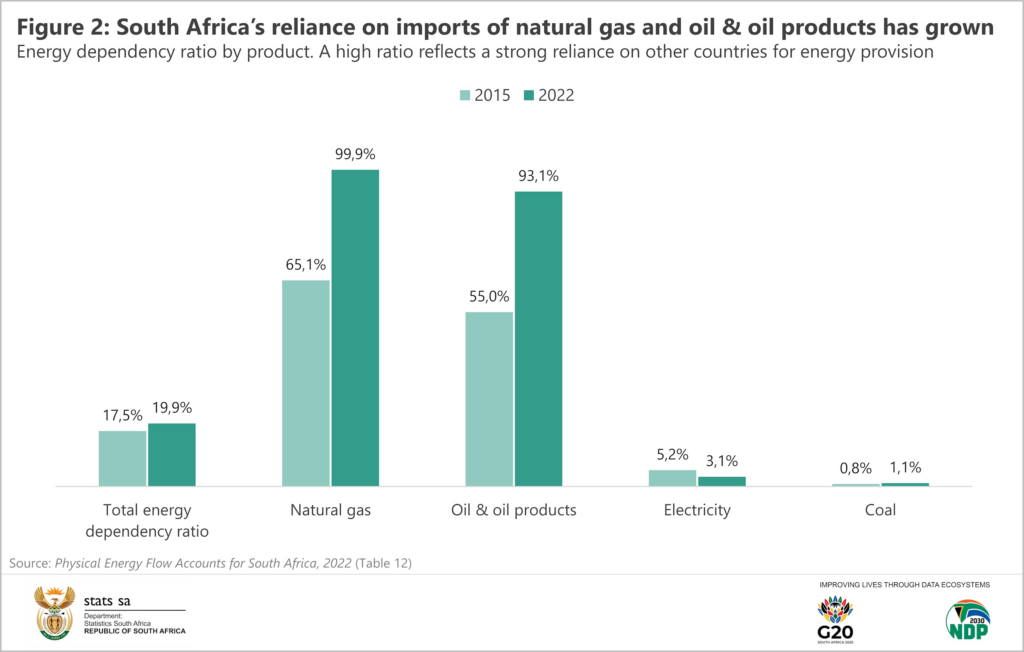
Overall, South Africa’s total energy dependency ratio peaked at 23.4% in 2020. In 2022, the ratio was 19.9%.
Stats SA explained that, despite the lower ratio in 2022 compared with 2020, it is still higher than the ratio recorded in 2015 (17.5%).
When focusing this data on specific energy sources, the picture becomes more troubling, with Stats SA finding that South Africa is highly dependent on other countries for gas and oil.
South Africa’s energy dependency ratio for natural gas shot up from 65.1% in 2015 to 99.9% in 2022. For oil and oil products, this figure jumped from 55% to 93.1% over the same period.
This shows that South Africa’s consumption is heavily reliant on imports, rendering the country ‘energy dependent’ for these two crucial energy products.
Positively, Stats SA South Africa is far less reliant on the international community for electricity and coal, which recorded energy dependency ratios of 3.1% and 1.1%, respectively.
“The country mines most of its coal locally and produces most of its electricity. Hence, the lower energy dependency ratios indicate a degree of ‘energy sovereignty’ for these two energy products,” the agency explained.
This can be seen in the graph below, courtesy of Stats SA.
Mozambique and South Africa’s gas cliff
South Africa’s main source of gas for industry and power generation is Mozambique’s Pande-Temane fields.
These fields are owned by the Sasol Petroleum Temane (SPT) joint venture, which includes Sasol (70%), Empresa Nacional de Hidrocarbonetos (20%), and the International Finance Corporation (10%).
The natural gas from the Pande-Temane gas fields is exported to South Africa through the Republic of Mozambique Pipeline Investment Company (Rompco) pipeline.
Sasol is the developer and operator of the gas fields and buys all the natural gas from SPT that is exported to South Africa along the Rompco pipeline.
Sasol uses most of the natural gas from Mozambique for its own process needs, selling the balance to traders and industrial gas users in Mpumalanga and Gauteng.
According to the Industrial Gas Users Association – Southern Africa (IGUA-SA), South Africa’s natural gas supply from the Pande-Temane fields will be suspended by 2028.
This will leave the country without its main source of gas for industry and power generation, which is why industry stakeholders have warned about a looming “gas cliff” in South Africa.
This comes as the country is also looking to pivot towards a more gas-reliant economy, with the recently updated Integrated Resource Plan (IRP) for 2025 relying heavily on the resource to ensure stable electricity supply for South Africa.
Ensuring security of supply in the IRP 2025 hinges, in part, on commissioning 6 GW of combined cycle gas turbine (CCGT) capacity by 2030 to avoid supply shortfalls as older baseload power stations reach the end-of-life stage.
A CCGT is a power plant that generates electricity using both a gas turbine and a steam turbine in a combined cycle, making it highly efficient.
The requirement for gas CCGT in South Africa’s power system by 2030 is critical, given the impending decommissioning of 8 GW of baseload coal-fired plants.
The IRP explains that, due to new technology options lead times, there are limited credible options that can fill the gap by 2030.
This plan faces significant risks, as the implementation of the gas programme hinges on securing an adequate supply at the appropriate price with the required gas infrastructure and the transmission readiness to integrate the capacity onto the grid.
With South Africa extremely reliant on imports for its gas supply, this poses a significant risk to the IRP’s plans if an appropriate alternative cannot be found.






Comments