ANC government wanted to reduce unemployment to 10% by 2025. Instead, it increased to 33%.


When the ANC government adopted the National Development Plan (NDP) in 2012, it set a target of 6% unemployment by 2030. However, the situation got worse rather than better.
South Africa is currently engaged in a National Dialogue process. However, long before that, there was a similar process which resulted in the NDP.
On 15 August 2012, the former Minister in the Presidency of the National Planning Commission, Trevor Manuel, launched the plan during a joint sitting of both houses of Parliament.
Manuel said the National Development Plan was the product of thousands of inputs and perspectives of South Africans.
“We received comments from individuals and organisations and engaged with government departments, provinces, municipalities, state-owned enterprises and agencies,” he said.
“They spoke about the ravages of crime on their lives and their communities. They expressed concern that good policies are poorly implemented and therefore fail.”
These consultations and feedback were used to develop the NDP, which set overarching objectives and key targets for various sectors.
The National Development Plan also made 119 recommendations on how these targets can be achieved.
“It is a plan for a better future in which no person lives in poverty, where no one goes hungry, where there is work for all,” he said.
There was a strong focus on economics and employment, as it is the primary way to address poverty and related social problems.
The NDP stated that the unemployment rate should fall from 24.9% in June 2012 to 14% by 2020 and to 6% by 2030.
“To achieve these targets, South Africa requires an additional 11 million jobs. Total employment should rise from 13 million to 24 million,” it said.
It added that the proportion of adults working should increase from 41% to 61%. The proportion of adults in rural areas working should rise from 29% to 40%.
The National Development Plan further aimed to increase the labour force participation rate from 54% to 65%.
What has really happened to unemployment in South Africa
On 1 August 2023, the National Planning Commission (NPC) released a ten-year review of the National Development Plan.
It showed that the South African economy failed to grow at the rate required for the objectives of NDP to materialise.
The economy was also not structured to serve the interests of all South Africans, resulting in poverty and inequality remaining extremely high.
Daily Investor considered the National Development Plan’s targets on employment to assess the government’s performance.
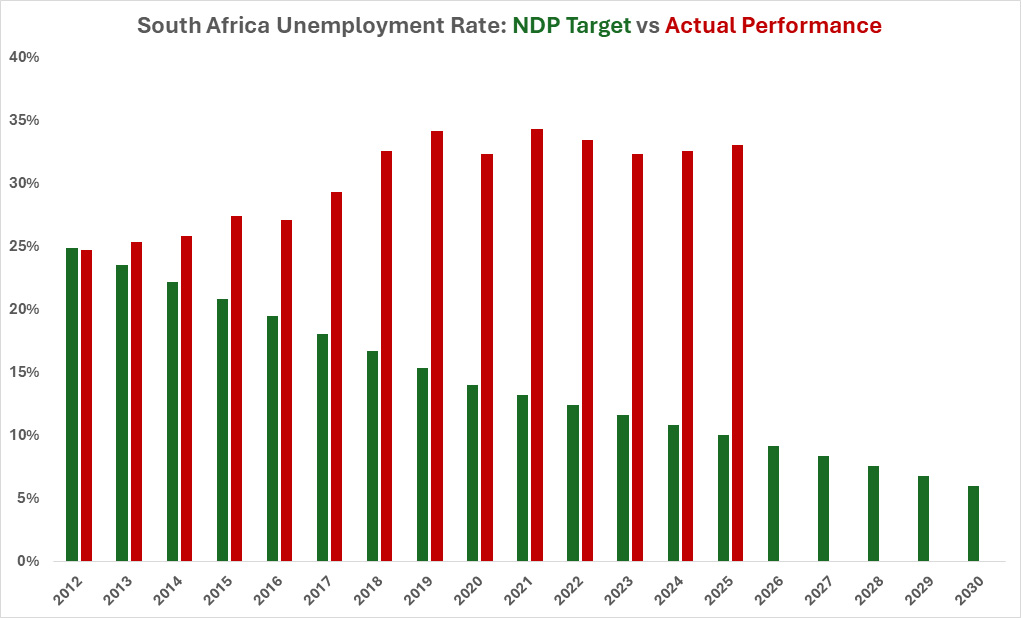
South Africa failed miserably in meeting the targets. Instead of reducing unemployment to 14% by 2020, it increased to 32%.
Over the last few years, the situation has continued to worsen. By 2025, the unemployment rate had increased to 33%. This is much worse than the target of 10%.
The chart below shows the National Development Plan’s unemployment target versus actual outcomes.
Number of employed people in South Africa
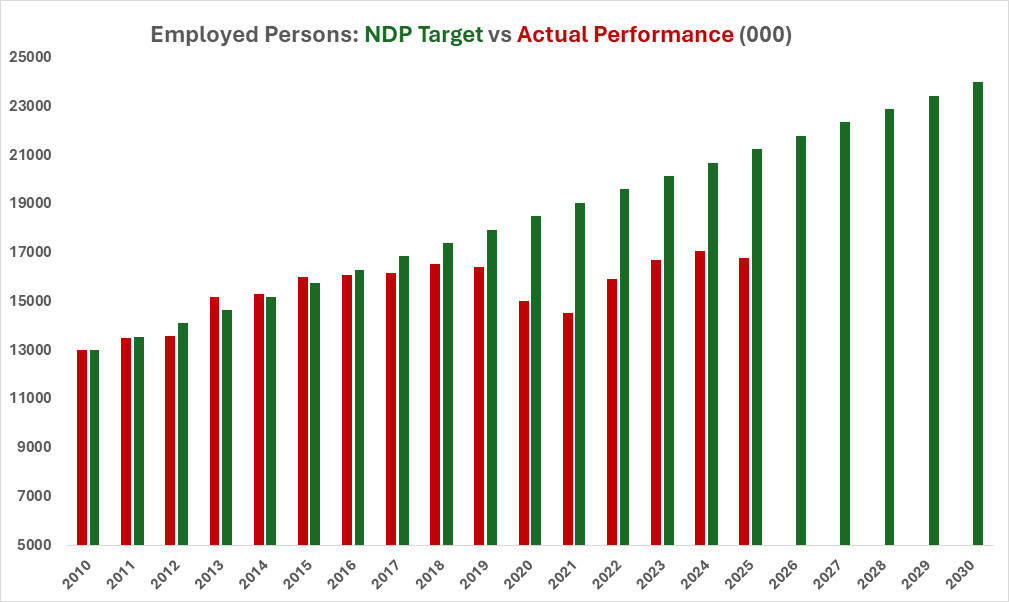
In the National Development Plan 2030, the government wanted to increase the number of employed people from 13 million to 24 million.
This would have required South Africa to create 550 thousand new jobs every year for two decades. This would have required strong economic growth.
The country managed to maintain that level up to around 2018, after which it drastically fell behind.
In the latest labour statistics, South Africa only had 16.8 million employed persons, the same level it reached in 2018.
This means that South Africa has not seen any real growth in the number of employed persons for the past 7 years.
The National Development Plan 2030 also stated that it aimed to have 61% of all adults working by 2030. When the report was released, 41% of working-age adults were employed.
In the latest labour statistics, more than a decade later, this has worsened to only 40.2%.
 Loading ...





Comments