Eskom risks another load-shedding crisis


Eskom’s recent moves to legally challenge the five electricity trading licences granted to private companies by Nersa threatens to undermine the progress South Africa has made in ensuring energy security.
The action by Eskom seeks to entrench the utility’s monopoly in the electricity sector, undoing the government’s energy reform programme and inhibiting the private sector from investing in new generation capacity.
New generation capacity is vital for South Africa, as research shows that when the utility begins decommissioning some of its coal-fired plants, as it is scheduled to do in the coming decade, the country will face an electricity supply crunch.
This is feedback from business lobby groups Business Leadership South Africa (BLSA) and Business Unity South Africa (BUSA), who urged Eskom to withdraw all legal challenges relating to electricity trading licences.
“Eskom’s current strategy of litigation and obstruction is directly undermining South Africa’s national goal of achieving energy security,” the groups said.
“These actions create uncertainty and send a negative signal to investors, delay critical energy projects, and ultimately may prolong the devastating economic and social impact of load-shedding.”
The business groups also said that Eskom’s actions stand in contradiction to the government’s stated policy of unbundling the utility, encouraging private investment, and create a competitive electricity market.
These measures were implemented by the government as a response to South Africa’s severe load-shedding crisis over the past few years.
Eskom’s monopoly over the electricity sector was no longer seen as fit for purpose, with South Africa’s reliance on a single entity for the provision of energy being outdated.
The utility’s historic mismanagement and financial deterioration also ensured that it could not be relied upon to invest heavily in adding new generation capacity to the grid in an efficient manner.
Since March 2023, Eskom’s performance has improved significantly, combining with private-sector investment to meaningfully reduce load-shedding.
However, its finances remain in a poor state, preventing it from ensuring South Africa’s energy security in the future and its mismanagement has resulted in it losing the skills necessary to undertake engineering projects at scale.
As a result, the government planned to create a competitive electricity sector, with increased private participation in the generation and distribution of energy.
“Eskom cannot be both the primary cause of our energy crisis and the gatekeeper of its solution,” CEO of BLSA Busi Mavuso said.
“South African businesses are failing, jobs are being lost, and our economy is stagnating. We need more power on the grid, now.”
“For Eskom to spend public money on litigation designed to frustrate the very reforms the government is championing and block the investment that can help secure cheaper and more secure energy is illogical and completely untenable.”
Load-shedding crisis looms

Private investment is vital for South Africa’s energy security in the future, with some of Eskom’s coal-fired power plants scheduled to be decommissioned in the coming decade.
A report from Standard Bank’s Corporate and Investment Banking (CIB) division with Credo shows that the country is not adding new energy generation capacity fast enough to prevent another severe electricity crisis when the decommissioning begins.
This latest report shows that, while load-shedding has been significantly reduced since March 2024, the country’s long-term energy security now depends on getting new capacity quickly.
“Considering the looming risk of another energy crisis, which may materialise as soon as coal decommissioning is resumed, new capacity additions and RE implementation need to increase at a dramatic rate,” the report read.
“There is no room for error in REIPPPP Bid Window 7, gas-fuelled generation capacity additions or delays in the private sector procurement.”
The Just Energy Transition Partnership is a noble and essential effort, but total generation still needs to meet demand, both annually and hourly, the report said.
This risk comes despite a rapid uptick in private energy generation projects over the past few years, with thousands of additional megawatts in the pipeline.
To date, the Electricity Regulation Act has led to investment in new renewable generation projects of over R30 billion, expected to generate nearly 10,000 new job opportunities in generation and storage alone.
Introducing a competitive wholesale market is essential to unlock an additional 6 GW of new private solar PV and 3.5 GW of wind by 2030. This represents a further R132 billion in private investment and substantial job creation.
BLSA and BUSA said that Eskom’s actions threaten to block this progress by creating uncertainty for investors and preventing private projects from being financially viable.
The Organisation for Economic Cooperation and Development (OECD) said that South Africa needs to fundamentally restructure its electricity sector, with ongoing reforms pushing the country in the right direction, but that Eskom presents a significant hurdle.
The electricity regulation component of the OECD’s Product Market Reform (PMR) indicator shows that South Africa’s electricity sector is more heavily regulated than nearly all OECD and emerging economies.
Eskom owns or operates most of the sector’s transmission and distribution segments and generates around 91% of the country’s electricity.
This current structure limits the entry of new players in all segments, providing preferential access for Eskom’s ageing fleet to the grid and limiting competition and energy security.
In effect, Eskom has the power to set barriers for renewable energy investments and prioritise its own energy generation facilities, creating a major conflict of interest.
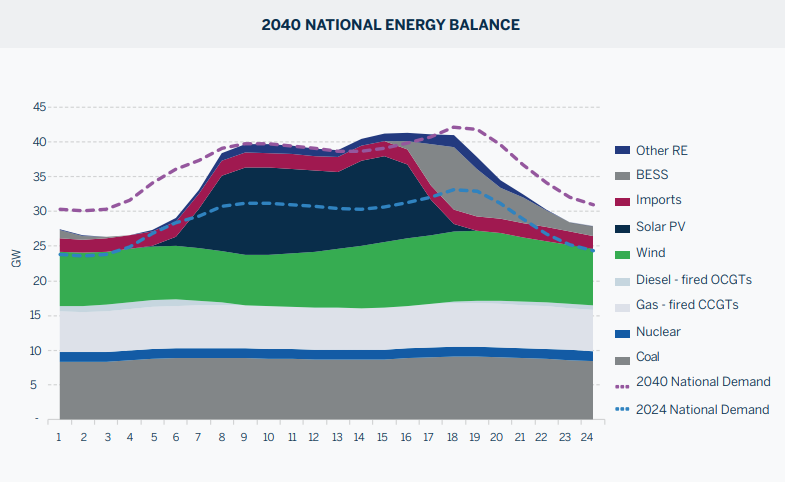
The graph below illustrates the projected distribution of energy generation across a 24-hour day in 2040, based on currently planned and announced projects.
It indicates that there will still be substantial shortfalls in energy supply during significant parts of the day, requiring ‘top-ups’ with gas, nuclear, or other types of generation.


Comments