The company making millions for Vodacom and MTN



AI-powered fintech firm Optasia has helped telecom giants such as Vodacom and MTN to significantly increase their revenue generation by millions of rands every year.
This is because Optasia’s artificial intelligence solutions are the driving force behind the airtime advance and microlending services offered by these mobile network operators.
Founded in 2012, Optasia has grown to become one of the largest AI-powered fintech platforms in the world, operating in 38 countries across Africa, Asia, and the Middle East.
South Africa and Nigeria are among the company’s biggest markets, with it even listing on the Johannesburg Stock Exchange (JSE) in November 2025.
Leveraging its patented Optasia 2.0 AI platform, the company accesses thousands of data points to assess the creditworthiness of underbanked consumers.
This allows Optasia to approve or disapprove microloans and cash advances which are directly embedded into mobile services such as Vodacom’s M-PESA or MTN’s MoMo.
The company reportedly processes over 34 million credit decisions every single day, serving a customer base of over 124 million active monthly customers.
This has made Optasia a key partner for MTN and Vodacom, with both companies reporting airtime advance payments as significant areas of revenue growth.
When asked how much airtime advance contributed to Vodacom’s revenue, a spokesperson for the company said this is not something which is disclosed separately.
However, they indicated that it remained a substantial contributor to Vodacom’s overall financial services revenue in South Africa, which grew by 8.1% during FY26.
During the last three months of 2022, Vodacom advanced R3.4 billion in airtime to its customers, equating to 45.1% of prepaid recharges during that period.
On the other hand, MTN said its XtraTime service remained a key adder of value to its prepaid business, accounting for between 30% to 40% of airtime recharges.
MTN launched XtraTime in 2016, opting to charge customers a small nominal service fee on each airtime advance purchase as opposed to charging interest.
Optasia’s share price turbulence

While Optasia’s listing on the JSE was met with high anticipation, its short time as a JSE-listed company has already experienced significant uncertainty.
Optasia’s JSE debut in November 2025 was the largest initial public offering (IPO) in South Africa that year, priced at R19 per share.
This gave the company an initial market capitalisation of R23.5 billion across 1.23 billion issued shares, with the IPO raising R6.5 billion and being several times oversubscribed.
When it published its first set of financial results as a JSE-listed company in March 2026, Optasia reported revenue growth of 75.51% and operating profit growth of 29.40%.
However, investor confidence in the company would wane substantially the following month when it announced on 15 April that it would temporarily suspend all airtime credit services in Nigeria.
This followed after Optasia’s mobile operator partner in the country paused its airtime and data credit services to comply with new regulations regarding nontraditional lending.
Nigeria is one of Optasia’s biggest markets, with more than 40 million Nigerian residents estimated to rely on prepaid airtime lending services.
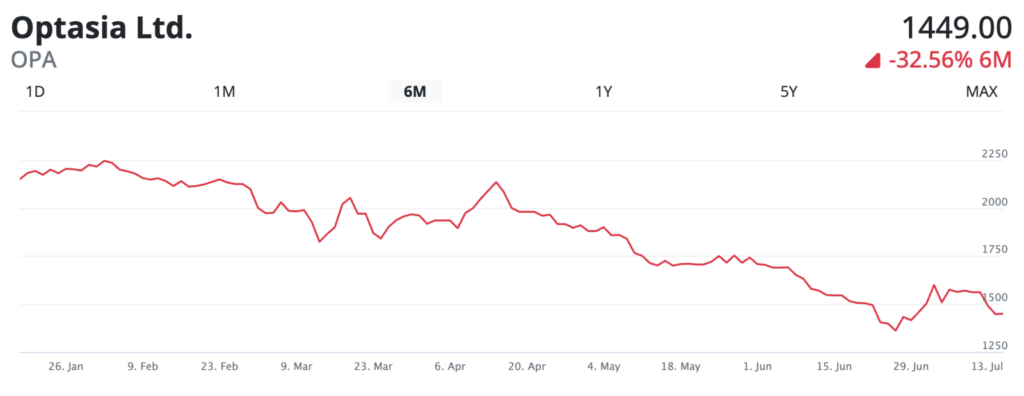
This caused Optasia’s share price to drop by 30% over the last three months, now sitting at just R14.50 per share from a peak of R21.35 which it reached the day before the suspension.
Despite this, some investors remain confident in the company’s prospects and have recommended potential buyers to opt in now while the price is low.
Körner Perspective Director Graeme Körner expressed excitement at Optasia’s fintech business model, and said it had the potential to disrupt traditional banking markets.
Körner pointed to the company’s strong earnings growth potential, which he estimated to be somewhere between the 30% to 40% mark.
He also said Optasia’s price-to-earnings ratio, which currently sits around 26, showed that investors were still willing to pay more for shares in the company, as they expect it to grow exponentially in future.
Optasia announced towards the end of June that it would resume its airtime credit services in Nigeria, following the suspension of the new regulations pending legal proceedings.
This had an immediate positive impact on the company’s share price, yet it remains to be seen whether it can fully reclaim the value it has so far lost this year.
Optasia’s share price over the last six months





Comments