The forgotten story behind Discovery in South Africa


Discovery has grown to be one of the most successful South African businesses of the last three decades, with the insurer valued at R150 billion on the JSE.
The company has become a financial services giant, generating R15 billion in normalised profit over the past financial year across its medical aid, health insurance, asset management, and banking businesses.
While Discovery’s immense successes over the past 30 years are well-documented, it is often forgotten that it was the brainchild of a 27-year-old.
Adrian Gore was at the beginning of his career at Liberty when he had the idea to launch his own health insurance business.
FirstRand co-founder Laurie Dippenaar recently told the story behind Gore’s initial business plan and how he convinced Rand Merchant Bank (RMB) to financially back his new venture.
Speaking from the audience at the 2025 Chairman’s Conversation hosted by PowerFM, Dippenaar explained that Gore was initially met with rejection.
“Actually, I said to him, ‘Sorry, this is not disruptive enough. But, if you do come up with something that is truly disruptive, please call me.’ I thought I would never hear from him again,” Dippenaar said.
Gore continued working at Liberty, where he had already had some success in building the insurer’s Medical Lifestyle product.
Liberty was one of the first insurers to offer medical coverage, with the market growing beyond the capacity of medical aid societies.
This experience in working at an insurance giant, which was expanding into medical aids, gave Gore an edge in understanding the issues these companies were having and how new value could be offered to consumers.
“A year later, he gave me a call. He described the Discovery Health product with a medical savings account. That was the thing that triggered something in me,” Dippenaar said.
“I now thought, ‘This is a disruptive product’. He sketched all the problems the other medical aids were having with bureaucracy and all that.”
Gore had an agreement with Dippenaar and RMB. He resigned at Liberty to dedicate his time to building a business plan for Discovery.
“We gave him an office and paid him a salary, the same he got at Liberty. We said, ‘You have got three months to come up with a business plan. If we like it, we will back you. If we don’t, you are on your own’,” Dippenaar recalled.
“That is how it happened. Three months later, he came up with a plan that we liked, and I am proud to say that RMB was the first client of the health insurance product.”
Discovery Health was launched a year before the end of Apartheid amid immense uncertainty. Despite this, it would go on to become one of the most successful entrepreneurial stories in South African history.
It rapidly became the largest healthcare insurer in South Africa by pioneering an innovative shared-value model and was listed on the JSE in the late 1990s.
From zero to R15 billion

Gore has led Discovery to immense success over the past 30 years, but this was never guaranteed with new competitors emerging and the company having to navigate the ‘Valley of Death’.
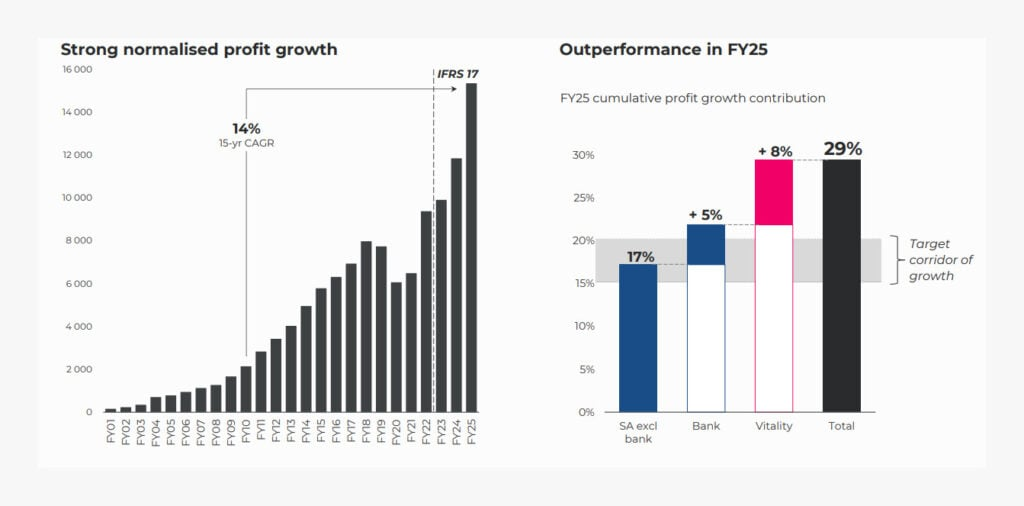
Since 2000, Discovery has grown its normalised profit from close to zero to over R15 billion at the end of its most recent financial year.
It now has ambitious plans to double this number by the end of 2029 as its immense investments in building a bank, short-term insurer, and asset management business bear fruit.
The company has gone from offering medical aid coverage to being a financial services giant, able to offer clients services ranging from banking, investing, and car insurance, to medical aids, health coverage, and life insurance.
Gore has repeatedly explained Discovery’s transition over the past 30 years in three distinct phases, which have seen the company’s strategy shift dramatically over time.
These shifts are all guided by Gore’s intention to ensure Discovery does not fall into the ‘Valley of Death’ for a company, where its growth flatlines and it gets outcompeted as it ossifies.
While a slowdown in growth is natural for any business as it becomes established, the important thing, Gore says, is to avoid stagnation.
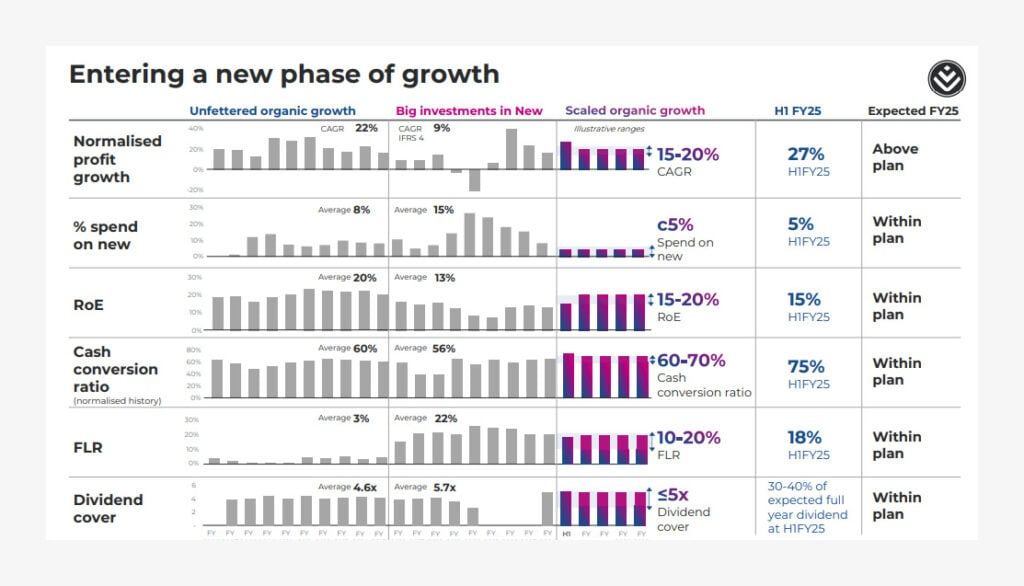
The company’s first era, described as “unfettered organic growth”, saw it grow its profits at an annual rate of 22%, with it nearly doubling in size every three years.
Gore explained that the ‘Valley of Death’ for most companies comes after this phase, when growth slows and they begin to rest on their laurels.
He told Daily Investor in interviews following Discovery’s latest annual results that this phase requires plenty of hard work to break out of, with effectively two options open to companies.
These two options are to grow through acquisitions or organically by investing heavily in new products and services.
Discovery chose to invest in itself, developing its bank and expanding its Vitality model globally. This resulted in tens of billions of rands in investment, with the bank alone soaking up R14.5 billion.
This inevitably impacted Discovery’s financial performance, with profit growth slowing to 9% per annum, return on equity falling to 13% and cash conversion ratio slipping to 56%.
These two phases got the company to where it is today, generating R15.2 billion in normalised profit for the 2025 financial year.
Doubling up
Discovery has set itself ambitious goals for the next phase of its company life. If achieved, these targets will result in the company’s profits doubling in the next five years.
This phase, termed “scaled organic growth” by Discovery, will see its spending on new initiatives decline, resulting in an improved return on equity and enhanced cash conversion.
The prior decade of investment has positioned the company well to continue growing, with it aiming for annual profit growth of 15% to 20% per annum.
Discovery’s cash conversion ratio is expected to rise between 60% and 70% during the next five years, and its debt load will come down significantly, freeing up further cash to be returned to shareholders or invested in the business.
Gore said having these lofty targets is good, but hard work and execution are needed to ensure the strategy provides the desired results.
In its first set of results following the announcement of this new strategy, Discovery revealed that it is actually exceeding these targets.
With profit growth of 27% year-on-year, a cash conversion ratio of 75%, and a bank that is profitable ahead of schedule, the strategy appears to be paying off.
Gore admitted that profit growth of 27% is unlikely to be sustained for the full five-year period, but it does show that the company can achieve its lofty targets.
“We think the five-year projection for this kind of growth is a good one. But having said that, as we go forward, if it plays out like we are currently seeing, it also provides optionality,” Gore told Daily Investor.
“There may be opportunities that come up that we have not thought of yet. So, the default case is five years of this growth. We can achieve that. It is hard to do, but it is doable.”
Gore explained that if Discovery manages to grow at its expected rate of 15% to 20% per annum, the company will be double the size it currently is in terms of profit.
Another centre of growth is Discovery’s international business, with strong demand for its Vitality health insurance in the UK and US, which generates value foreign currency earnings.
Its investment in Chinese insurance giant Ping An is also going from strength to strength, with it contributing R424 million to Discovery’s bottom line in the last six-month period.
However, the company will have to navigate major challenges during this period, many of which are beyond its control.
Gore said the company spends a lot of time and resources to ensure that short-term swings from interest rate changes to tariffs on trade do not significantly impact its businesses.
“There are a lot of substantial economic risks. We have tried our best with regard to the structure of the organisation so that these risks do not hurt us,” the CEO said.
“Across all of our various matching and hedging strategies, the one fundamental issue is to not take risks on stuff that we are not in charge of.”
Gore explained that Discovery tried to minimise the economic risk to the business as far as possible to ensure that everything was in its own hands.
“Then you are left with the core operating execution risk, which we think we understand well. So, I do not think there is an execution risk, and there is no capital risk,” he said.




Comments