Capitec’s hidden R13 billion powerhouse that operates in five countries across the world



Capitec’s Avafin has seen notable growth over the past few years, now advancing R13 billion in loans annually and operating across five markets worldwide.
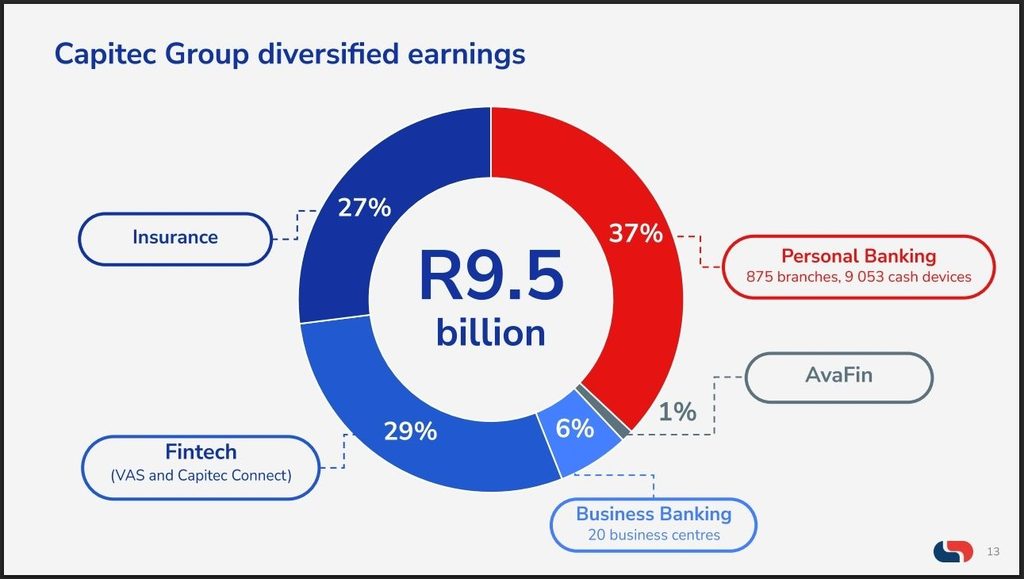
The business boasts 200,000 clients and contributed 1% to Capitec’s headline earnings in the first half of its 2027 financial year.
In the years to come, Avafin is set to play a larger role in Capitec’s business as it considers an international expansion.
Formerly known as Crean Finance Holdings, Avafin entered into a partnership with Capitec in 2017.
The South African banking giant acquired a minority stake in Avafin in 2017 to gain insight into international online credit markets.
Avafin had only been established five years earlier, in 2012, as an international fintech group that specialises in digital consumer lending.
It was founded in Latvia, and soon expanded its footprint across Europe to Czechia, Poland, Latvia, and Spain. In 2016, Avafin expanded outside the continent, setting up operations in Mexico.
Today, Avafin’s international headquarters are located in Warsaw, Poland.
As Avafin continued to grow, Capitec’s interest in the company grew, and by 2024 its stake had grown to 40.66%.
In May 2024, the banking giant acquired a controlling stake in Avafin for R547 million, bringing its interest to 97.08%.
This transaction transformed Avafin from an equity-accounted associate into a fully consolidated subsidiary.
Under Capitec’s wing, Avafin has also transitioned from single-payment short-term loans toward lower-risk, longer-term instalment loans and credit lines at lower interest rates.
This is not unlike the transition Capitec underwent as it became a challenger to South Africa’s incumbent Big Four banks.
To support Avafin’s transition into lower-risk, longer-term lending, Capitec has been funding the company directly from its balance sheet.
This helped to lower Avafin’s wholesale funding costs and enabled it to scale longer-tenor products.
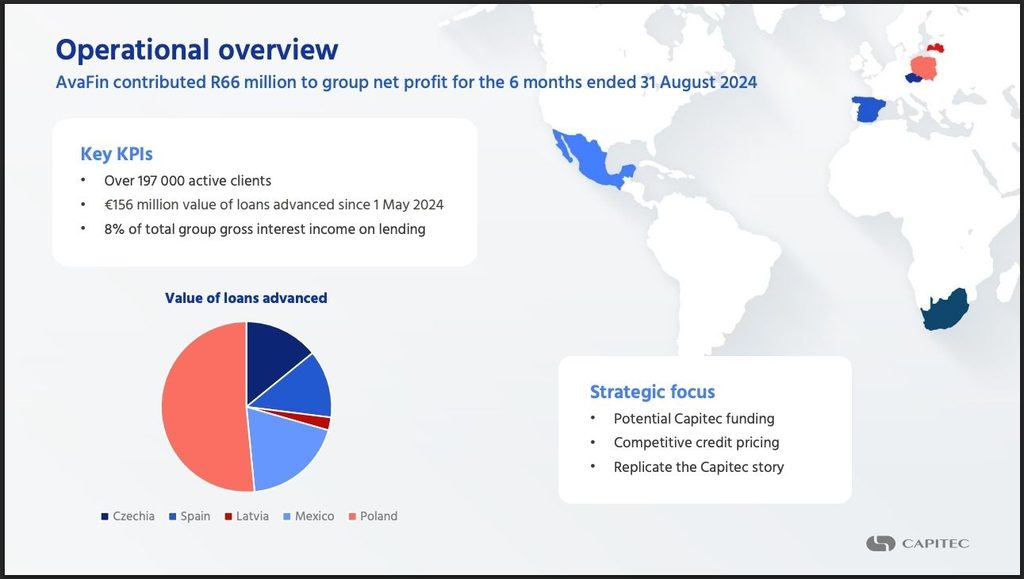
Avafin’s financials
In the first half of Capitec’s 2027 financial year, it explained that Avafin’s unique client base dropped from 250,000 to 200,000 – and that this was a good thing.
This substantial drop in clients can be attributed to the business targeting higher-quality borrowers.
Along with this 20% drop in clients, Avafin’s contribution to Capitec’s headline earnings declined by 25% to R90 million.
However, Capitec pointed out that this reflects a significant recovery from the R8 million Avafin contributed in the first half of the 2026 financial year, driven by lower credit impairment charges.
In the interim results presentation, Capitec CEO Graham Lee explained that this is part of the bank’s plan for Avafin.
“The plan at Avafin is to increase term, reduce rates, and attract better quality clients, which in the short term means that we’re earning less interest income,” Lee said.
“The proof point of that is that Avafin’s credit loss ratio has gone down by more than a third.”
The pivot to lower-risk borrowers allowed Avafin’s annualised credit loss ratio to drop from 50.4% to 33.8%.
Its net credit impairments decreased by 27% to R555 million, while its expected credit loss coverage ratio moderated to 31.7% from 33.8% previously.
While its earnings contribution shrank, Avafin’s disbursements grew, up 4% to R5.99 billion.
To support Avafin’s continued growth, Capitec’s Personal Banking division has also provided an interest-bearing intercompany facility of R3.1 billion.
Capitec beyond borders
In Capitec’s interim results presentation in September, it outlined how it plans to grow beyond banking in the coming years.
One of the last steps in this process involves going “beyond borders”, and Daily Investor asked Lee to shed more light on what this would entail.
Lee explained that, while there are no set plans yet, Capitec is starting to look at opportunities outside of South Africa, even beyond Avafin.
“We do not have any active plans in place in the sense of people working on the ground in any countries other than where Avafin operates,” he said.
However, he said Capitec is considering the different routes it could take should international expansion come to the table.
The first route, he said, would be to use the businesses already within Capitec’s stable, which includes building out Avafin. “Clearly, that’s our plan,” Lee said.
He explained that this will largely take the form of organic growth, with Capitec supporting Avafin in what it already does well.
The R3.1 billion funding will support this growth, with Lee explaining that this facility has a “double benefit”: it’s cheaper funding for Avafin and has better returns for Capitec Bank.
“Added together, the group gets double benefits in the bottom line,” Lee explained.
This first “route” for Capitec’s international expansion that Lee described could also include its enterprise payments business, for example.
Lee said the bank would consider whether that or other products are appropriate for other African countries, and build out from there.
Another route for expansion would involve applying Capitec’s successful products and models to other businesses and assessing their applicability.
Lee described this route as taking “specific things that Capitec does well for ourselves, and seeing whether those things are exportable as business-to-business services”.
He used the example of Capitec’s airtime advances product, which is rapidly growing and was built to be “externally faceable”.
“This means it could be usable by somebody else in South Africa. For example, Rain could use it,” Lee said.
“Equally, we could make it available elsewhere, and there are companies who have built an entire business model on that, like Tesco, for example.”
While Capitec is weighing its options and opportunities, Lee emphasised that these ideas remain hypothetical.
“We’re starting to think about those things, but other than having them, we’re not acting on them,” he said.
“In order for us to continue growing on a sustained basis and grow our earnings, we need to be already working on the tenure strategies.”