Standard Bank employs 3,000 people just to comply with regulations


Standard Bank employs 3,000 people solely to comply with regulations across its businesses, which is indicative of the broader compliance costs companies have to pay to be able to operate in South Africa and the continent.
Stanlib chief economist Kevin Lings used this as an example to show how excessive the cost of doing business is in South Africa.
Lings, speaking at the 2025 Morningstar Investment Conference, said one of the things that South Africa has fumbled over the past 15 years is the elevated cost of doing business in the country.
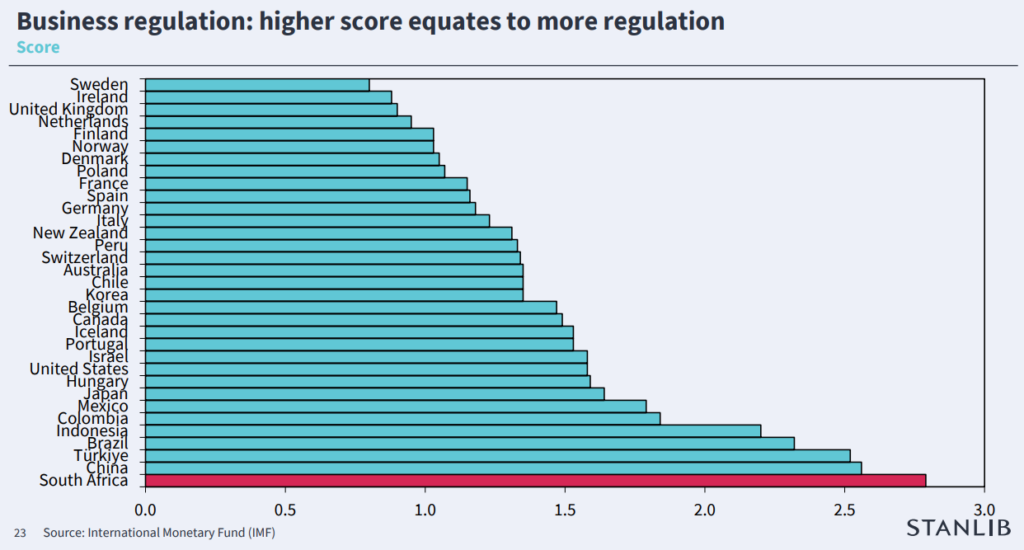
Earlier this year, the International Monetary Fund (IMF) measured South Africa’s ease of doing business against 49 other countries, and it came last.
According to this data, it is more difficult to operate a business in South Africa than it is in all developed countries and even many emerging markets.
It is easier to do business in Turkey, China, Brazil, and Colombia than in South Africa. This, Lings explained, is even before one considers having to operate in a stagnant economy.
The IMF said that if South Africa could achieve an ease of doing business equal to the average, the country’s economic growth rate could double.
“If you want business to flourish, what do you have to do? You have to make it easier to do business in the country,” Lings said.
Lings pointed to Stanlib’s owner, Standard Bank, to emphasise how much of a constraint this places on business expansion and, therefore, economic growth.
“Sim Tshabalala, some of you may know him. I call him Sim, so it feels like I know him. Sim is the boss of Standard Bank, and he said that the bank employs 3,000 people just to do compliance,” Lings said.
“3,000 people is a staggering amount. You have to pay 3,000 salaries just to do compliance. It is terrible. The cost of doing business is excessive.”
This is also partly explained by the bank’s immense scale, with it operating four business segments across 21 markets in Africa.
The cost of compliance is not only borne by big businesses. It also makes it extremely difficult to start a new company and grow meaningfully.
This limits competition and employment growth, with South Africa having a few big companies that dominate sectors of the economy.
The graph below shows the ease of doing business in South Africa in comparison to the other 48 countries surveyed by the IMF earlier this year.
Making it easier to do business
Apart from the IMF, other global institutions have also pleaded with South Africa to make it easier to do business in the country.
The World Bank released its Driving Inclusive Growth in South Africa report earlier this year, outlining two simple ways South Africa can improve its economic outcomes.
It explained that short-term success is vital for long-term reform as it provides momentum and evidence that changes are working.
Without short-term success, longer-term reform projects in the country are likely to stall and lose political backing.
One key area in which South Africa can relatively easily boost economic growth and create more jobs is by increasing competition.
The simplest way to do this is to make it easier to do business in South Africa, particularly for small businesses to enter new markets and compete with corporate giants.
“Today, many of South Africa’s markets lack dynamism. Firm entry and exit are a third of the average of a typical middle-income country,” the World Bank said.
The lender explained that this is one of the major driving factors behind the country’s high unemployment rate, as businesses are unable to expand and new companies cannot be started.
Increased competition will also result in greater economic growth and consumer welfare, as it boosts efficiency and promotes innovation.
The World Bank specifically highlighted the immense protection given to incumbents, including state-owned enterprises.
This creates a status quo that negatively impacts the success of small firms, which lack the capacity or financial means to navigate the complex system of rules and regulations.
This, in turn, significantly hinders the ability of low-skill workers to find jobs. Even if they do find employment, they face a heavy income tax burden.
Another part of this equation is the efficiency of South Africa’s institutions, which currently impose an excessive burden on business in the country.
The World Bank said the burden of institutions has become excessive – not only for businesses and citizens but also for public administration.





Comments