Money flooding out of South African bonds as United States interest rate hike looms



Foreign investors have been net sellers of South African bonds in the first two weeks of November, as expectations of an interest rate hike in the United States rise.
These expectations, along with hotter-than-expected US inflation, have lifted global bond yields and strengthened the US dollar.
In contrast, South Africa’s Reserve Bank opted to keep rates unchanged at its last meeting of 2026 in November.
This means that, if the US Federal Reserve decides to hike rates at its next meeting, the interest rate differential between the United States and South Africa will narrow.
A smaller gap will make South African assets, including bonds, less attractive compared to lower-risk US assets, putting pressure on the rand.
However, some investors believe South African bonds present a strong investment opportunity, offering good value with yields still comfortably above cash and inflation.
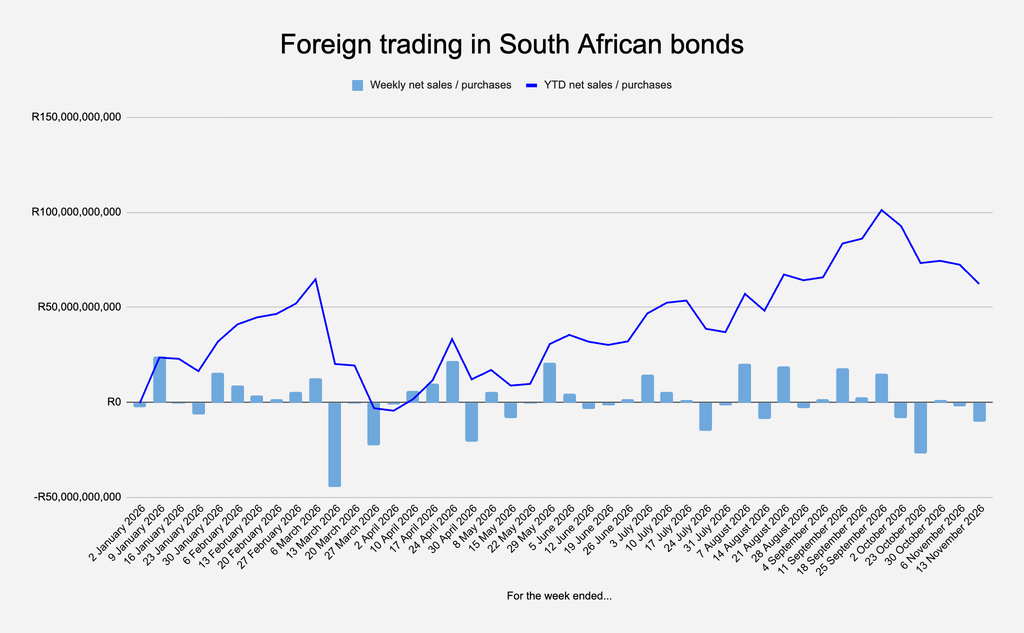
Based on the Johannesburg Stock Exchange’s (JSE) Weekly Market Data, foreign investors have been net sellers of South African bonds in the first two weeks of November.
In the week ended 6 November 2026, foreign investors sold a net R2.02 billion worth of South African bonds.
This brought year-to-date net foreign purchases of bonds to R72.47 billion, down from R74.48 billion the week before.
For the week ended 13 November 2026, foreign traders sold another net R10.19 billion worth of bonds, bringing the year-to-date figure to R62.28 billion.
This is the lowest it has been since August 2026, when year-to-date net purchases by foreign investors dropped to R48.23 billion.
These November sales come as South Africa’s economy is under significant pressure from both internal and external sources.
High global oil prices have seen domestic fuel prices reach record highs, CPI inflation accelerated to 5.2% in October, and GDP growth is expected to be a meagre 1.2% in 2026.
However, despite the pressures on South Africa’s economy, it is notable that foreign investors have remained net purchasers of the country’s bonds to date in 2026.
A good opportunity for investors
Ninety One portfolio managers Ruen Naidoo and Malcolm Charles explained that South Africa’s fixed income assets have remained resilient despite the global oil shock.
They attributed this to South Africa’s improving public finances, a credible Reserve Bank, and attractive real yields.
Naidoo and Charles said South Africa’s bond market was off to a strong start in 2026, and it seemed as though the “purple patch” would continue.
“South Africa had growth of close to 2% in its sights, the oil price was around $65 a barrel, and our inflation had fallen to 3%,” they said.
“But that all changed when the US and Israel launched airstrikes on Iran on 28 February this year.”
They explained that, since the outbreak of the war in Iran, global bond yields have climbed to multi-year highs, consumers have come under pressure, and countries are facing fuel supply crunches.
Naidoo and Charles noted that South Africa entered this shock from a position of relative strength, and that the Reserve Bank was slower to hike rates than some of its peers.
“This meant we had high real rates going into the crisis. Our lower 3% inflation target and fiscal improvements helped anchor expectations, providing a valuable buffer,” they said.
“We also maintained a healthy current account surplus over the first half of the year, thanks largely to the precious metals bull run.”
“Together, these factors have supported the rand. Despite a deterioration in the terms of trade, our currency has remained relatively stable.”
In addition, South Africa’s Medium-Term Budget Policy Statement (MTBPS), which showed a revenue overrun and a stable debt position, was well-received.
Rating agencies have taken note of South Africa’s fiscal progress, shifting the country’s risk perception and putting us on the right trajectory for future credit rating upgrades.
On top of this, Naidoo and Charles said issuance cuts and buybacks have supported the local bond market.
After suffering from “indigestion” in 2020, the Treasury has materially reduced its bond issuance. It announced another cut in issuance in the MTBPS.
“Another significant policy move is Treasury’s bond buyback programme, which will be implemented this fiscal year,” they said.
“We see this as a prudent way to manage the large repayments falling due over the next year. By using surplus cash to retire some of that debt early, Treasury eases the pressure on its repayment schedule.”
South Africa continues to face growth and inflation pressures, and some uncertainty remains regarding the country’s recovery, but Naidoo and Charles said the country’s bond market is well-positioned for growth.
“We believe South African bonds offer good value, with yields still comfortably above cash and inflation,” they said.
“If price pressures start to ease later next year, as we expect, there is scope for bond investors to earn capital returns.”
“With a credible SARB and improving public finances, South Africa is well placed to weather the challenges ahead.”
Login or register for unlimited free access.