One South African province contributes more to the economy than the Northern Cape, Free State, North West, Mpumalanga, and Eastern Cape combined


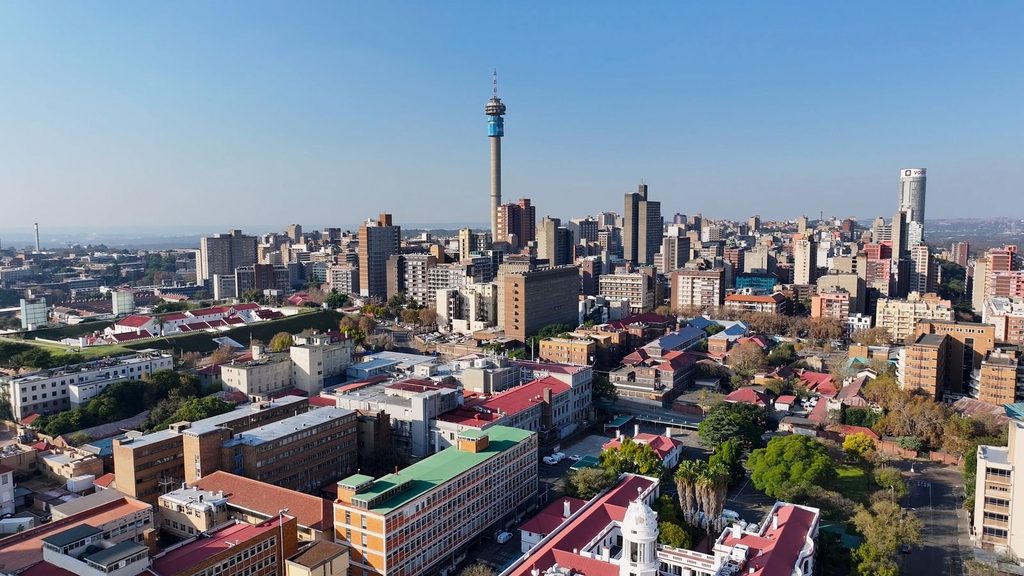
Gauteng remained South Africa’s largest provincial economy in 2025, contributing 32.5% to the country’s gross domestic product (GDP) that year.
This is more than the combined contributions of the bottom five provinces, including the Northern Cape, Free State, North West, Mpumalanga, and Eastern Cape.
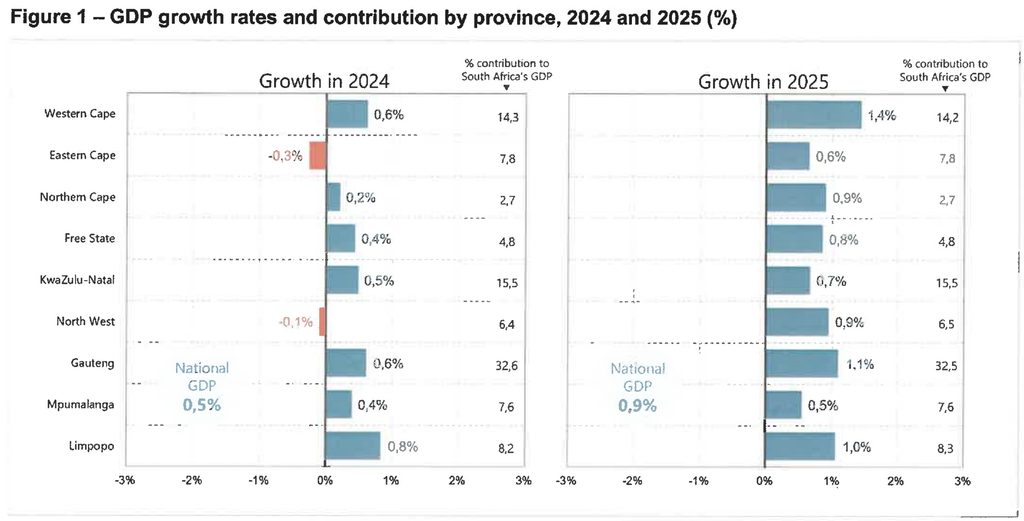
Data from Stats SA’s Provincial Gross Domestic Product release showed South Africa’s real GDP increased by 0.9% in 2025 compared with 2024.
All nine provinces recorded positive growth rates, with the Western Cape growing the most at 1.4%, followed by Gauteng at 1.1% and Limpopo at 1.0%.
Gauteng’s provincial GDP in 2025 was R2.6 trillion, with the finance, real estate, and business services sector accounting for 28.9% of this at R754 billion.
The province generated 43% of this sector’s national value and was the largest provincial contributor in seven other major industries.
Gauteng generated 41% of national value in government services, 40% of manufacturing, 35% of transport and communication, and 34% of electricity, gas and water.
The province’s large population is a key driver of its economic strength, having an estimated population of approximately 16.3 million as of mid-2026.
This makes Gauteng South Africa’s most populous province despite being the smallest at 18,178 km², accounting for just 1.5% of the country’s land area.
Gauteng’s population is largely concentrated in its three metropolitan municipalities of Tshwane, Ekurhuleni, and Johannesburg.
The latter is considered to be the financial capital of South Africa, contributing 15% of South Africa’s total GDP and hosting 74% of the country’s corporate headquarters.
The Johannesburg Stock Exchange, based in Sandton, is the largest stock exchange on the African continent and the 19th largest in the world by market capitalisation.
Many of the country’s largest listed companies are headquartered in Gauteng, including Standard Bank, MTN, Discovery, Sasol, and AngloGold Ashanti.
South Africa’s other provinces
Gauteng contributed nearly one-third of South Africa’s total GDP in 2025, followed by KwaZulu-Natal at 15.5% and the Western Cape at 14.2%.
While Gauteng was the largest contributor to national value in eight out of ten major industries, the Western Cape was the largest contributor to agriculture at 23%.
The province produces numerous high-value agricultural products, including wines, deciduous fruit, table grapes, and citrus.
It is also known for more niche, indigenous products used in teas and herbal remedies, including rooibos, honeybush, and buchu.
This was followed by KwaZulu-Natal at 15%, the Free State at 12%, and Mpumalanga and Limpopo both at 10%. Agriculture was Gauteng’s smallest industry at just 0.6% of provincial GDP.
KwaZulu-Natal and Mpumalanga are home to South Africa’s vast sugarcane fields, while the Free State is known as the country’s “bread basket” due to its wheat and maize production.
North West was the largest contributor to South Africa’s mining sector at 26%, followed by Limpopo at 25%, Mpumalanga at 20%, the Northern Cape at 12%, and Gauteng at 9%.
The Merensky Reef, home to more than 80% of the world’s platinum group metal reserves, stretches across North West, Mpumalanga, Limpopo, and Gauteng.
Mining is the largest industry in the Northern Cape, generating 29.9% of provincial GDP, with the province producing around 80% of South Africa’s manganese.
The Northern Cape was the smallest contributor to national GDP in 2025, accounting for 2.7% of South Africa’s economy that year.
Despite being the country’s largest province, accounting for 30.5% of South Africa’s total land area, it is the most sparsely populated, with just 1.38 million people, or 2.2% of the total population.
Collectively, the Northern Cape, Free State, North West, Mpumalanga, and Eastern Cape contributed 29.4% of South Africa’s national GDP in 2025, less than Gauteng.
While Limpopo only accounted for 8.3% of the country’s GDP in 2025, it had the third-highest growth rate at 1.0% due to its booming tourism and property sectors.
Login or register for unlimited free access.