South Africa’s state-owned telecoms company is cannibalising itself on purpose



Telkom is cannibalising its legacy fixed-voice revenue by offering customers free voice calls when purchasing data bundles.
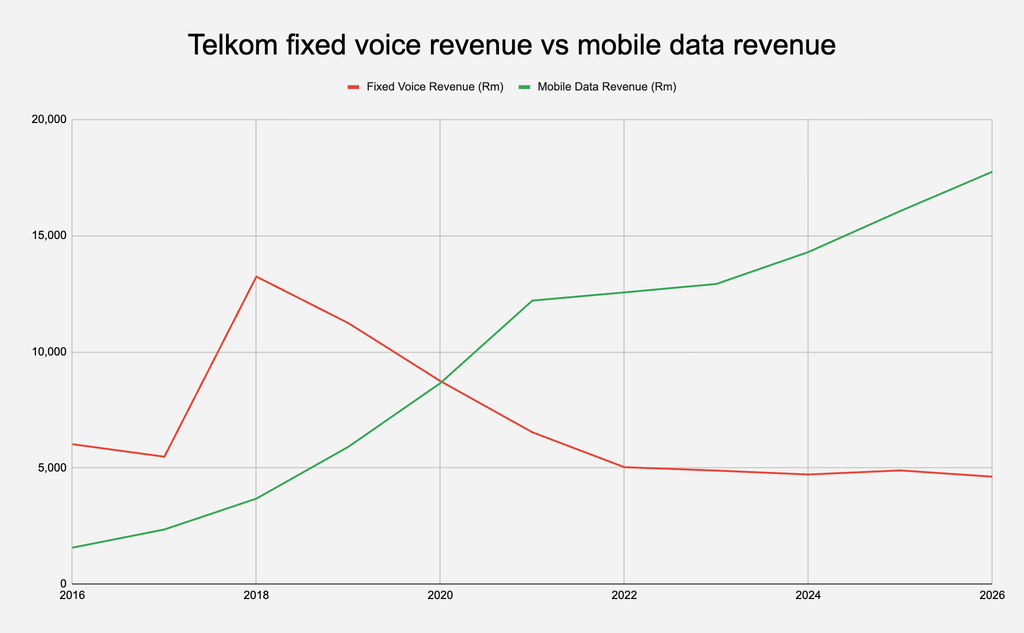
This forms part of a deliberate strategy, with Telkom wanting to shift its users to mobile data and transition away from traditional voice services.
Years ago, Telkom’s failure to recognise the need for this transition, even as its competitors had already begun, landed the telecoms giant in hot water.
However, Telkom is now taking a deliberate step away from its legacy assets and revenue sources, moving towards modern consumer demands.
This was revealed in Telkom’s results for the six months through September 2026, released on Tuesday, 17 November.
Telkom reported a 2% increase in revenue to R22.54 billion, with expenses rising by a moderate 1% to R16.59 billion.
This cost discipline saw Telkom’s EBITDA rise by 5.8% to R6.38 billion, despite the lacklustre revenue growth.
The group’s basic and headline earnings per share rose by 10.4% and 9.3%, respectively.
Telkom made a profit of R1.78 billion for the six-month period, up 10.8% year-on-year.
The group’s bottom line was aided by a 59.6% drop in impairments to R227 million, which Telkom attributed to stricter customer re-vetting and device management.
In addition, Telkom supported its cash flows by factoring R517 million of contract assets off-balance-sheet with financial institutions, booking a R98 million derecognition gain.
In the six-month period, Telkom’s capex dropped by a substantial 22.5% to R2.22 billion, led by a 35.1% cutback in fibre capex.
This means capex in the first half of the 2027 financial year fell significantly below the group’s medium-term target band of 12% to 15%.
Telkom attributed this to “the timing of planned network activity”, saying capex would ramp up in the second half of the year.
Telkom’s cannibalisation

A closer look at Telkom’s revenue revealed that the modest 2% increase reflects a deliberate strategy, rather than a true decline.
Telkom’s group revenue of R22.54 billion was primarily derived from data, which rose 6.6% to R13.93 billion.
The second-largest contributor to Telkom’s revenue, voice, saw its income drop by 13.1% to R2.70 billion.
This sharp decline in voice revenue dragged down overall revenue growth. Notably, this reflects a deliberate strategy shift, which has been a long time coming for Telkom.
One of Telkom’s biggest obstacles in the past has been its unwillingness to move away from voice and other legacy assets as its biggest revenue drivers.
As the company’s competitors invested heavily in their data, fibre, and mobile offerings, Telkom did not keep pace.
This meant that, over the past decade, Telkom’s traditional fixed-line circuit voice experienced steep, continuous annual revenue declines.
Since fixed voice was historically a high-margin business for Telkom, its erosion placed severe structural pressure on the group’s bottom line.
Due to its lack of investment in offerings beyond voice and copper, the group lacked alternative income streams to offset this decline.
At the same time, Telkom’s legacy copper access network began to suffer from severe cable theft and vandalism, resulting in high maintenance costs and a further erosion of its profit base.
This is one of the main factors that contributed to Telkom’s need for two turnarounds over the past decade.
Telkom attempted to right its ship in the early 2010s, launching its mobile operation, 8.ta, and starting to deploy Fibre to the Home and LTE.
However, Telkom still lagged behind its competitors, prompting the company to launch its PIVOT strategy, aimed at driving the transformation from voice to data, copper to fibre, and fixed-line to mobile.
The group reallocated capex into 4G and LTE mobile network densification, while its mobile active subscribers surged past 10 million by 2019.
Telkom hit a milestone in the 2021 financial year, marking the first time its revenue and profit from next-generation data streams surpassed its legacy revenue streams.
By the following year, these next-generation services accounted for 70% of the group’s total revenue.
However, Telkom’s transition is still not complete, and continued in the 2027 financial year, when the group said it took a far more deliberate step.
Speaking about the substantial decline in its voice revenue, Telkom explained that it “forms part of our strategy of proactively reducing voice revenues by shifting users to mobile data”.
“As a result, we initiated the market shift of providing customers free access to voice calls when purchasing data bundles,” the group said.
Telkom CEO Serame Taukobong called this a deliberate evolution in the company’s commercial model.
“We are increasingly aligning our propositions with customers’ demand for data while managing the transition away from traditional voice services,” he said.
Login or register for unlimited free access.