South Africa’s decade of financial pain on track to end


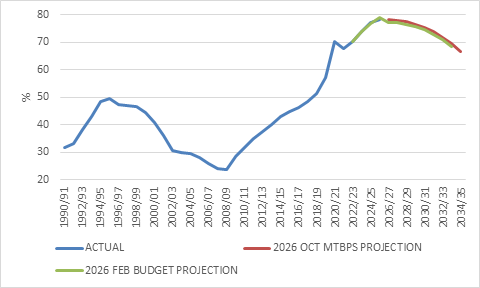
South Africa’s decade of financial pain is on track to end, with the state’s debt-to-GDP ratio peaking and its full budget deficit falling towards 3%.
The only ingredient missing for it to score the perfect economic hat-trick is 3% economic growth, which has proven elusive.
This mythical hat-trick of threes has been popularised by US Treasury Secretary Scott Bessent, who aims to get US growth to 3%, its budget deficit down to 3% as a share of GDP, and inflation below 3%.
Symmetry chief investment strategist Izak Odendaal said that South Africa is tracking well on this metric following a positive Medium-Term Budget Policy Statement (MTBPS) and a lower inflation target.
Odendaal said the 3-3-3 hat-trick is a useful rule of thumb for fiscal sustainability, but has largely been ignored by countries in recent history.
South Africa’s National Treasury has been paying attention, however, by implementing the painful process of fiscal consolidation.
This means the government has kept expenditure growth to a minimum and below revenue growth, resulting in a primary surplus.
Odendaal said this is painful for a country because it effectively means taxpayers hand more money over to the state, while getting less in return.
However, it has been successful in South Africa in producing successive primary surpluses and a declining fiscal deficit.
The difference between the primary balance and the main budget balance is the debt-service cost, or interest payments.
In other words, the government is spending less money than it brings in through tax revenue.
According to the MTBPS, South Africa’s main budget balance will have a three on the left-hand side of the decimal point for the first time in a decade in this fiscal year.
It is projected to fall below 3% by 2029 as the primary surplus widens and debt-servicing costs are set to peak.
The main thing is that the debt ratio peaked in the previous fiscal year, Odendaal said. Future shocks might still push it off course, but the Treasury will table legislation to entrench a fiscal anchor.
Fiscal consolidation is politically difficult, but it is a case of short-term pain for longer-term gain. This can be seen in the graph below.
Inflation and economic growth
The other two parts of the economic hat-trick are inflation at 3% or below and economic growth of 3% and above.
South Africa is currently off target on these counts, with inflation rising to 4.5% in September and remaining well above the Reserve Bank’s 3% target.
Odendaal expects inflation to remain between 4.5% and 5% for the next few months, but does not expect the Reserve Bank to hike rates in response.
This is because it can do little to change the situation. It cannot drill oil wells or improve refining capacity. All it can do is stop second-round effects.
Odendaal said the Reserve Bank is also able to wait for high fuel prices to roll over in early next year as annual inflation catches up with the start of the war in Iran.
By April next year, high fuel prices will be in the base for year-on-year comparisons, and inflation should decline towards a three-digit figure quickly.
This means further rate increases are probably unnecessary and unlikely. Treasury forecasts inflation to average 4.4% in 2026, 3.7% in 2027 and 3.2% in 2028.
If inflation eventually anchors on 3%, the Reserve Bank’s policy rate can fall and settle around 5.5% to 6% from the current level of 7.25%, boosting consumer spending nd economic growth.
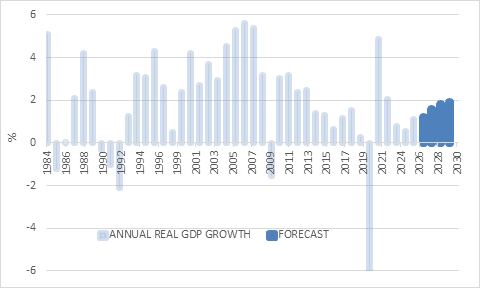
Growth remains the missing ingredient. To ensure long-term fiscal sustainability, it is not enough to squeeze taxpayers and tighten belts.
Faster real economic growth will organically generate the tax revenues to fund the government’s many spending needs without resorting to borrowing.
Unfortunately, the last time South Africa posted 3% real GDP growth in a calendar year was in 2011, when the China-led commodity boom was still running, and before the breakdown of the country’s critical infrastructure.
One of the most effective ways the government can raise growth rates is by unlocking private investment to fund a much-needed infrastructure upgrade.
Getting to 3% growth will eventually require deeper reforms and faster implementation than currently on the table, Odendaal said.
Nonetheless, the best we can realistically hope for today is not 3% growth but three straight years of accelerating growth, which was last experienced in 2016, 2017 and 2018.