South Africa isn’t getting any richer, and McDonald’s sued over a sandwich


The rand was trading at R16.62 against the US dollar on the morning of Friday, 30 October 2026, with the currency remaining range-bound over the week.
The rand drew support from South Africa’s market-friendly medium-term budget and the South African Reserve Bank’s new 3% inflation target.
However, global risk aversion linked to concerns about artificial intelligence investment returns and the ongoing Middle East conflict weighed on sentiment. Rising oil prices also added pressure to the currency.
South African government bonds strengthened, with the 10-year benchmark yield easing to around 8.70%, supported by the global pull-back in yields and the domestic budget.
The South African Reserve Bank’s repo rate remains at 6.75%, with its next Monetary Policy Committee meeting scheduled for late November.
On Wall Street, the S&P 500 fell 0.3% to 7,720, while the Nasdaq Composite dropped 1.4% to 26,184 as technology stocks came under pressure.
The sell-off followed concerns that heavy artificial intelligence investment may not translate into stronger cash flows.
However, the broader market remained positive for the week, with eight of the 11 S&P 500 sectors gaining.
In Europe, the Euro Stoxx 50 rose 0.6% to 6,207, while Germany’s DAX gained 1.3% to 26,040, supported by strong earnings from energy and industrial companies.
The UK’s FTSE 100 added 0.3% to 10,722, while the European Central Bank kept interest rates unchanged but warned that higher energy prices could increase inflation.
Asian markets fell on Friday morning, led by losses in technology and semiconductor stocks. South Korea’s KOSPI dropped 5.1%, while Japan’s Nikkei 225 declined 2.7%.
In the commodities market, Brent crude traded around $112 per barrel after reaching nearly $116 earlier in the week, driven by concerns about supply disruptions in the Middle East.
Gold fell nearly 1% to around $3,988 per ounce, extending its monthly decline to approximately 4%.
Important finance and investing news
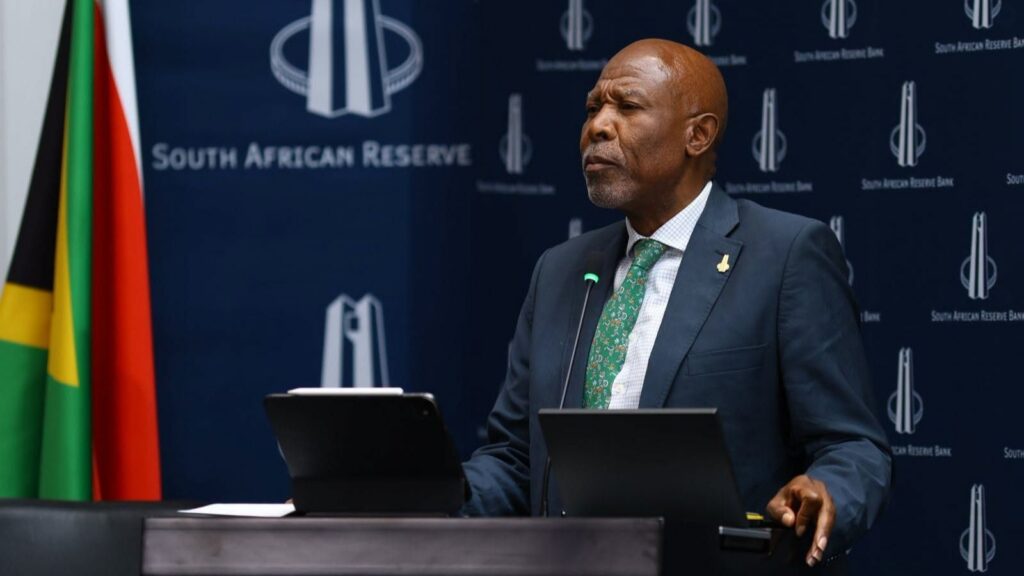
South Africa’s economy is getting bigger, but not richer: The South African economy may be larger, but that doesn’t mean the country is wealthier. Lesetja Kganyago, the Governor of the South African Reserve Bank, stated that this increase allows for a clearer understanding of the economy. [eNCA]
Starbucks bets on AI: Starbucks plans to use artificial intelligence and its app to help baristas recognise customers, their orders, and their cars in the drive-through lane. With about half of its customers using this service, the company aims to test AI models to enable faster, more accurate order entry.[Yahoo Finance]
Gauteng’s new water-monitoring plan: The Gauteng Co-operative Governance and Traditional Affairs Department is piloting a new water-monitoring system to detect leaks and monitor chlorine levels across the province. Developed by the Council for Scientific and Industrial Research, this initiative aims to prevent health crises like those in Bronkhorstspruit and Hammanskraal by improving oversight of municipal water systems. [SABC]
OpenAI’s $15 billion shortfall: OpenAI has secured less than half of the $30 billion it originally aimed to raise in its latest funding round, as market concerns regarding the AI sector have diminished investors’ enthusiasm for one of the industry’s largest names. [Wall Street Journal]
Justice is served for McDonald’s: A federal judge on Friday denied McDonald’s request to dismiss a class action lawsuit accusing the company of misleading customers about the McRib sandwich. The plaintiffs claim McDonald’s shaped the patties to resemble pork ribs, leading diners to believe the sandwich contained rib meat, which is known for its higher fat content and flavour. [Reuters]