Government waves goodbye to 27,450 employees in two years



The National Treasury revealed that 27,450 government employees have had their early retirement applications approved.
This is one of the latest measures the Treasury has implemented to rejuvenate the public sector and reduce the state’s wage bill.
The employees who are retiring early are typically older and higher-paid individuals, with the plan being to replace them with younger employees.
These younger employees would not have had their salaries skewed by the five years of rapid wage growth from 2015 to 2020.
This period distorted the public sector wage bill, with many individuals being pushed through to higher salary bands.
As a result, while South Africa’s 1.3 million-strong civil service is below the OECD average relative to total employment, these public servants are paid disproportionately well.
This is something the National Treasury wants to change, as it is a major driver behind why the public sector wage bill consumes 33.4% of non-interest spending.
Such a large share of government spending going towards salaries has repeatedly been identified by the Treasury as a major risk to South Africa’s finances.
Spending on salaries does not have the same positive multiplier effect as the same spending on infrastructure.
Since 2008, the government has significantly increased spending on salaries, which has failed to translate into faster economic growth.
This has resulted in the government posting consecutive budget deficits, creating the large debt burden the country sits with today.
The National Treasury is now working to reverse this trend by limiting the growth of the public sector wage bill and by increasing infrastructure investment.
So far, its measures, such as no more performance bonuses and a salary freeze in 2021, have reduced the public sector wage bill’s share of spending from 36.1% in 2018/19 to 33.4% in 2025/26.
Early retirement success
A major challenge for the National Treasury is that it cannot cut the overall headcount of public servants without impacting service delivery.
Its data shows that 88.3% of public servants are employed in education, healthcare, social development, policing, defence, and home affairs.
Relatively few state employees are senior managers, with these only making up 0.9% of public servants. This means the vast majority are frontline workers.
Cutting these jobs, the Treasury said, would impact the state’s developmental priorities and constitutional obligations.
Thus, it has had to find other ways to reduce the government’s wage bill than cutting headcount.
Apart from tackling fraud and payroll irregularities, the National Treasury has implemented the Early Retirement Programme (ERP) and Voluntary Exit Programme for 2025/26 and 2026/27.
These programmes aim to rejuvenate the public sector and support fiscal sustainability by reducing the individual per capita cost of employment.
“The programme aims to manage aggregate headcount and long-term wage costs by incentivising long-serving employees to exit the system,” the Treasury said in the full Medium-Term Budget Policy Statement.
“It will facilitate the entry of younger talent at lower entry notches, rejuvenating the public service and lowering the unit cost in the public-service wage bill.”
The Treasury said applications would only be rejected if critical skills cannot be replaced.
There has been strong uptake during the first two phases of the programmes, particularly at the provincial level, the Treasury said.
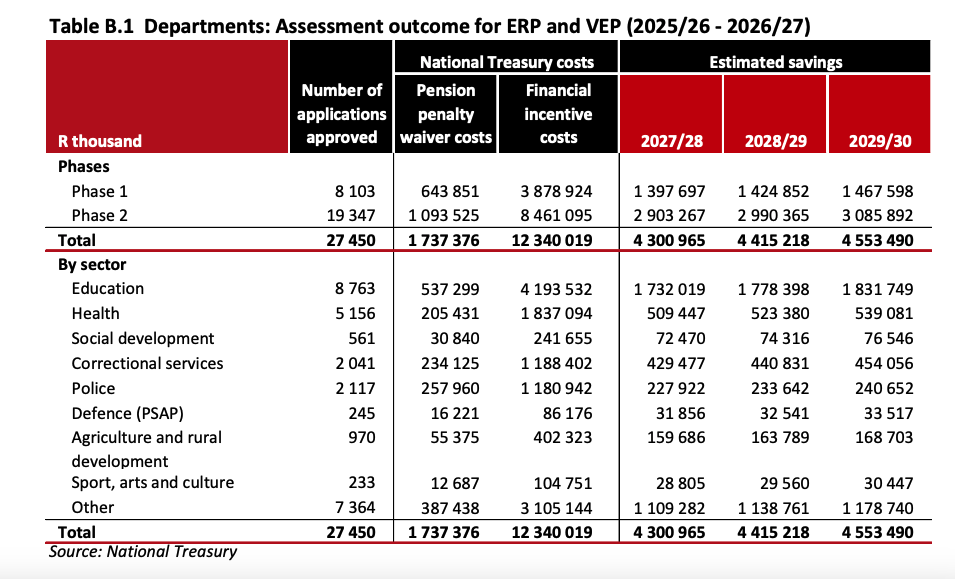
In the first phase, 8,103 applications were approved, and these employees left the system at a cost of R3.87 billion to the fiscus.
The second phase is much larger, with 19,347 applications being processed. This brings the total approved applications to 27,450.
After accounting for exit costs, the Treasury said the plan will realise savings of R4.3 billion in the coming financial year. This will increase to R4.4 billion in 2028/29 and R4.6 billion in 2029/2030.
Data shows that applicants overwhelmingly come from salary levels 8 to 10, indicating that the programmes are having the desired effect.
“By allowing senior employees to exit and subsequently filling the posts with younger employees at lower entry notches, the state captures medium- to long-term savings,” the Treasury said.
“It is estimated that, on average, a permanent saving of R110,097 per year per employee is realised through this process.”
The savings are kept in the baseline budgets of the departments from which employees leave, enabling them to hire additional staff to boost capacity.
For example, the Treasury said the basic education department will be able to add 2,860 personnel, healthcare 841, correctional services 709, and the police 376.
These are over and above the replacements of employees who exit under the programmes, enhancing state capacity without increasing the public sector wage bill.