State-owned bank making a R5.23 million loss wants a R2.5 billion bailout from the government



Postbank has submitted a request to the National Treasury for a R2.5 billion injection, which it needs to transition into a fully licensed, state-owned commercial bank.
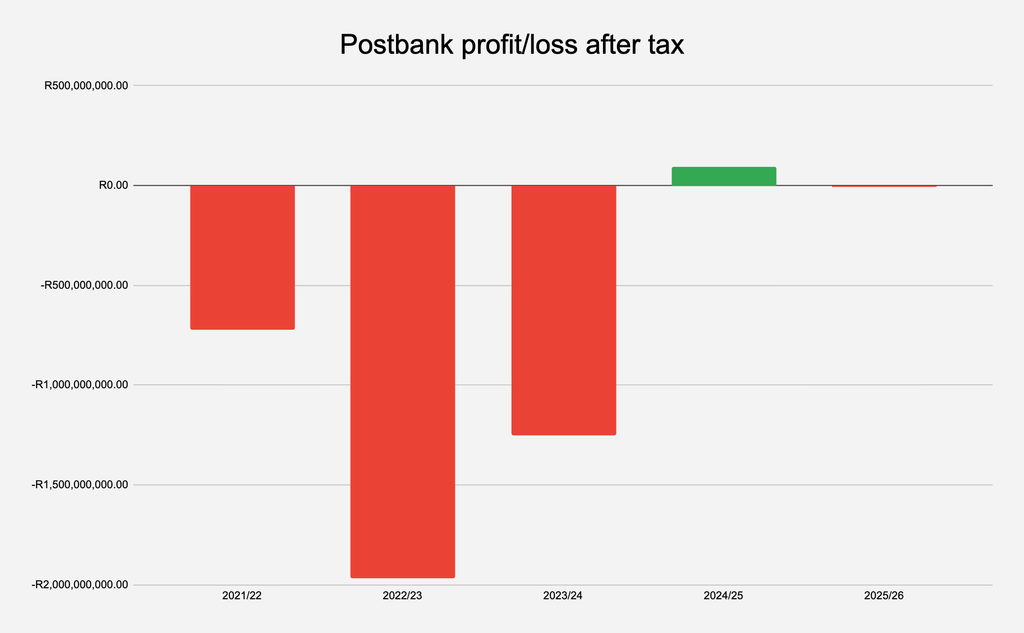
This request comes as Postbank continues to seek financial stabilisation, with the 2025/26 fiscal year showing another loss for the state-owned bank.
Postbank reported a net loss after tax of R5.23 million for 2025/26. However, it claimed this would have been a R42 million profit before tax were it not for a R44 million SARS interest charge.
“This context is important in understanding the underlying performance of the business while recognising that we must continue to build a stronger and more diversified revenue base,” Postbank CEO Nikki Mbengashe said.
She also noted that the bank should work to improve its efficiency and convert its significant customer reach into greater customer utilisation and sustainable commercial value.
Postbank finds itself in an advantageous position compared to private commercial banks, as it is tasked with paying and processing social grants to millions of recipients.
The bank historically disbursed grants to 7.1 million beneficiaries, of which 2.4 million are social relief of distress grant recipients. It distributed more than R100 billion annually.
Therefore, Postbank has access to millions of active clients who rely on and interact with its services at least once a month.
Postbank’s social grant recipients are in addition to its core retail depositors. The bank did not report how many of these depositors it had in the 2025/26 financial year.
In the years prior, Postbank reported that its client numbers peaked in 2022/23, with 20 million active accounts.
In 2023/24 and 2024/25, this dropped significantly to 5.5 million and 4 million, respectively.
This was largely due to a SASSA verification audit conducted during that period, which removed millions of ineligible grant beneficiaries.
A variation notice from the Reserve Bank in 2024/25 and 2025/26 also restricted Postbank from issuing cards or onboarding new core depositors. This capped Postbank’s customer growth.
The bank listed this notice and two other factors as the three main reasons for the constraints on its commercial performance in 2025/26.
The other two factors it listed were “a difficult macroeconomic environment, and limitations in our internal systems”.
Regardless of the reasons, Postbank reported a loss of R5.23 million for the 2025/26 financial year.
This, along with its dangerously low capital adequacy ratio (CAR), leaves Postbank in a precarious position.
R2.5 billion bailout request
To improve its position, Postbank has requested R2.5 billion from the National Treasury.
The bank said this funding is a core component of its strategy to recapitalise the institution, meet commercial banking standards, and finalise its long-delayed banking licence application.
The R2.5 billion funding request is split into two “pools”: R500 million will fund capital and IT infrastructure, while R2 billion will be used to restore the bank’s regulatory capital base.
The second pool is critical for Postbank’s continued self-sufficiency, as its capital adequacy has been eroded to a dangerously low level.
In 2025/26, Postbank’s CAR dropped from 4.25% to 1.62%, which is well below the capital threshold required of fully licensed commercial banks.
In essence, such a low CAR means that if an unexpected loss were to occur, Postbank would be unable to absorb it and might not remain solvent, exposing its depositors to severe losses.
The bank attributed its severe capital deficit to a R4.1 billion write-off of irrecoverable debt owed by the South African Post Office (SAPO).
SAPO has been undergoing business rescue and, through this process, offered creditors 12 cents on the rand for the debt it owes.
Postbank was one of these SAPO creditors and had to write down billions of rands as a result.
Now, Postbank has an extremely low CAR, which directly affects its ability to operate as a fully licensed commercial bank.
The bank’s capital deficit impairs its ability to secure its full Section 16 commercial banking licence from the Prudential Authority.
This Section 16 licence requires institutions to maintain a minimum CAR of 11.5%.
With its CAR at only 1.62%, Postbank will need the R2 billion funding from the National Treasury to acquire this licence.



Comments