South Africa stuck in a dollar trap


South Africa and other emerging market economies remain heavily exposed to the United States dollar.
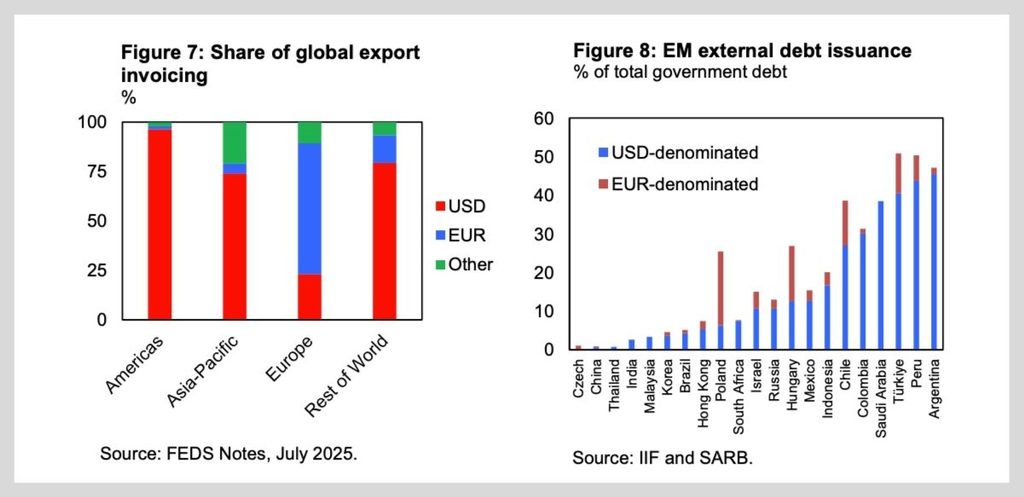
This is because the vast majority of international trade invoicing and external debt borrowing continues to be dollar-denominated.
Therefore, despite South Africa’s relatively low exposure to dollar-denominated debt, it will likely remain stuck in a structural “dollar trap”.
This is according to a research note published by the Reserve Bank’s Chris Loewald and Manisha Morar, titled ‘De-dollarisation and emerging markets: more policy space or less?’.
In this note, Loewald and Morar define de-dollarisation as the gradual reduction of reliance on the US dollar in trade, finance, and reserves.
Reducing reliance on the US dollar has become a hot topic in the post-pandemic era, with the greenback having undergone a notable shift over the past year.
Some experts believe that the fundamentals underpinning the dollar’s dominance in global markets are being eroded.
“The propensity of the US to run current account deficits on a continuous basis, irrespective of GDP growth cycles, generates sustainability concerns for debt,” Loewald and Morar said.
“These dynamics prompt unease over the dollar’s dual role as a global public good and a potential source of systemic risk through policy and geopolitical channels.”
This concern, combined with a sharp increase in potential tariffs on US imports, led to a significant depreciation of the US dollar in 2025.
While the outbreak of the Iran war in early 2026 interrupted the rand’s strengthening, the US dollar has also failed to retain the same safe-haven status it had during previous periods of heightened uncertainty.
Ninety One portfolio manager Varun Laijawalla and investment director Jen Ford explained in May 2026 that the US dollar may be entering a new cycle.
“This matters for investors because dollar cycles are lengthy, lasting 18 years on average,” they said.
With the current cycle already having lasted for over 20 years, it appears as though the time has come for a new era.
“If the dollar cycle has indeed turned, the headwind for emerging equities could turn into an ongoing tailwind,” they said.
The dollar trap
Despite the US dollar’s weakening in 2025, Loewald and Morar said it is easier said than done for emerging markets (EMs) to reduce their reliance on the greenback.
“Even as the dollar cyclically weakened in 2025, EMs remain structurally exposed to it,” they said.
“Most external borrowing remains denominated in dollars, alongside the majority of international trade, regardless of exchange-rate regimes.”
“This ‘dollar trap’ can limit the policy autonomy that flexible exchange rates provide by increasing marginal debt costs and existing debt service burdens.”
They explained that the ‘dollar trap’ is difficult to escape due to the scale, deep liquidity, and institutional effects of US capital markets.
Alternative currencies or payment mechanisms cannot quickly replicate these features, and moving away from the US dollar can do more harm than good for EMs.
Loewald and Morar said moving toward smaller regional markets can raise risk premiums, increase asset volatility, and elevate rollover risks for emerging economies.
However, the researchers noted that South Africa may be in a better position than some EMs in this regard.
This is because South Africa’s foreign-currency debt accounts for only a small share of total public borrowing.
Since South Africa relies more on local-currency funding than on foreign-currency funding, the country has been better able to contain external vulnerabilities and currency-mismatch risks.
“Relatedly, the share of dollar deposits in the domestic banking system is limited, unlike EMs such as Türkiye and Argentina,” Loewald and Morar said.
“This also reduces downside risks to the rand as the likelihood that residents would aggressively swap domestic currency deposits for foreign-denominated ones is low.”
Therefore, South Africa is largely insulated from the direct balance-sheet trap because its government borrowing is overwhelmingly denominated in local currency.
However, Loewald and Morar said South Africa remains vulnerable to volatile portfolio flows and domestic capital allocation, making a material move away from the US dollar unlikely.





Comments