Eskom missed its most important target but still paid executives and staff big bonuses


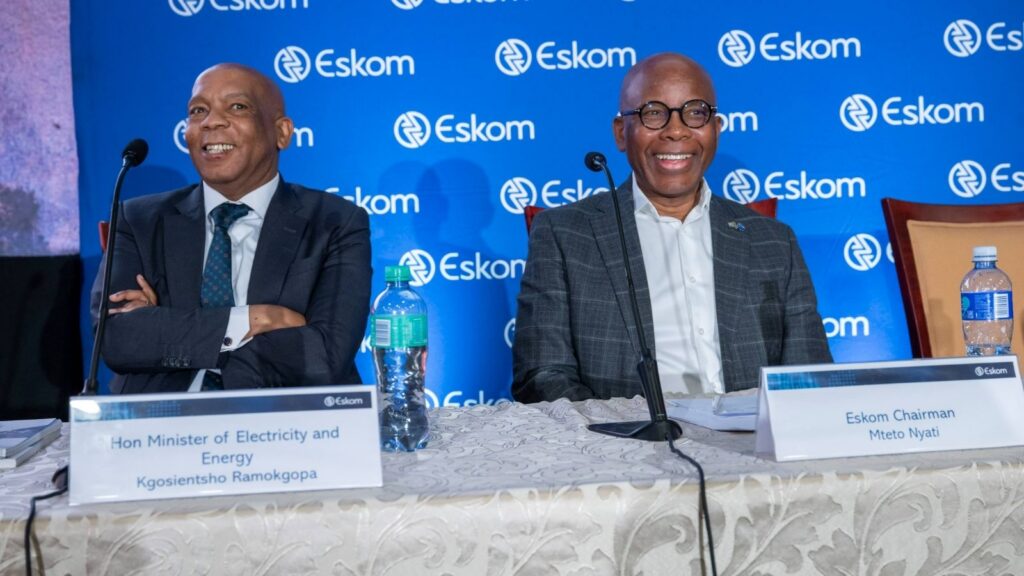
There has been a noticeable improvement in Eskom’s performance. However, the utility has failed to meet any of its energy availability factor (EAF) targets since the 2019 financial year.
This is despite the utility repeatedly moving its own goalposts, having gone from targeting 90% EAF to 80%, then 70%, and finally 60%.
Eskom’s annual EAF target is mutually agreed upon between the utility and its largest shareholder, the national government.
Yet despite the utility having missed this target for most of the past two decades, Eskom’s board members have consistently been paid large performance-based bonuses.
While EAF is not the only measure used to assess the utility’s performance, it is an important metric for determining the reliability of Eskom’s power plants.
Simply put, it measures the percentage of time a power plant or grid is able to produce electricity relative to its full capacity.
For example, an EAF of 60% means Eskom’s power plants are producing and supplying power at 60% of their maximum capacity.
The remaining 40% is lost capacity, which can be due to planned maintenance, breakdowns, or other plant issues.
Between 2010 and 2016, Eskom’s EAF deteriorated, falling from a high of 85.21% in 2010 to 71.07% in 2016.
The utility attributed this decline to its ageing coal fleet, growing maintenance backlogs, and running plants above international norms to avoid load-shedding.
Eskom saw a short-lived recovery in the years that followed, meeting and exceeding its annual targets in 2017 and 2018, supported by capacity additions and fewer unplanned breakdowns.
However, the utility experienced an operational crisis from 2019 to 2024, with its availability collapsing to an all-time low of 54.56% in the 2024 financial year.
South Africans felt the impact of this, as 2023 was the worst load-shedding year on record, with 335 days of power cuts and stage 6 reached on numerous occasions.
Eskom’s annual EAF targets, compared with its actual reported EAF, are shown in the table below.
| Financial year | Shareholder compact annual EAF target | EAF achieved |
| FY10 | 85.50% | 85.21% |
| FY11 | 86.50% | 84.59% |
| FY12 | 84.10% | 81.99% |
| FY13 | 80.00% | 77.65% |
| FY14 | 80.00% | 75.13% |
| FY15 | 80.00% | 73.73% |
| FY16 | 74.10% | 71.07% |
| FY17 | 72.00% | 77.30% |
| FY18 | 78.00% | 78.00% |
| FY19 | 78.00% | 69.95% |
| FY20 | 71.50% | 66.64% |
| FY21 | 73.00% | 64.19% |
| FY22 | 74.00% | 62.02% |
| FY23 | 65.00% | 56.03% |
| FY24 | 65.00% | 54.56% |
| FY25 | 65.00% | 60.60% |
| FY26 | 70.00% | 65.16% |
Eskom moves the goalposts
Aside from its annual shareholder compact targets, Eskom’s leadership and turnaround boards have also introduced overarching long-term target frameworks over the past two decades.
In October 2010, Eskom aspired to raise its EAF to 90% over a six-year period, hoping to rank among the top five power utilities globally.
To help it achieve this goal, Eskom set a short-term EAF target of 84.20% for 2012 to align its plant reliability with demand constraints.
A year later, Eskom initiated a core strategy targeting a sustainable EAF of 80%, allocating 10% for planned maintenance and the remaining 10% for unplanned outages over the next five years.
However, as it entered a crisis between 2019 and 2024, Eskom was forced to formulate a new plan in 2023, developed by its board’s Business Operations Performance Committee (BOPC).
The BOPC devised a plan to stabilise EAF at 60% by March 2023, reaching 65% by March 2024, and 70% by March 2025.
While Eskom’s EAF has improved since the 2024 financial year, it has not come close to meeting any of its targets.
As Eskom’s performance started to stabilise, it adjusted its EAF trajectory to target 66% by the end of its 2026 financial year, and is targeting 68% by 2027 and 70% from 2028 onwards.
For its 2026 financial year, Eskom reported an EAF of 65.16%, well below its shareholder compact target of 70% and falling just short of the 66% target by the end of FY26.
Eskom executive remuneration
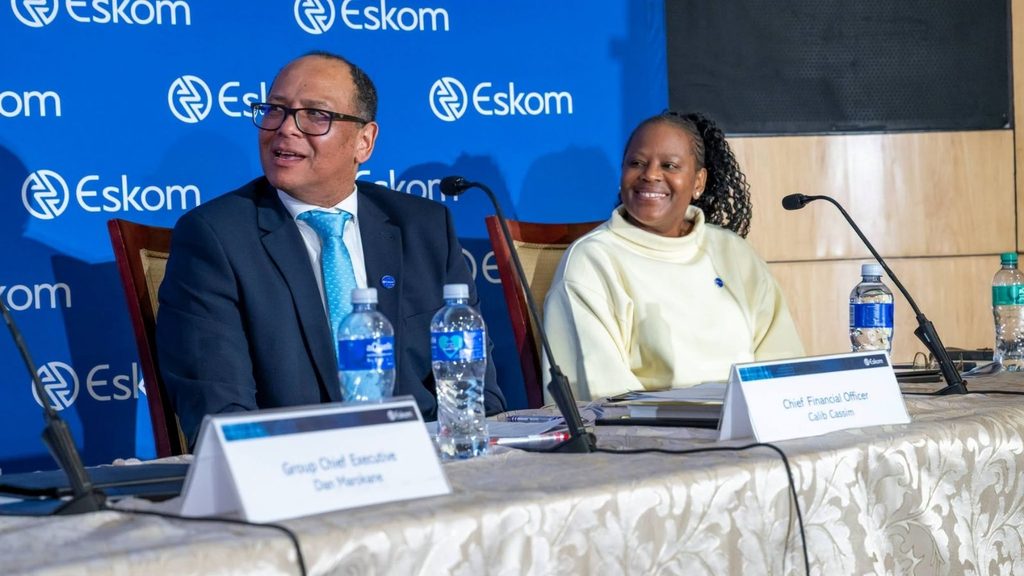
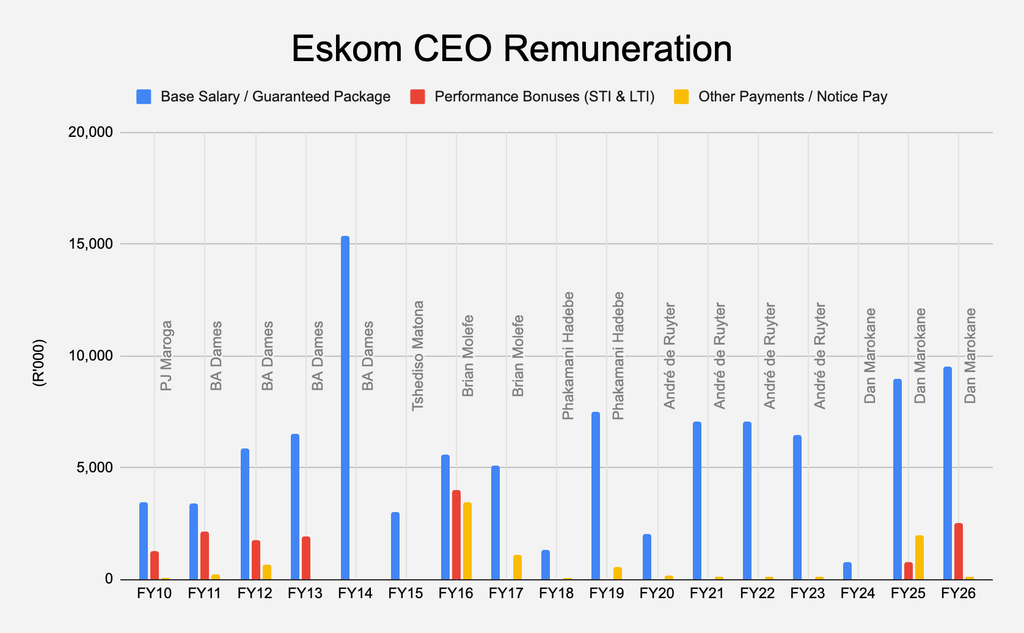
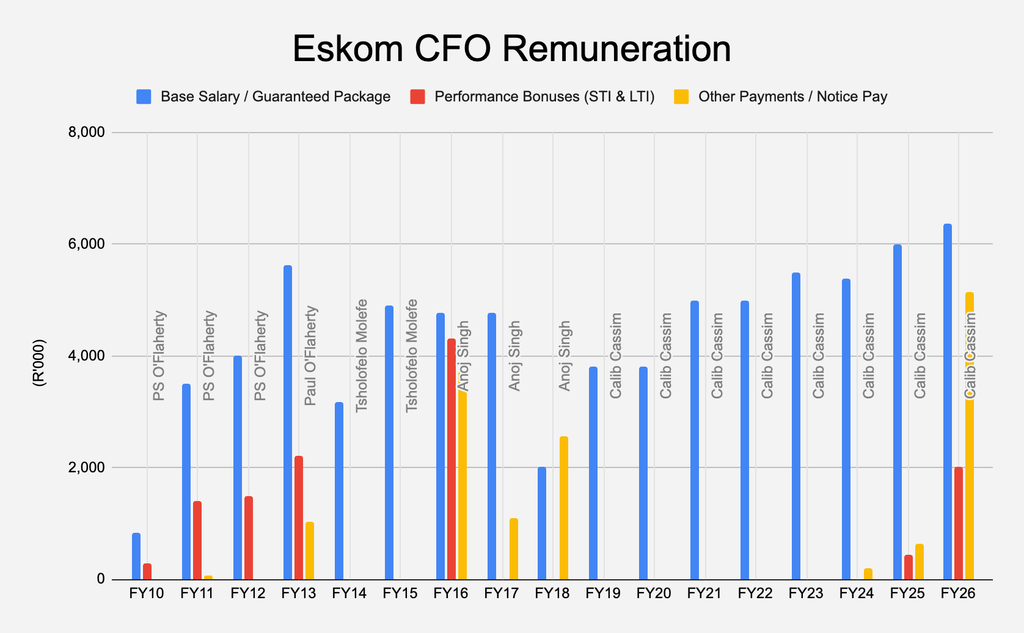
Despite Eskom consistently falling short of its own targets, the utility’s executives have continued to be awarded performance bonuses and substantial salary increases.
The Special Appropriation Act of 2019 and subsequent debt-relief conditions tied to Eskom’s R254 billion bailout from the National Treasury sought to address this disconnect.
Between the 2020 and 2024 financial years, no increases or variable performance incentives were paid out to any F-band executives.
However, in the 2025 financial year, following shareholder approval and a return to operational stability, Eskom reinstated the short-term incentive (STI) scheme, despite its EAF still falling short of the target.
This is because EAF performance is not taken into account directly when awarding executive bonuses.
Instead, it is measured through its operational sub-components and final outcomes, including unplanned breakdowns and load-shedding, rather than the EAF figure itself.
Under Eskom’s reintroduced STI scheme, the bonus pool size is determined by an organisational scorecard that is weighted across five key performance indicators:
- Generation Performance (Unplanned Capability Loss Factor) – 40% weight
- Financial Performance (Cash from operations) – 30% weight
- NTCSA (Transmission) Performance (System minutes lost < 1 minute) – 10% weight
- Distribution Performance (System Average Interruption Duration Index, SAIDI) – 10% weight
- Safety Performance (Lost-Time Injury Rate, LTIR) – 10% weight
To qualify for an STI payout, Eskom executives must also achieve an individual performance rating of three or higher on a five-point scale under their agreed performance compact.
The final bonus amount is then calibrated based on this individual rating.
The remuneration for Eskom’s CEOs and CFOs since 2010 is shown in the graphs below.






Comments