Telkom’s black sheep


After three rounds of layoffs, cost-cutting measures, and multiple acquisitions, Telkom’s BCX business continues to act as a drag on the group’s performance.
This is despite Telkom itself staging a successful comeback, while BCX struggles to maintain upward momentum.
BCX, formerly known as Business Connexion, is an information and communications technology (ICT) company.
It acts as a digital transformation partner and systems integrator, providing services ranging from telecommunications and cloud hosting to cybersecurity and hardware procurement.
Founded in 1996 in Pretoria by twin brothers Benjamin and Isaac Mophatlane, BCX later merged with Comparex Africa. It was listed on the JSE as Business Connexion in 2004.
A big change came in 2015, when Telkom acquired BCX for a whopping R2.7 billion, and it became a wholly owned subsidiary of the telecommunications giant.
The acquisition formed part of Telkom’s strategy to scale its IT infrastructure services, driving its convergence strategy.
With this strategy, Telkom was hoping to offset its declining traditional fixed-voice revenues by migrating customers to bundled, high-speed next-generation data services.
BCX was set to play a central role in this ambition, as it immediately provided Telkom with the scale and IT expertise to offer these bundles to residential and business customers.
With BCX in its stable, Telkom could cross-sell its IT services to the telecom giant’s existing customer base and vice versa.
Thus, BCX would also serve as Telkom’s central IT arm, integrating its internal IT systems and personnel to eliminate duplicate systems.
However, this strategy fell short of Telkom’s ambitions, though it did yield some wins.
BCX’s acquisition led to some synergistic contract wins, especially with B2B customers spanning the banking, retail, and public sectors.
One of the core goals of Telkom’s strategy – more diversified revenue streams – was also met, as IT services went from representing 0.9% of total revenue to 16.2% by the 2019 financial year.
All of these wins aside, BCX still had one fatal flaw – it struggles to make money.
BCX’s profit problem

When Telkom acquired BCX, it was reporting strong revenue and profit growth, with room for further expansion in the years ahead.
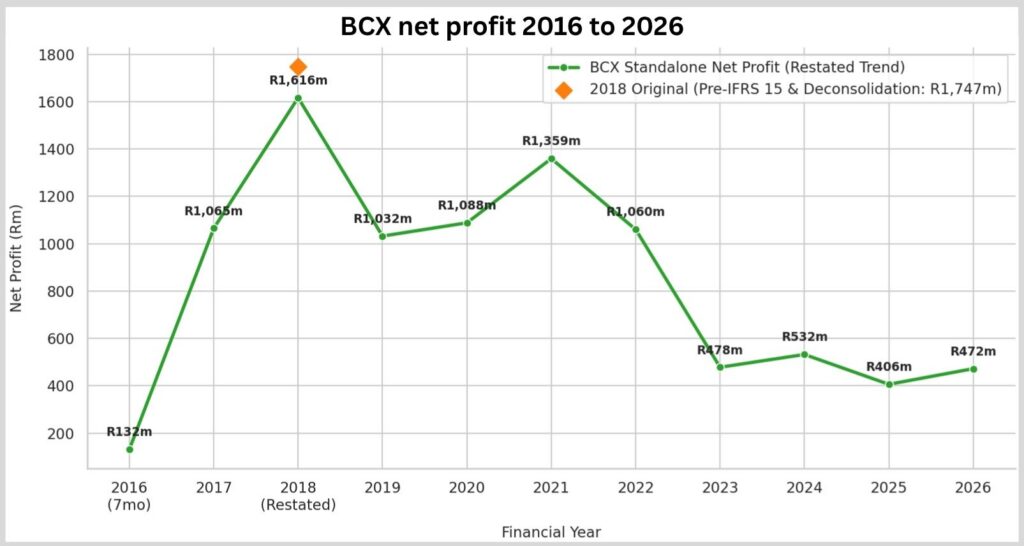
The business’s income statement only improved after Telkom sold its Enterprise business division to BCX for R5 billion in the 2017 financial year, integrating the two units into a single point of contact for customers.
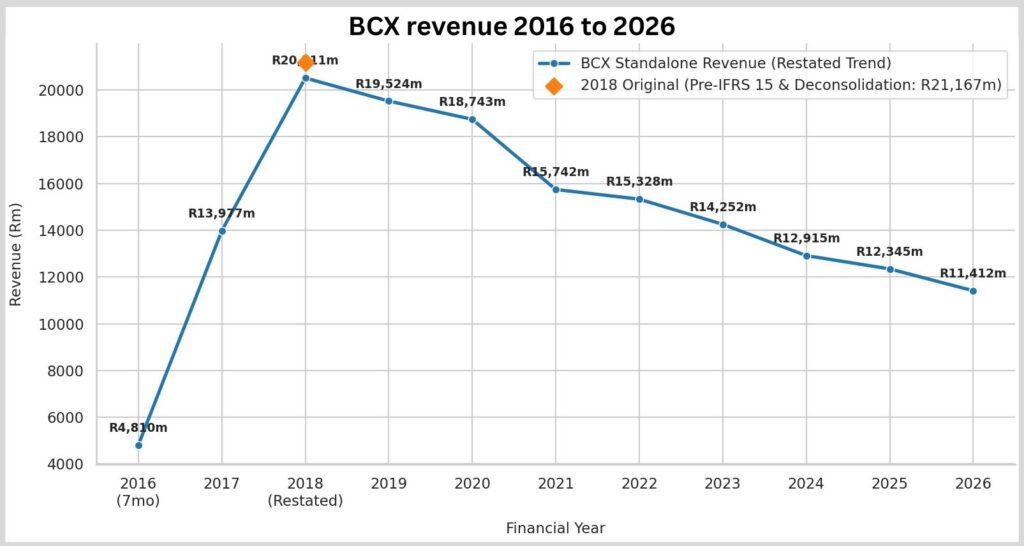
This merger significantly expanded the IT segment’s margins, from 7% in 2016 to 15% in 2017. That same year, the segment’s revenue hit R13.98 billion, and its net profit reached R1.07 billion.
2017 was the year of acquisitions for BCX, as it further expanded its portfolio by acquiring Taropa Technologies for R13 million, African Arete for R19 million, and Relational Database Consulting for R30 million.
In the 2018 financial year, BCX outdid itself, reaching record revenue and profit of R21.17 billion and R1.75 billion, respectively. This was the most revenue and profit BCX has ever made in a financial year.
Trouble came in 2018 and 2019, when severe economic pressure led to deferred corporate ICT spending and reduced public-sector spending.
The business was also constrained by its BBBEE rating, which restricted its ability to bid for tenders.
These pressures forced BCX to initiate Section 189 proceedings and reduce its headcount.
Its revenue declined to R19.52 billion in the 2019 financial year, while net profit fell 40% to R1.03 billion.
BCX’s troubles did not improve in the years that followed, as the Covid-19 pandemic delayed ICT projects and affected corporate IT budgets and service delivery.
The business’s revenue stabilised in the 2022 financial year, though it had to implement a margin defence strategy to ensure its profit did not dip below R1 billion.
However, this did not last long. Severe load-shedding and high inflation in 2023 led to a decline in BCX’s revenue, and its profit more than halved to R478 million.
This triggered a major R187 million asset impairment, and BCX had to initiate another round of lay-offs.
Hopes for recovery
BCX’s profit recovered somewhat in the 2024 financial year, though its revenue continued to drop, now standing at R12.92 billion.
Over this same period, Telkom was implementing its own turnaround strategy, which saw it shift from a substantial R10 billion loss in 2023 to a profit of R3.5 billion in its latest financial year, 2026.
However, this turnaround has yet to extend to BCX, with the ICT giant still struggling to materially improve its financial performance.
This is despite having launched another Section 189 process in the 2025 financial year, which resulted in 175 voluntary package exits and 84 retrenchments.
With lower staff costs to contend with, things were looking somewhat better in Telkom’s latest financial year.
BCX’s profit increased for the first time since 2023, now at R472 million. However, revenue continued its downward trajectory, dropping to R11.41 billion.
In its 2026 Annual Report, Telkom said BCX is now “focused on execution” and “repositioning itself as a connectivity provider for digital services”.
“While the BCX turnaround remains a multiyear journey, management’s focus is on improving portfolio quality, scaling cloud and cybersecurity solutions, and enhancing execution discipline,” Telkom CEO Serame Taukobong said.
“The business is reviewing its product portfolio to prioritise offerings that are scalable and can deliver improved profitability.”
“BCX’s long-term differentiation lies in combining digital services with Telkom’s connectivity infrastructure through OneTelkom.”
However, it remains to be seen whether these interventions and ongoing cost-discipline measures will yield results or leave BCX stuck in its downward trajectory.
Former Telkom CEO Sipho Maseko, who led Telkom’s turnaround before Taukobong took over, recently made his feelings about BCX known.
In an interview with the Investec Minds podcast, Maseko was asked a quickfire question: “BCX, yay or nay?”. Maseko opted for “nay”.






Comments