Millionaire town collapsing in front of everyone’s eyes



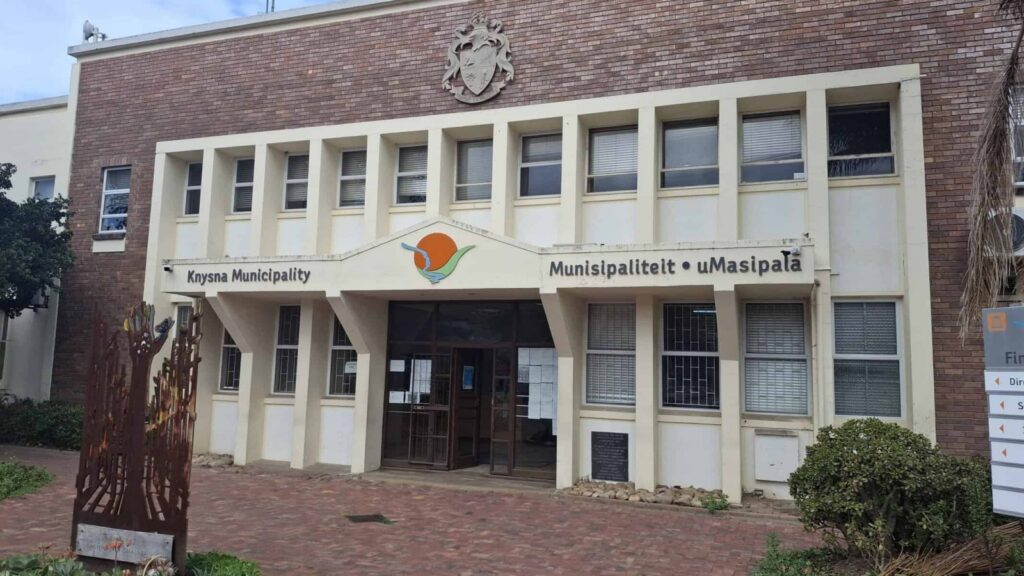
The Knysna Local Municipality in the Western Cape is facing systemic collapse amidst an escalating governance crisis.
Despite the municipality receiving a fully-funded budget of R1.5 billion a year, issues such as water shortages and sewage failures have become increasingly common.
Municipal and provincial interventions have so far failed to restore stability to Knysna, with a Hawks investigation now underway into small-scale corruption at the municipality.
In September 2025, Western Cape provincial authorities attempted to place Knysna under full administration through a Section 139C intervention.
This would have resulted in the full dissolution of Knysna’s municipal council, and fresh local elections would have been held within 90 days, in line with standard political processes.
This intervention was ultimately unsuccessful, as the National Council of Provinces voted to overturn the provincial ruling to place Knysna under administration.
At the same time, the municipality has been under a Section 154 support intervention, receiving between R70 million and R80 million over the last 24 months, according to the Western Cape Premier.
Ron Weissenberg of The Accountability Group (TAG), which supported the Section 139C administration, told BizNews that this financial support had still not been enough.
“They tend to paper over the problems, and they address urgencies and emergencies on a short-term basis,” Weissenberg said.
“When the money ends, and the resources are withdrawn, we are left with exactly the same staff complement, management, and issues around leadership.”
Weissenberg explained that the municipality had been beset by a “revolving door” of mayors and senior executives, specifically at the management level.
Despite Knysna’s municipal office having 1,117 positions, only 633 are currently occupied, leaving a vacancy rate of 43%.
Of the 484 vacant positions, nearly 80% are considered critical core functions, such as plumbers, electricians, road workers, and engineers.
Weissenberg said much of this vacancy could be attributed to South Africa’s stringent equity requirements, which are enshrined in the country’s constitution.
“We have an unemployment rate of some 32%,” Weissenberg said. “But in reality, the skills that are available may only be available from a different demographic.”
“Alternatively, you have a situation where a newly qualified plumber will get a position over and above a plumber with 25 years of experience.”
The cause of Knysna’s problems
Much of Knysna’s instability has been attributed to the prevalence of an alliance between the ANC, the EFF, the Patriotic Alliance, and Plaaslike Besorgde Inwoners (PBI).
This has been described as an example of a “kingmaker coalition”, with the smaller parties holding the deciding votes needed for the larger party to form a government.
During South Africa’s last local government election in November 2021, the Democratic Alliance received the largest share of the vote at 35.4%, while the ANC received 33.2%.
With neither party receiving an overwhelming majority of the vote, the three smaller parties acted as “kingmakers”, placing the ANC in charge of the municipality.
“The Democratic Alliance actually has the most seats in the council, but due to the coalition arrangements with those three parties, they have the majority,” Weissenberg said.
“Voters appear, not only in Knysna but nationwide, to like the concept of coalitions. But toxic coalitions don’t like voters.”
Weissenberg explained that once these coalitions have secured the majority, they pivot towards managing the coalition itself rather than running the municipality, damaging local service delivery.
Instead of fulfilling the promises made in their election manifesto, the coalition shifts focus to internal political manoeuvring, resulting in tender corruption, delays, and bureaucracy.
With the country’s next local elections coming up in November this year, Weissenberg is confident that the face of the Knysna municipal government will change.
He said voters in Knysna who have seen the direct consequences of having a coalition government in power will be more likely to actively vote against it.
“It is critical that we do need a majority-controlled municipality, so that accountability can be placed directly at a political party rather than diluted as it is at the moment,” Weissenberg said.
“One thing communities can do is use current legislation and best practice to pressurise those political parties or individual independents into more appropriate action.”
Weissenberg said community members in Knysna should campaign for psychometric testing to establish the competency and aptitude of all municipal candidates.
He also recommended the establishment of a municipal appointment interview panel consisting of independent, qualified individuals from the community.



Comments