Standard Bank shares good news about South Africa


South Africa’s ongoing efforts to unwind infrastructure bottlenecks and address crime and corruption are delivering an earnings boom for the continent’s biggest lender by assets.
Standard Bank’s South Africa business grew profit 15% in the six months to June — more than twice the 7% pace registered in the lender’s operations elsewhere on the continent — as efforts to improve governance and sort out power, water and logistics issues bear fruit.
The upswing lifted the unit’s contribution to overall headline earnings to 51%.
“The momentum in the South African economy is profound, it is pervasive, and it is massive, and it’s showing up actually in the performance of our group,” CEO Sim Tshabalala said in an interview with Bloomberg TV.
Africa’s largest economy has grown by less than 1% annually on average over the past decade after being beset by chronic mismanagement and corruption.
Standard Bank anticipates that the country has entered its strongest phase in 10 years and that expansion could accelerate if efforts to clear its infrastructure backlog gain traction.
A credit upgrade by S&P Global Ratings, removal from the Financial Action Task Force’s dirty-money list and slower inflation are further evidence of a better trajectory, it said.
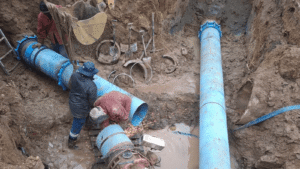
The bank expects gross domestic product to accelerate to 1.3% in 2026, reach 1.7% by 2027 and breach the 2% mark by 2028 as the government and private sector work to revive dilapidated water infrastructure.
The government also intervening to help deeply dysfunctional municipalities that are unable to provide basic services. While it’s an improvement, it’s below the average of 4% growth expected for the rest of the continent.
“It’s showing up in our balance sheet and in our growth, in our customer activity,” Tshabalala said.
The central bank’s most recent data show that growth in the lenders’ credit to the private sector is driven by loans to corporate entities, “and that’s as a consequence of these structural reforms,” he said.
South Africa’s reforms have been driven by Operation Vulindlela, an initiative set up by President Cyril Ramaphosa to remove regulatory and administrative bottlenecks that have curbed investment and constrained economic growth.
The unit has since expanded to target water infrastructure, municipal performance, spatial inequality, digital transformation and visa reforms.
Nedbank Group Ltd. estimated that ongoing reforms in South Africa could unlock a R1 trillion opportunity for lenders operating in the country.
Investec, which targets high-net-worth clients in South Africa, meanwhile, expects reforms to lift growth toward 3% by 2030. The outlook is more bullish than the International Monetary Fund’s 1.8% forecast.
“It’s a very exciting time to be in South Africa,” Tshabalala said.
Earlier, the bank said headline earnings grew 10% to a record R26.1 billion in the six months through June 30, buoyed by fee growth and higher trading revenue, the Johannesburg-based lender said in a statement on Thursday.
It declared an interim dividend of R9.02 per share, its biggest to date.
The bank’s shares climbed as much as 3.2% — the biggest jump in more than a month — before paring gains to trade 1.3% higher by 2 p.m. in Johannesburg.
Headline earnings from the bank’s rest-of-Africa operations advanced 7%, and the unit now comprises 40% of the lender’s total earnings, with Angola, Ghana and Kenya among its top contributors.
To further tap the “significant opportunities” across Africa, Standard Bank invested $80 million of additional capital in its Tanzanian operations in July and plans to increase its shareholding in its Angolan business.
The bank is seeking to strengthen the group’s presence in two of the continent’s most attractive growth markets, it said.


Comments