Nedbank’s patience is paying off



Nedbank’s performance in the first half of 2026 exceeded its expectations as its restructuring began to yield results and bolster its financial performance.
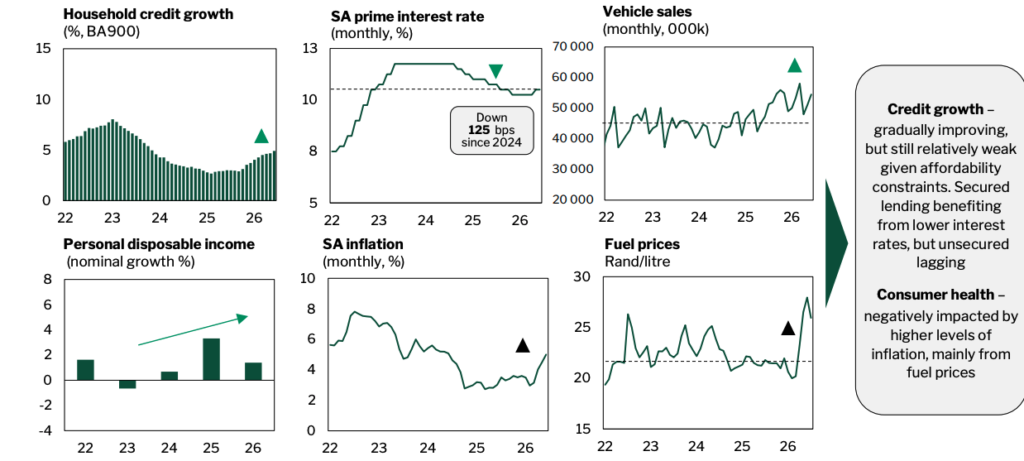
This is despite the tables turning on the bank with regard to the performance of the South African economy, rising inflation, and an unstable geopolitical environment.
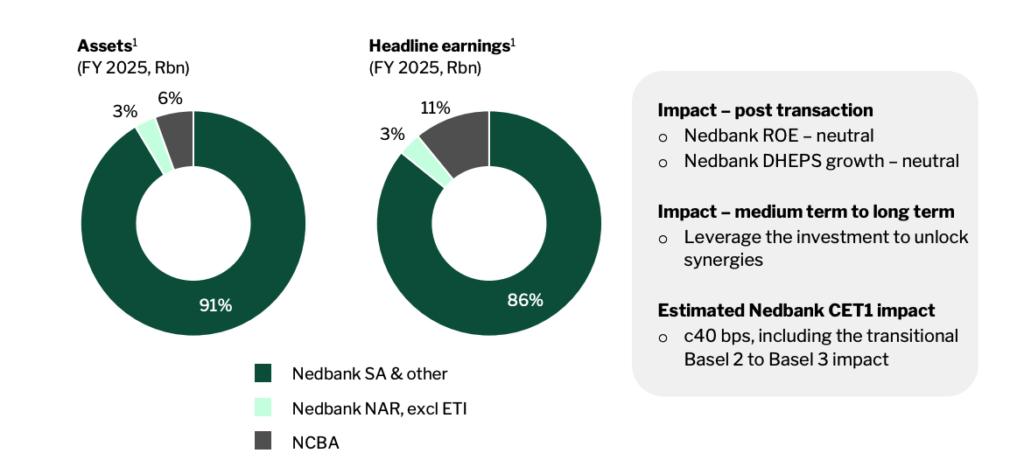
Nedbank is heavily exposed to the South African economy relative to its peers, with 91% of its assets being held in the country.
This stands in contrast to its historical peers, such as Standard Bank, FirstRand, and Absa, which have a significant presence in the rest of Africa.
Nedbank is trying to change this through its acquisition of 66% of East African lender NCBA, which will give it a foothold in faster-growing economies on the continent.
However, the bank’s financial results for the first half of 2026 were still very much a reflection of its operating environment in South Africa.
Nedbank expected South Africa’s economy to grow at up to 1.8% in 2026, with inflation hovering around the Reserve Bank’s 3% target.
Six months into the year, and this picture has changed, with Nedbank CEO Jason Quinn forecasting 1.4% GDP growth and inflation averaging 4%.
This means that banking conditions did not improve as expected, putting pressure on Nedbank’s financial performance.
The bank weathered this shift well, with its financial performance exceeding its expectations at the start of the year as its restructuring drives strong underlying growth.
Headline earnings for the six months ended 30 June were flat year-on-year at R8.4 billion. However, this is largely because of a higher impairment charge and no recognition of associate income from Ecobank (ETI).
Nedbank disposed of its 21% stake in the West African lender in 2025 as it looks to pivot to East Africa and have full control of its banking operations on the continent.
Excluding ETI, headline earnings grew by 12% year-on-year, indicating a far stronger underlying performance. Diluted headline earnings per share growth was also very strong at 15%.
The bank’s return on equity remained above its cost of capital at 15% and exceeded expectations from earlier in the year. Nedbank declared an interim dividend of 10.52 rand per share.
Quiet revolution
Nedbank has undergone a significant restructuring process since Jason Quinn took the CEO job in May 2024, with it overhauling how it does business.
Mimicking the structure of some of its peers, Nedbank split its Retail and Business Banking cluster into two separate units – Personal and Private Banking and Business and Commercial Banking.
Nedbank CFO Mike Davis previously explained to Daily Investor that the business units prior to the split were unable to meet client demand.
“We recognised that it was difficult to sell products into the retail client base, given the fact that it sat across clusters. The other thing was that our private banking business was split across retail and Wealth,” Davis said.
This change has begun to yield benefits, with Nedbank seeing the positives in its financial results from increased client engagement and better service levels.
“In 2025, we took bold steps to become more client-centred, unlock growth and diversify earnings,” Quinn said.
“This included implementing and finalising the strategic organisational restructure, progressing the integration of Eqstra, and concluding the acquisition of iKhokha.”
These two businesses are housed under the Business and Commercial Banking unit, led by former FNB stalwart Andiswa Bata.
Bata is looking to leverage Nedbank’s strong balance sheet to turbocharge the growth of these businesses and, in the case of iKhokha, win over small businesses.
At a higher level, the other major pivot under Quinn has been the sale of Nedbank’s 21% shareholding in ETI, ending its exposure to West Africa.
This was coupled with Nedbank announcing its intention to acquire 66% of NCBA to support growth in East Africa.
Its offer has been well received by NCBA shareholders, with it being accepted by enough for Nedbank to reach its 66% shareholding in the bank.
NCBA is a giant in its own right, with 60 million clients and managing R84.4 billion in assets. Nedbank said that the bank distributes R126.9 billion in loans on an annual basis.
This acquisition will reduce Nedbank’s exposure to the slow-growing South African economy and give it a foothold in East Africa, a region that is set to be highly lucrative for banks.
Nedbank is funding 80% of the transaction by issuing new Nedbank shares to those who take the offer, and the remaining 20% will be paid in cash.





Comments