Foschini identifies 300 stores to be shut down in South Africa


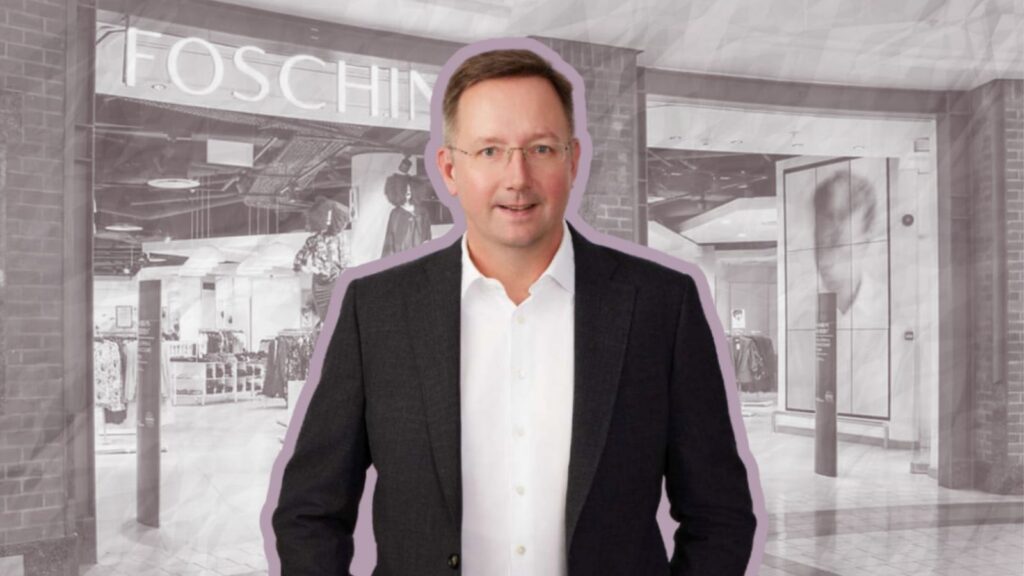
The Foschini Group (TFG) has identified 300 underperforming and marginal stores within its network and closed 100 in its 2026 financial year.
This will lead to a sustained reduction in the retailer’s cost base, which grew faster than its sales in the 2026 financial year.
Consequently, TFG was forced to hold back R600 million in capital expenditure and implement significant short-term savings across Africa, Australia, and the United Kingdom.
TFG is hoping that closing its loss-making stores will prevent this from happening again. The strong growth of its Bash e-commerce platform enables this rationalisation.
In its Integrated Report for the year 31 March 2026, TFG CEO Anthony Thunström said the retailer’s strategic recalibration is well underway.
This recalibration, he said, is the natural evolution of TFG’s BOLTS strategy, which stands for Build Out, Optimise, Leverage, Transform, and Sustain.
TFG has been implementing this strategy for the past five years, and it is now substantially complete.
“Great businesses and brands have been built and invested in – the imperative now is to align the platform with the realities of the current environment,” Thunström said.
TFG’s profitability and returns have come under pressure. Its annual profit declined from R2.91 billion in 2022 to R1.32 billion in the 2026 financial year.
This was largely driven by significant impairments and a quickly rising cost base, driven by multiple acquisitions that saw the retailer take on higher levels of interest-bearing debt.
As a result, TFG’s finance costs have nearly tripled over the past five years, going from R783.8 million in the 2022 financial year to R2.05 billion in 2026.
Thunström explained that TFG’s relatively high fixed-cost base, which is expected given its multi-brand model, places significant pressure on the retailer’s operating margins.
In times when turnover and gross margins are already under pressure from factors outside TFG’s control, the high fixed cost-base becomes a problem.
Thunström pointed out that the inverse is also true when trading conditions improve, but TFG cannot wait for clear skies before taking action.
“Given the very uncertain global outlook, we cannot and will not simply wait for conditions to improve,” he said.
“We are taking the decisive, strategic action required now to protect and improve profitability, productivity, and capital returns.”
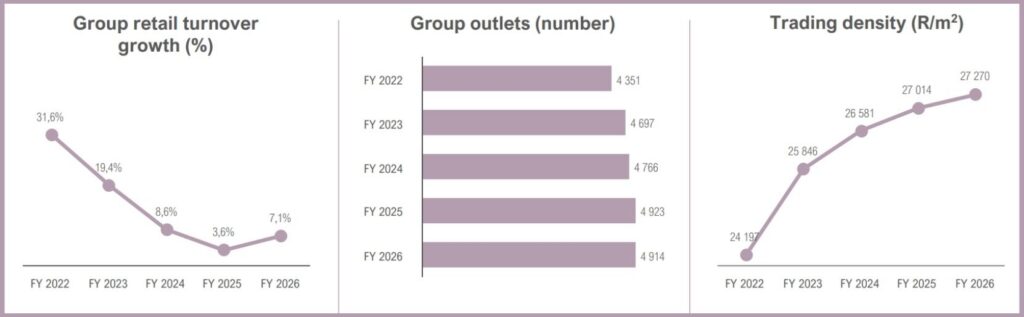
Pinning hope on e-commerce
Thunström said TFG now has four priorities to reset its profitability and returns. A major part of this strategy hinges on its e-commerce platform, Bash.
Launched in February 2023, Bash has become a notable catalyst for e-commerce growth over the past few years.
In 2022, online retail turnover contributed only 3.1% to TFG’s Africa segment’s total turnover. In 2026, online sales exceeded 10% of TFG Africa’s sales.
Thunström explained that TFG now wants to leverage Bash’s success and fulfilment capabilities to make its business more efficient.
With Bash growing at 49% year-on-year at equivalent gross margins to TFG’s stores business, he said the economics of physical expansion are changing.
“The additional R1.1 billion in Bash sales this year would have required opening more than 100 new stores, at approximately R500 million in capex and inventory investment,” he said.
“Going forward, we will leverage Bash and our fulfilment capabilities to drive a more capital-light model, reducing new store requirements while preserving and growing revenue.”
Essentially, TFG will be closing a lot of stores over the next few years. It already closed 100 in the 2026 financial year, and has identified 300 underperforming and marginal stores.
At the same time, TFG plans to simplify its brand architecture in Africa, a strategy that forms part of its “Project Vela”.
Project Vela is TFG’s programme to organise brands into operating ‘stacks’, with the next phase involving simplifying its brand structures.
This means removing brands’ layers and improving agility, with marginal brands folded into more efficient operating models.
This, along with store closures, will shrink TFG’s cost base, which grew faster than its sales in the 2026 financial year thanks to new store costs and inflationary pressure.
Aside from these initiatives, TFG will also implement tighter control of its capex and inventories, an aggressive reduction in structural operating expenses, and cut corporate overheads.
“Al-enabled process automation and decision-support is already contributing to cost efficiencies, and we expect this contribution to increase materially over the next few years,” Thunström said.
TFG Chairman Michael Lewis said the retailer is operating in times of great economic, financial, and geopolitical uncertainty.
This, the stringent action now underway to cut costs, simplify TFG’s operating model and rationalise its brand and store portfolios, will leave the business in a better position.
He believes these initiatives will limit the impact of these adverse conditions on TFG’s profitability.




Comments