Eskom and municipal price increases make it difficult to reach 3% inflation target


The Reserve Bank’s efforts to bring inflation back to its 3% target are complicated by government-run entities raising prices by double or triple that rate.
These price increases, chiefly from Eskom and municipalities, are also sticky, which means they contribute to rising prices in other parts of the economy.
This entrenches inflation at an elevated rate, leaving the Reserve Bank with little to do other than hike interest rates and make it clear that inflation will be brought back to 3%.
Symmetry chief investment strategist Izak Odendaal explained that this is done in the hope that inflation expectations will move lower.
As expectations move lower and South Africans become accustomed to 3% inflation, price increases above this rate will become less sustainable.
Odendaal said this will take time, which is something the Reserve Bank does not appear to have in abundance.
The bank’s Monetary Policy Committee (MPC) left interest rates unchanged on 23 July, surprising markets and weakening the rand.
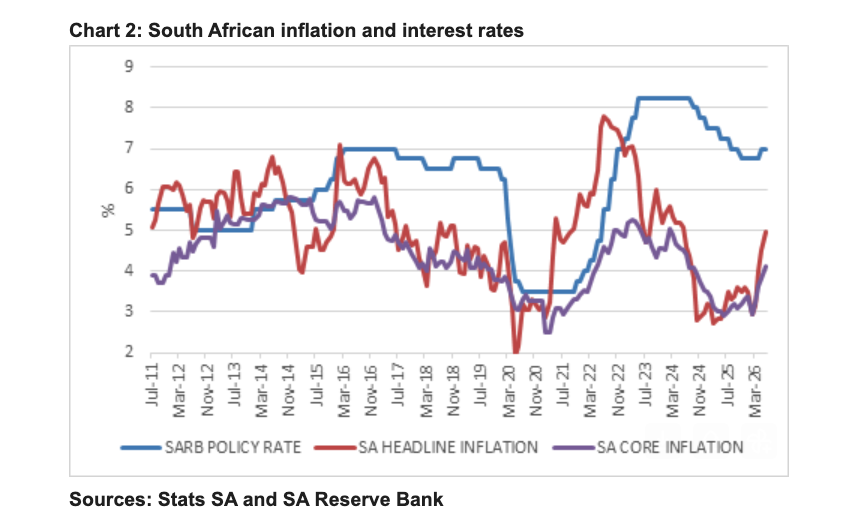
“The market expected an increase, not just because of crude oil prices. June’s inflation data, released earlier in the week, also showed that core inflation increased,” Odendaal explained.
“While the increase in headline inflation to 5% in June from 4.5% in May was due to fuel inflation, the increase in core inflation to 4% suggests some passthrough from higher fuel prices to other goods and services.”
Despite this surprise, Odendaal noted that there is a case for adopting a wait-and-see approach due to the volatility of oil prices.
Interest rates in South Africa are also already elevated to historic levels, and the rand has remained relatively stable throughout the war.
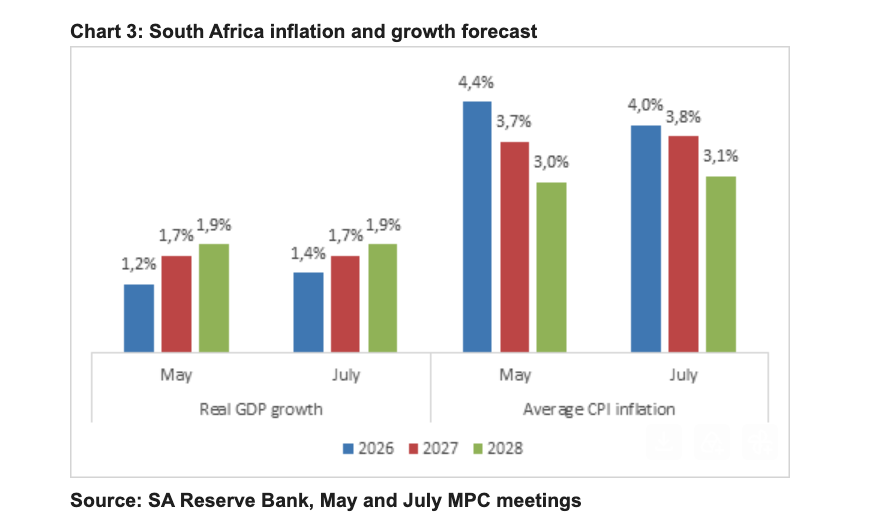
The bank’s forecasts indicate that inflation will average 4% this year, lower than what it expected in May. However, it said that inflation will take longer than expected to return to the 3% target.
This suggests that it could take a bit longer for the first rate cut to arrive, with inflation on course to hit the target in the first quarter of 2028.
Odendaal explained that state-run institutions greatly complicate the Reserve Bank’s challenge in combating inflation.
“It remains highly ironic that the government chose the 3% inflation target, but public entities, notably Eskom and municipalities, are the biggest culprits in pushing through massive price increases that are double or triple the targeted inflation rate,” he said.
“However, the more we all become accustomed to the idea of 3%, the more difficult it will be for these entities to simply force these cost increases onto consumers.”
The miracle
The move to a lower inflation target, if the Reserve Bank can maintain it, will be immensely beneficial for the South African economy.
Odendaal explained that the 3% target is the Reserve Bank’s North Star. Everything it does is geared toward maintaining its credibility by meeting the goal.
The path there, however, is far from straightforward and will result in some pain for South African consumers and businesses.
“While the 3% target implies elevated interest rates over the next 6 to 12 months, they can decline to structurally lower levels thereafter,” Odendaal explained.
Odendaal estimated that the policy rate, which was formerly the repo rate, will settle at 5.5% to 6%. This is about 1 percentage point below the current level of 7%.
“Lower interest rates will, in turn, be positive for local interest-rate sensitive assets, including bonds, property and financial shares,” he said.
“Given that these all still trade on elevated yields, the longer-term return prospects are enticing for local and international investors.”
More importantly, the lower inflation target will bring South Africa in line with its trading partners, improving its economic competitiveness. This will also result in a more stable currency.
“Some might see this as being far-fetched, but so was the idea of achieving a 3% to 6% inflation target when it was first introduced in 2000,” Odendaal explained.
Inflation was consistently in the double digits in the 1970s, 1980s and 1990s, making a target range with 6% at its upper end seem ridiculous.
Researchers at the Bureau for Economic Research estimate that a lower inflation target can result in additional GDP growth of over 0.25% per year within five years.
For the government, a lower inflation target means lower debt-servicing costs, saving the state R130 billion worth of interest payments in the first five years and R600 billion over a decade.



Comments