ANC chased South Africa’s most iconic company out of the country


The ANC has broken South Africa’s mining industry by implementing policies hostile to investment, with companies choosing to reduce their exposure to the country despite its rich mineral resources.
This has seen exploration investment plummet, thousands of jobs lost, and giants like Anglo American leaving the country for more predictable jurisdictions.
These policies have created a handful of extremely rich individuals who benefit from their political connections, while leaving the broader industry a shadow of its former self.
The Institute of Race Relations’ (IRR) head of policy research, Anthea Jeffery, explained how South Africa’s mining sector has been crushed by ANC policy.
Jeffery told the Free Market Foundation that the mining sector has gone from being South Africa’s economic backbone to being uninvestable in the past 20 years.
This has been driven by the consistent ramping up of unrealistic Black Economic Empowerment (BEE) requirements to operate and mining policies that are hostile to investment.
“Mining is one of the areas in which South Africa can do very well, particularly in this environment where critical minerals are in high demand,” Jeffery said.
“But, South Africa has had, since 2004, a very damaging mining statute, which effectively gave the state control of all mineral resources still below ground.”
This has been described as a form of nationalisation of the sector by giving the government complete control and ownership over South Africa’s mineral resources.
“This meant that everybody had to apply for new mining rights despite operating in the country for decades,” Jeffery said.
“The state used this opportunity to impose its BEE requirements, which are simply unrealistic and have hugely enriched ANC politicians but made the mining sector uninvestable.”
South Africa’s mining sector is a shell of what it used to be, with it losing thousands of jobs and billions of rands worth of value since 1994.
Research from the IRR shows that there were 118 mining companies listed on the JSE since 1994. By 2012, there were 69 and by 2025, only 39.
Over the same period, mining exploration investment fell from R6.3 billion in 2006 to R0.7 billion in 2025. This means that companies are no longer searching for minerals in South Africa.
This is despite there being strong evidence of a rich mineral bounty in South Africa. The country has 88% of platinum group metal reserves, 80% of manganese, and 72% of chromite.
Chasing companies out of South Africa
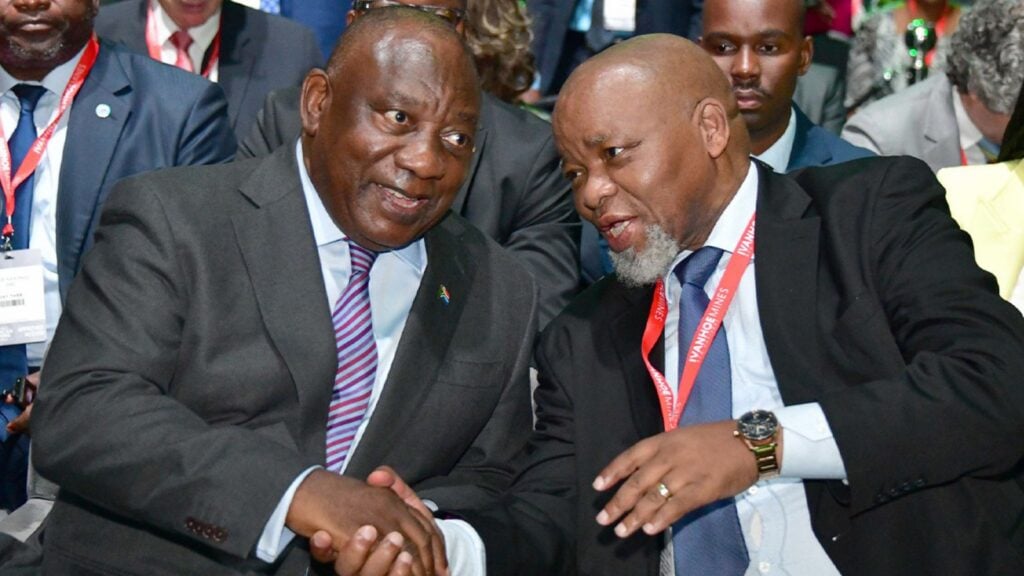
No mining company has been left unscathed by the ANC’s destructive policies, with even the giant Anglo American seeking shelter in London.
Before the ANC implemented these policies, Anglo American was one of the largest companies in the world and dominated the South African economy.
The Oppenheimer-built company employed hundreds of thousands of South Africans and was the largest single contributor to the fiscus, and drove the industrialisation of the country.
However, despite Harry Oppenheimer fighting against it, the company was pushed out of South Africa by the ANC’s mining policies and close alliance with trade unions.
Today, Anglo American’s only presence in South Africa is Kumba Iron Ore, which operates mines in the Northern Cape.
It has unbundled its coal assets into Thungela and separated its platinum business, which is now Valterra. More recently, its subsidiary, De Beers, shut its only South African diamond mine.
Anglo’s merger with Teck Resources will move its headquarters to Vancouver and reduce its South African presence further.
Modern Corporate Solutions mining analyst Peter Major told BizNews that Anglo will soon leave South Africa completely as it completes a decades-long process to reduce its exposure to ANC policy.
“We are talking decades later. Anglo effectively left this country in 1999. I think the claws were out for them along with the grinders and the hacksaws,” Major said.
“The unions and the ANC said in the 1980s what they were going to do to Anglo when they came to power.”
“They put the fear of God into everybody related to Anglo, including investors, and so when they had the chance to leave in 1999, they took it.”
Major recalled that the Oppenheimer family could not win over Anglo’s executives, who saw the writing on the wall and wanted to avoid what happened in other parts of Africa.
“I give them credit, they read the situation pretty well, having seen what happened before in Zambia, Uganda, and Zimbabwe when mines were nationalised,” Major said.
Major expects Anglo to keep ownership of Kumba Iron Ore, which operates in South Africa, as it is relatively easy to control and run.
However, he expects Anglo to sell the asset if a good offer comes in for the company, whether it be to take it private or from a competitor.



Comments