Spur steak for 50 cents



A South African could enjoy a 300g Cheddamelt steak from Spur for R0.50 in the 1970s. Now, the same steak goes for R254.90.
This is thanks to inflation, which has steadily eroded the purchasing power of South Africans using rands since the currency’s inception in 1961.
The example of the change in price of a single product is useful to demonstrate the impact of inflation over a period of time.
In the short term, an inflation rate of 5% may seem small and insignificant. However, compounding over decades, it can have a significant impact.
Symmetry chief investment strategist Izak Odendaal said that this also shows the importance of investing your savings well to ensure they beat inflation.
By beating inflation, your savings and investments will maintain your purchasing power and grow it over time, enabling you to retire with a good lifestyle.
“The great villain of investors is inflation. As prices rise, the value and quality of the goods and services your money can buy decline,” Odendaal explained.
Instead of using a single product to display the impact of inflation on a South African’s savings and investments, Odendaal used the value of a basket of goods that cost R100 in 1961.
In 1961, the rand was introduced in South Africa and replaced the South African pound as legal tender in the country. An average basket of the most-purchased goods at the time cost R100.
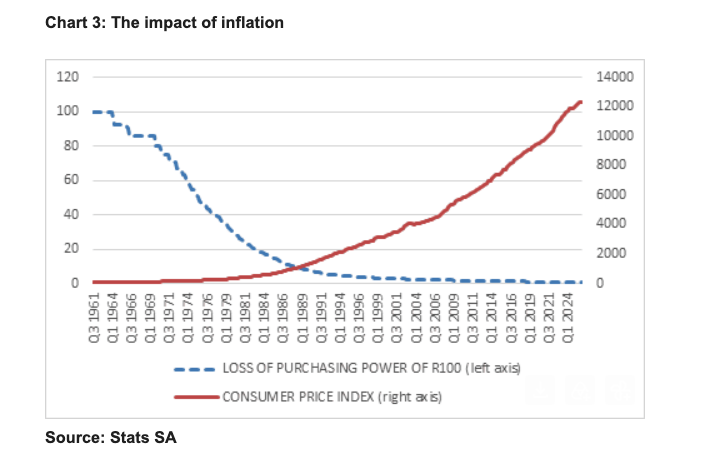
The same basket that cost R100 in 1961, when the rand was introduced, will cost R12,365 today. Though the composition has changed, this shows the impact of inflation on the value of money.
The buying power of R100 has declined significantly since 1961. Today, R100 only gets you 0.8% of what you could get in 1961.
This can be seen in the graph below, which displays the inflation index, which measures the cost of the average basket of goods and services of an urban household.
The inflation index is compared to the purchasing power of R100 from 1961 until the present day, highlighting the impact of inflation.
Equities are the answer
The impact of inflation on the value of money underscores the importance of investing in assets that consistently outpace inflation over time.
This enables one to grow wealth, improve their purchasing power, and eventually retire with a high quality of life at the right time.
Local and global equities have been the most effective method of outpacing inflation over the past 100 years, with investors being handsomely rewarded for their patience.
Odendaal’s calculations show that the South African stock market turned R100 of today’s money into R229,000 over the past century. The US equity market turned $100 into $317,000 over the same period.
This period includes many significant events that would have caused widespread panic among investors and across financial markets.
In South Africa, the past century included the rise and fall of apartheid, global isolation and reintegration, significant uncertainty, and several mining booms and busts.
“There were many hairy moments along the way. At no point did it feel inevitable that the market would continue rising, just as it doesn’t today,” Odendaal said.
However, the data show that over the long run, equities are on a relentless march upwards, despite short-term volatility.
In the current environment, fears of a shifting geopolitical order, climate change, and artificial intelligence are concerns for investors.
The data show that if money is left to compound in equities around the world, its growth will outpace inflation. It is critical that the compounding process is not interrupted.
“Where do the riches come from? Not from the gods of Olympus, but from the magic of compound growth,” Odendaal explained.
“Equity prices are driven by sentiment in the short term and can fluctuate wildly over days, weeks, and months.”
Over years and decades, equity prices rise because the profits of underlying companies grow over time. This is partly because companies can capture the inflation that is so deadly to households.
More importantly, companies continuously look for innovative ways of growing their revenues and expanding their margins.
A portion of the profits they generate is ploughed back into growing the business, and the rest is paid out as a dividend. Investors can use these to buy more shares that will pay more dividends, to buy more shares and so on.






Comments