Top South African company kisses R75 billion goodbye


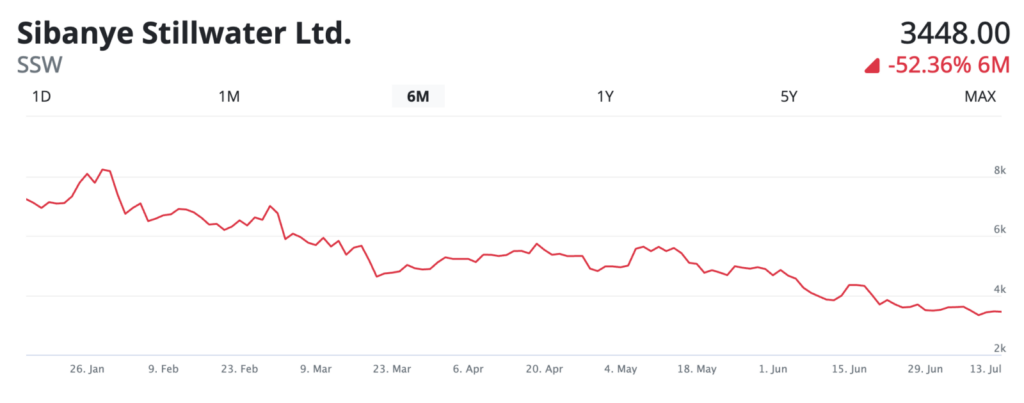
The share price of Sibanye Stillwater experienced significant turbulence during the first six months of 2026, with its trajectory mostly downhill since a January spike.
Formed in 2013 from the unbundling of Gold Fields, the company began life as a gold miner before branching out to other precious metals such as platinum and palladium.
The Johannesburg-based mining company’s share price on the JSE has plummeted by 43% since the beginning of the year, now sitting at around 3,422ZAC per share.
Year-to-date, this has caused the company to shed R74.86 billion in market capitalisation, bringing its value down to R97.29 billion.
Measured from the company’s most recent peak in late January, the destruction of value has intensified, with an estimated R109.88 billion in market value lost.
It is important to note, however, that this comes after the company saw its market capitalisation increase by more than 200% over the course of 2025.
Sibanye’s steep decline in value throughout the first half of 2026 followed a significant rally toward the end of January, which saw its share price peak at around R82.23 per share.
The surge was attributed mostly to rebounding platinum group metal (PGM) prices and record-high gold prices over $5,000 per ounce.
This rebound pushed Sibanye to pay out its first dividend since 2023, with shareholders receiving R3.7 billion despite the company reporting a net loss in 2025.
Afriforesight’s Head of PGMs and Battery Commodities, Kirthi Ramdhanee, expressed optimism at the time about the sector’s viability in an interview with BusinessDayTV.
“A year ago, we were sitting at very low levels, just under $1,000 per ounce for platinum,” Ramdhanee said. “Today, we see platinum at around $2,100 per ounce.”
“This is more than double. The reason for this is heightened geopolitical tensions. We saw US tariffs come in over the last year, and wars raging in different countries.”
Ramdhanee pointed to the announcement of a multi-year deal between Sibanye-Stillwater, Johnson Matthey, and Valterra Platinum as a sign of positive growth prospects for the PGM sector.
Why Sibanye-Stillwater’s share price plummeted
The company’s value would begin a steady decline soon after the outbreak of the conflict in the Middle East between the United States and Iran.
The subsequent spike in oil prices, caused by the closure of the Strait of Hormuz, led many to move away from volatile commodities such as PGMs.
Many shifted instead towards safe-haven assets, with the US dollar in particular seeing significant strengthening on the back of inflationary pressures.
This saw the price of metals such as platinum and palladium drop drastically, as global supply chains were interrupted and demand decreased significantly.
Gold also saw its value drop significantly during the conflict over fears of potential interest rate hikes, eschewing its usual status as a safe-haven commodity.
In a follow-up interview with BusinessDayTV, Ramdhanee explained that the uncertainty created by the war had caused many people to stop buying into PGMs and gold.
“In terms of investment, there are other avenues,” Ramdhanee explained. “We saw a lot of investors flock to the dollar instead of holding platinum and gold.”
“Selling platinum and gold was an easy way to get money to cover shortfalls in other investments, so we did see people sell their platinum ETFs just to have some cash on hand.”
This heavily impacted investor confidence not just in Sibanye-Stillwater but in many other major South African mining companies across the PGM sector.
Impala Platinum and Valterra Platinum, two of South Africa’s largest platinum producers alongside Sibanye, have also seen their share prices steadily decline in 2026.
Despite the volatile market conditions, Sibanye-Stillwater said it plans to continue moving ahead with its ambitious goals under new CEO Richard Stewart.
One of these goals involves halving the company’s gross debt over the next two to three years, something which Stewart believes would significantly boost its share value.
But while Stewart told Currency this 50% reduction could be achieved within the next year and a half, he said this would depend on PGM prices not declining too much further.
Currently, platinum prices still remain substantially higher than they were towards the beginning of 2025 before the price surged.
Sibanye-Stillwater’s share price over the past six months





Comments