The state-owned company that has had only three CEOs in 28 years


Since its establishment in 1998, the South African National Roads Agency (SANRAL) has only had three permanent CEOs.
This is a departure from other state-owned enterprises (SOEs) in South Africa, many of which have struggled to maintain stability at the top.
SANRAL’s number of CEOs is set to grow to four in the coming months following the resignation of Reginald Demana, effective 31 August 2026.
Heading up SANRAL is a difficult job, as the SOE is charged with financing, improving, managing and maintaining the national road network.
Before SANRAL was established, the national road network was managed directly by a branch within the Department of Transport, named the South African Roads Board.
When South Africa became a democracy, the newly elected ANC government under former President Nelson Mandela wanted to corporatise public infrastructure management.
Thus, SANRAL was born, with the SOE formally established in May 1998 under the South African National Roads Agency Limited and National Roads Act.
From the get-go, SANRAL was set up as an independent, statutory public company, registered in terms of the Companies Act.
When SANRAL was established, it inherited a solid and extensive road network, spanning 7,000 km by the late 1990s. While extensive, the network was also ageing and required maintenance and upgrades.
Since then, South Africa’s road network has grown significantly, now standing at 23,500 km, and SANRAL’s job of overseeing the country’s “economic arteries” has only become more difficult.
In the 1990s, much of South Africa’s public funds were prioritised towards social spending like housing, healthcare, and education, leaving little remaining for infrastructure like roads.
This is why, in the late 1990s and 2000s, SANRAL introduced and consolidated the concept of Public-Private Partnerships (PPPs), pioneering it in South Africa and across the wider continent.
Faced with a lack of funding, SANRAL, under CEO Nazir Alli, brought in private concessionaires to bid for the right to manage a major highway corridor.
These concessionaires would then raise the funds to build or upgrade roads and would be responsible for maintaining their networks.
In exchange, private companies are allowed to collect tolls from road users, ensuring they recoup their investments and make a profit.
SANRAL’s PPP model culminated in the internationally acclaimed Maputo Development Corridor, a highly complex cross-border partnership between South Africa and Mozambique.
This corridor was built by a private concessionaire, Trans African Concessions, and linked Gauteng’s industrial heartland to the port of Maputo, thereby improving regional trade.
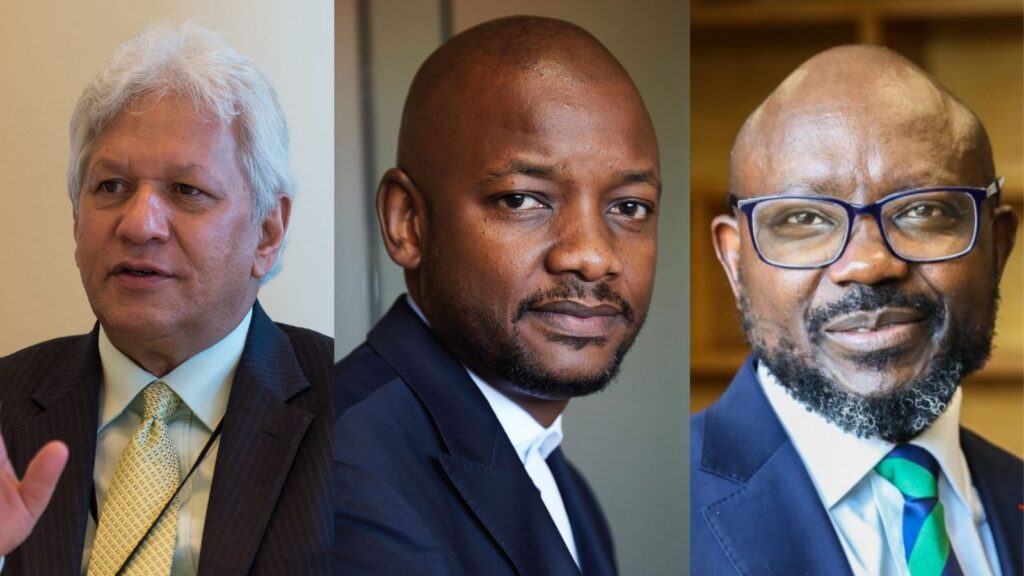
SANRAL’s CEOs
SANRAL’s pioneering spirit under Alli served it well in the late 1990s and early 2000s, but the company started to run into trouble in the late 2000s.
This is when SANRAL, still under Alli’s leadership, introduced the Gauteng Freeway Improvement Project (GFIP), also known as the e-toll project.
The GFIP was introduced as a way to ease severe congestion on Gauteng roads, particularly in Johannesburg and Pretoria.
This project saw SANRAL upgrade the Gauteng highway network and implement an electronic, open-road tolling system, known as e-tolls, in December 2013.
The backlash was swift and severe, with the GFIP facing resistance from the public, civil society groups, and trade unions, who refused to pay.
Compliance rates hovered below 20% for years, as citizens refused to comply and the state lost its power to enforce the new system.
Ultimately, after a decade-long standoff between the government and the public, the e-toll project was officially shut down in April 2024.
However, this fiasco left SANRAL with a huge debt burden, with the SOE requiring a R47 billion bailout from the National Treasury and the Gauteng Provincial Government.
In addition, it led to SANRAL’s founding CEO, Alli, tendering his resignation in May 2012 following a high-profile court verdict that temporarily halted the GFIP.
This resignation was short-lived, as the government rejected Alli’s departure at a time when SANRAL needed operational stability. Alli ultimately only left his position in 2015, when he retired.
Skhumbuzo Macozoma succeeded him as SANRAL CEO in 2016 and served in this role for 5 years until his departure in 2021, when his contract ended.
Macozoma’s tenure was challenging, as the CEO had to navigate SANRAL’s severe liquidity constraints following the GFIP. In January 2023, Macozoma was succeeded by Reginald Demana, who recently resigned.
Finding a new SANRAL CEO

In July 2026, Demana tendered his resignation, saying he would be transitioning to a new role in the financial services sector. He will not complete his five-year contract, which was set to end in 2028.
This move was not surprising, as groups like the Organisation Undoing Tax Abuse (OUTA) said Demana was faced with a disruptive environment and interference from the previous SANRAL board.
During his tenure, Demana helped to secure significant infrastructure funding for SANRAL as the SOE was still recovering from the GFIP shutdown.
OUTA CEO Wayne Duvenage said Demana did not have an easy job, and that he is surprised the chief exec held onto the position for as long as he did.
“Leading an SOE is challenging enough, but leading one where the board appeared to have involved itself in operational matters and constantly overreaching made his job far more difficult,” Duvenage said.
“Frankly, I’m surprised that Demana even stayed for as long as he did. He really had an untenable and tough job from what we could see.”
Duvenage said SANRAL is now tasked with filling Demana’s position with someone capable of leading the embattled SOE.
He said it is important for SANRAL to function well, as South Africa’s economy benefits from strong and dependable road infrastructure.
“We hope the board will be able to find a CEO with unquestionable integrity and strong governance and leadership to rebuild SANRAL,” he said.
“It has collapsed a bit over time, and it needs to restrengthen its engineering excellence, financial oversight, and public confidence and how it manages billions of rands of taxpayers’ money.”
The table below shows SANRAL’s three permanent CEOs since its founding and their tenures.
| CEO | Tenure |
| Nazir Alli | 1998 to 2016 |
| Skhumbuzo Macozoma | 2016 to 2021 |
| Reginald Demana | 2023 to 2026 |



Comments