South Africa’s private education giant where 16 out of 31 junior Springboks studied


STADIO recently revealed that 16 out of South Africa’s 31-strong junior Springbok squad studied at the institution.
This comes as STADIO continues to go from strength to strength, with the private education giant striving to become South Africa’s second-biggest higher education provider after the University of South Africa (UNISA).
STADIO is a JSE-listed company that provides higher education to over 55,000 students across 16 campuses and distance learning support offices.
The group offers more than 100 accredited qualifications, ranging from higher certificates, degrees, and postgraduate degrees, and has plans to achieve university status in the coming years.
In December 2025, STADIO also became the official higher education partner to SA Rugby, kicking off its partnership with the Springboks.
As a higher education partner, STADIO supports South African rugby players’ educational and development initiatives across all SA Rugby national teams.
This includes the Springboks, Springbok Women, Springbok Sevens, Springbok Women Sevens, Junior Springboks, and SA pathway teams.
“We believe that helping these athletes obtain a degree will create meaningful ripple effects,” STADIO CEO Chris Vorster said when announcing the partnership.
He said the collaboration will not only benefit the players themselves, but also their families, communities, and the young people who look up to them.
“It is extremely important for us to ensure players are well-rounded, with career options beyond rugby,” SA Rugby President Mark Alexander said.
“Having a partner like STADIO, one that commits to both sport and education, is crucial, and strengthens our ability to provide meaningful opportunities for all players.”
So far, this partnership appears to be off to a great start, with STADIO’s most recent Annual General Meeting (AGM) revealing that more than half of the junior Springbok squad studied at the institution.
“It’s also very exciting for me to announce that 16 out of the 31 junior Springboks that have just been selected to represent South Africa in the upcoming junior World Cup studied at STADIO,” Vorster said.
“So, 16 out of the 31 – those are 16 new ambassadors for the STADIO brand.”
STADIO’s big dreams

STADIO’s successful partnership with SA Rugby comes as the company continues to go from strength to strength, now boasting more than 55,000 students.
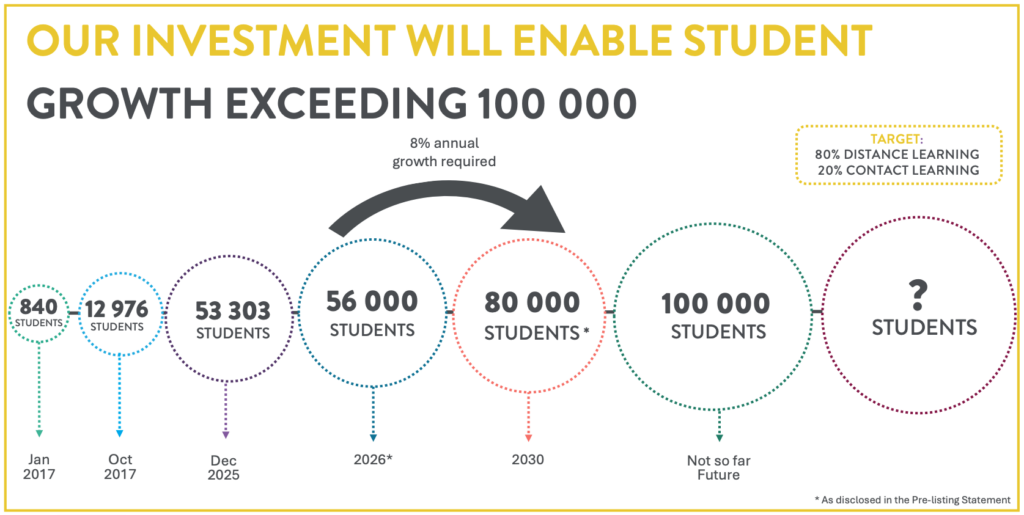
This puts the company well on track to reach its goal of 56,000 students in 2026 and 80,000 students by 2030.
At the AGM, Vorster said STADIO is well-positioned for accelerated growth in the coming years, with the company aiming to become South Africa’s largest higher education provider outside UNISA.
Currently, UNISA is by far South Africa’s biggest university, boasting more than 370,000 distance-learning students.
When it comes to traditional contact universities, the Tshwane University of Technology takes the lead, with around 60,000 students.
This is followed by North-West University, which boasts about 54,000 students, and the University of Pretoria, with roughly the same number.
Considering that STADIO has achieved a compound annual growth rate of more than 10% over the past five years, its ambition to become the second-biggest higher education provider in South Africa may not be far off.
“Although the market expects us to get to 80,000 students by 2030, we believe with these new growth initiatives and investments that we are going to make this year, we want more than 80,000,” Vorster said.
In fact, he said STADIO has taken the necessary steps to reach 200,000 or more students.
“We believe that the 80,000 students we’ve targeted to reach by 2030 might come earlier if we are successful with all these investment projects. And the 100,000 students target should then not be so far in the future,” the CEO said.
A year of investment
Vorster said 2026 is the year for STADIO to make big investments in its growth aspirations, with the company now at an inflexion point.
He explained that the foundation-building phase of its business is largely completed, and the company can now turn its attention to accelerating growth and achieving its lofty ambitions.
To aid in this new phase of growth, STADIO has appointed three CEO that will take over its three brands – STADIO Higher Education, AFDA, and Milpark Education.
“This will free up the time of the holdings executives to go out and explore new markets and new geographical areas where we think there is a market for us,” Vorster explained.
He said the company will look to expand into more markets in and outside of South Africa, which could include future mergers and acquisitions.
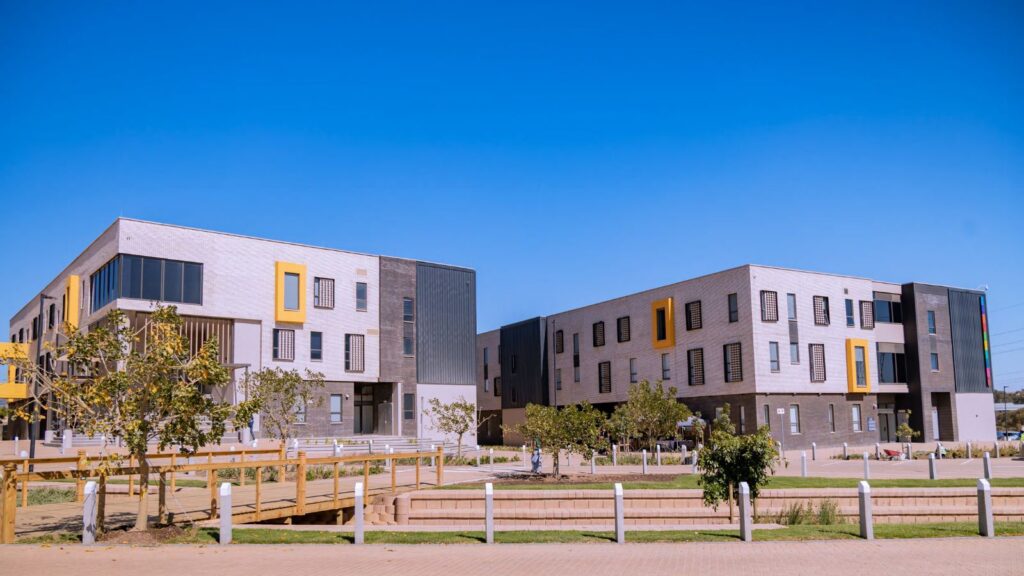
Another major source of growth for STADIO in the coming years will be its new mega-campus in Durbanville, Cape Town.
This campus has already seen more than 1,300 enrolments, despite only having opened its doors to students in January 2026.
Construction at the campus is also still ongoing, having started in 2024 and taking place in phases. The first phase set the group back R205 million, with the total estimated cost of the campus being R325 million.
Once completed, the Durbanville campus will have the capacity to accommodate between 4,000 and 5,000 contact-learning students, while also serving as a regional support centre for STADIO’s distance-learning students.
The second phase of the campus development is currently underway and is expected to be completed in August 2026.
In the meantime, STADIO’s older mega-campus in Centurion continues to grow rapidly, now boasting more than 2,300 students.
Alongside its goal to reach 80,000 students by 2030, STADIO is also targeting a specific composition of 80% distance-learning students and 20% contact-learning students.
In this regard, the group’s mega-campuses will be key in ensuring continued growth in contact-learning students, while STADIO’s continued investment in technology will boost its distance-learning capacity.





Comments