One South African bank moves R300 million every minute


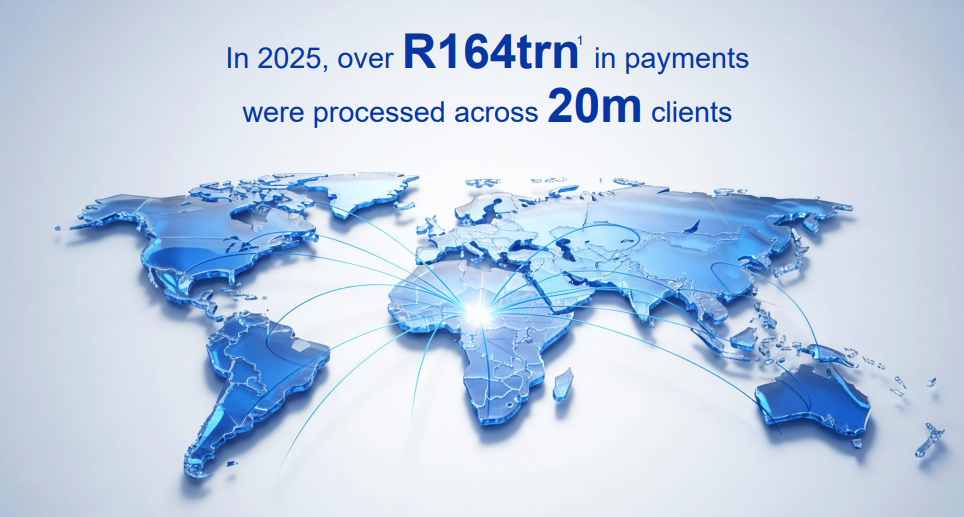
Standard Bank says it processed more than R164 trillion in payments across Africa in 2025, with 2.3 billion payments taking place on its platforms.
This figure, which includes inter-bank transfers and those with correspondent banks, means that more than R300 million flows through Standard Bank’s infrastructure every single minute.
The bank’s COO, Margaret Nienaber, revealed this at Standard Bank’s 2026 Capital Markets Day, where it unveiled its new medium-term strategy.
This strategy will be CEO Sim Tshabalala’s last big test as leader of Africa’s biggest lender by assets and aims to build on the transformation at the bank over the past five years.
The strategy is based on the bank’s ability to capitalise on Africa’s surging economic growth, with it facilitating the continent’s expenditure in infrastructure and trade.
One of the other key drivers Standard Bank identified was the evolution of Africa’s financial services landscape, particularly the shift towards digital transaction channels.
This presents a substantial opportunity for a bank, enabling it to generate significant capital-light revenue and reduce the cost to serve clients.
Nienaber explained that the bank will do this by investing heavily in its technology stack, which is significant considering Standard Bank’s scale.
However, Nienaber first addressed where the bank is today with its technical systems, noting that they are under scrutiny following a series of outages in 2021 and 2022.
These outages ultimately led to chief engineering officer Alpheus Mangale leaving the bank, and to Nienaber taking responsibility for its technical operations.
The bank has also faced questions from investors regarding its shift away from legacy systems and operating its own data centres to using cloud-based services to improve its operating leverage.
Nienaber explained that over the past two years, the bank has migrated 71% of its operations to the cloud and decommissioned 88% of its legacy servers.
This enabled it to shrink its physical data centre footprint by 27% and reduce outages by 98%.
More importantly, Nienaber said this allowed the bank to scale its systems efficiently and ensure they operate at a scale that only a handful of institutions can match.
“Standard Bank processed one of the largest payment volumes on the African continent, moving more than R164 trillion in payments in 2025 across 20 million clients,” Nienaber said.
“In 2025, the bank processed 2.3 billion individual payments, reflecting a 9% year-on-year increase, driven by expanding digital channels, stronger acquisitions, and the adoption of new forms of instant payments.”
Nienaber explained that these are not merely numbers, but the direct result of the bank’s deliberate, integrated payments strategy across Africa.
These payments cut across traditional banking rails, such as electronic payments, card issuing, merchant acquiring, and cash and collections.
However, it also increasingly covers emerging rails, such as embedded payments, instant payments, and cross-border flows of digital assets.
Making it more efficient
A key focus now for Nienaber and her team, which aligns with a shift towards cloud computing, is to make Standard Bank’s technical operations more efficient.
Operating at scale has come with significant legacy systems, which are costly to maintain, and the bank previously reported a decline in return on spending.
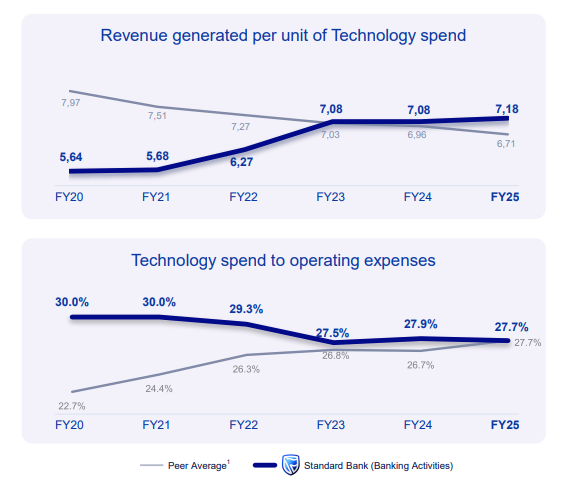
In the 2020 financial year, Standard Bank’s revenue generated per unit of technology spend was far below that of its peers.
The bank generated R5.64 of revenue per R1 spent on technology, while its peers generated R7.97 for the same expenditure.
Nienaber has managed to flip this picture over the past five years as part of the SBG 2025 strategy, with Standard Bank now generating R7.18 for every R1 spent on technology.
This has been helped by the bank’s revenue growing substantially over the past five years, but it is also a function of its declining technology spend as a share of operating expenses to just over 27%.
Tshabalala and CFO Arno Daehnke have spent considerable time telling investors that much of the bank’s major technology spending has already been completed.
As a result, the bank expects its operating leverage to continue to improve. In other words, it expects to generate more revenue without a corresponding rise in operating expenses.
Nienaber explained that this will be driven by a fundamental shift in how Standard Bank operates on a technical level.
She said the bank’s technical workforce has been significantly overhauled, with the percentage of technical staff to management rising from 54% in 2020 to 73% in 2025.
This not only gives the bank greater capacity but also makes its technical workforce more efficient, enabling faster product and feature rollouts.
Under the medium-term target to 2028, Nienaber said the bank will invest heavily in its cloud operations, growing its footprint with hyperscalers such as Amazon Web Services, Microsoft Azure, and Huawei.
The bank will also look to modernise its client platforms, rolling out a new online business banking platform and a personal banking experience.
A major part of Nienaber’s focus will also be on investing in enhanced cybersecurity to ensure clients’ personal data is not compromised.
Ultimately, the bank has built a simplified, cloud-based technology platform over the past five years, and now looks to invest in optimising how clients engage with it.






Comments