Eskom heading for serious trouble


Despite significant improvements over the past few years, Eskom faces serious financial risks that could derail its progress.
Climbing municipal debt, an unsustainable tariff path, and continued lower sales are putting immense pressure on Eskom’s finances and could undo the benefits from the utility’s R254 billion government debt relief package.
Eskom’s financial results were recently outlined in detail in a presentation to the Standing Committee on Appropriations on 24 March 2026.
In this presentation, Eskom celebrated its improved financial standing, with the utility having posted its first profit in eight years for the 2025 financial year and on track to do it again in 2026.
In its presentation, Eskom stated that its performance in the 2026 financial year to date shows sustained improvements, with the utility in a far better place than it was a few years ago.
However, the utility also highlighted notable risks that threaten to derail its progress.
The first risk of note relates to Eskom’s two main sources of revenue – tariffs and sales – both of which are under significant pressure.
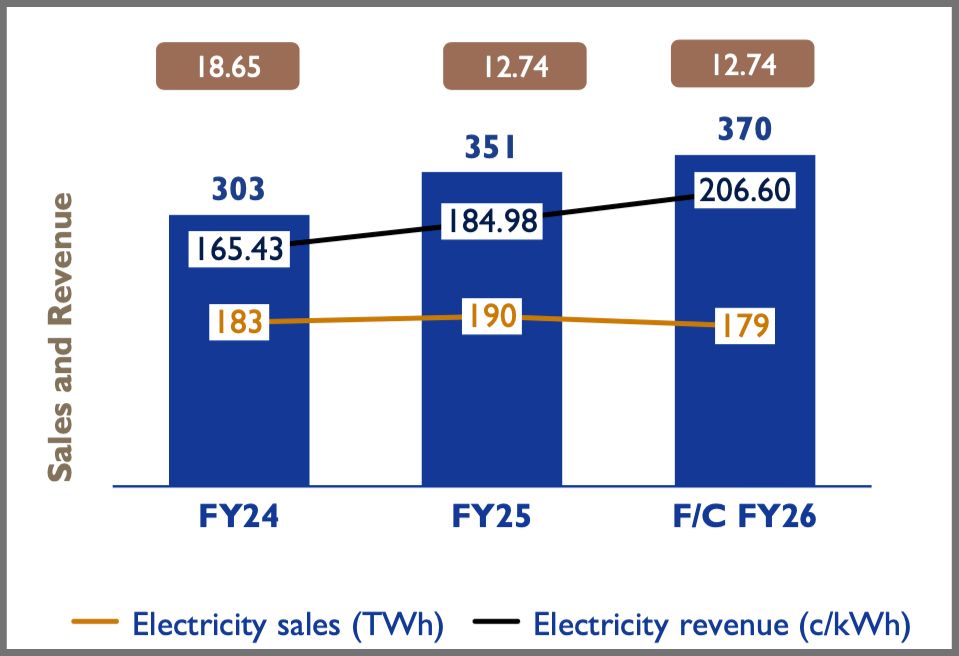
Eskom’s revenue growth of 15.84% in the 2025 financial year was driven mainly by tariff increases, with the utility’s sales volumes remaining flat.
The utility attributed this to the impact of an increasing number of customers going off-grid and general economic conditions.
Therefore, most of its revenue growth was due to tariff increases over the period, with electricity costs having skyrocketed over the past few years.
Several energy experts have warned that this is an unsustainable path, as continued above-inflation increases in electricity tariffs will chase away Eskom’s wealthier customers who can afford to invest in alternatives.
This will result in a so-called “death spiral”, as the utility could be left with only non-paying or poorer customers, forcing Eskom to raise its prices, thereby chasing even more customers away.
In its projections for the upcoming years, Eskom said it expects only single-digit tariff increases for the coming years.
This could put pressure on the utility’s revenue going forward, as it cannot rely as heavily on tariff increases to drive growth, and will need to increase sales volumes as well.
This is concerning, as Eskom itself expects electricity sales to decrease in the 2026 financial year.
Soaring municipal debt
Another major risk to Eskom’s financial health over the next few years is municipal debt, which continues to climb despite the National Treasury’s debt relief programme.
In its presentation, Eskom explained that municipal arrears remain a significant risk, both to its own finances and the electricity industry as a whole.
It said overdue balances from municipalities are expected to rise to R116 billion by the 2026 financial year and more than double to R358 billion by 2031.
The utility said this poses a threat to its financial sustainability and could unwind the benefits of its R254 billion Debt Relief Programme.
Recognising the serious risk municipal arrears pose, the National Treasury implemented its municipal debt relief programme in 2023.
This was hoped to offer at least a partial solution to this growing problem, and experts were optimistic when 71 municipalities across South Africa signed up for the programme and received approval.
To receive the associated debt relief offered by the National Treasury, participating municipalities had to meet certain criteria, including paying current monthly accounts, enforcing credit control and installing smart meters.
However, nearly three years later, only 10 municipalities are compliant with paying their current account.
Worryingly, Eskom revealed that 61 of the approved municipalities are in overdue status, which includes R33.8 billion in debt accumulated post-approval.
To try and address this problem, Eskom and the government have now teamed up on alternative solutions.
This includes distribution agency agreements (DAAs), where the licence remains with the municipality, but they are required to hire an agent, like Eskom, to collect the revenue from customers.
Eskom said it is hopeful that these DAAs will support municipalities in achieving sustainable local service delivery, while also ensuring the utility’s financial stability through improved billing and revenue collection.
“Solutions to the municipal debt growth are critical to the financial sustainability of Eskom, the electricity distribution industry, and the legal separation timelines of Eskom’s distribution business,” the utility said.
The graph below shows the historic and projected growth of municipal debt owed to Eskom.






Comments