Eskom going from hero to zero


Eskom has made immense progress in improving its operational performance, with load-shedding essentially a thing of the past in South Africa.
However, the utility now faces a major threat from continued investment by households and companies to reduce their electricity use.
This trend first emerged amid the load-shedding crisis, as companies and households invested to ensure a stable electricity supply.
Now, this trend is still ongoing, driven by Eskom’s surging electricity prices, which have pushed companies, in particular, to invest in alternative energy sources to reduce their operating costs.
There is also a need for South African companies to reduce their reliance on carbon-intensive electricity generation to minimise tax liabilities under carbon taxes and to ensure their exports are not hit with additional levies in the European Union and elsewhere.
As a result, the trend of companies investing in alternative energy sources has accelerated in recent years, with 2025 being a record year for private electricity generation in South Africa.
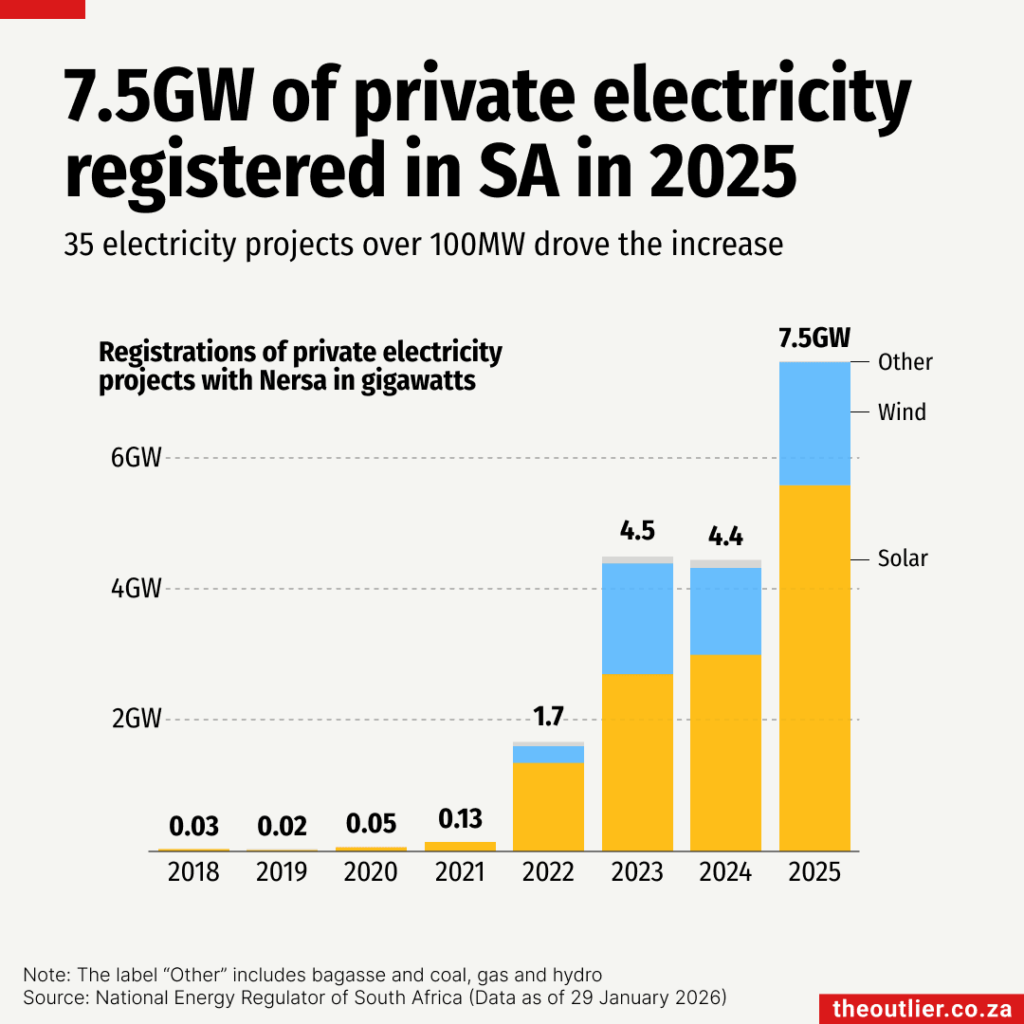
Over 7.5 GW of private electricity generation projects were registered with Nersa in 2025, representing a 68% jump from the 4.4 GW registered in 2024.
The Outlier’s analysis revealed that this was almost solely driven by 35 large-scale electricity projects, each with a capacity of 100 MW or more. These projects made up 90% of the total capacity registered in 2025.
Its study also showed that most of the new capacity came from solar generation, with this technology making up 75% of the total megawatts registered in 2025.
Wind also proved to be relatively popular, with several significant projects registered, including the Great Karoo Phase 1 project in the Northern Cape with 280 MW of wind capacity.
Four 240 MW wind projects were also registered in the Western Cape. Three of these were developed by Red Cap, with the fourth by Mulilo.
By the end of 2025, Nersa had registered a total of 2,393 electricity generation facilities, representing 18 GW of capacity. This can be seen in the graph below, courtesy of the Outlier.
Eskom’s death spiral
The continued growth in registration of private electricity generation projects indicates that companies and households are increasingly turning away from Eskom.
The City of Cape Town has recently announced it will call for tenders to implement several major projects that aim at cutting electricity costs in the city.
Cape Town, home to about 5 million people, is the first major metro to seek to break Eskom’s monopoly.
While one of the city’s largest metros is looking to dump the utility, South Africa’s largest retailer, Shoprite, has invested billions to reduce its reliance on government services.
Shoprite has installed over 100 solar systems across South Africa and Namibia, with a peak capacity of over 43.3 MW from its rooftop PV systems.
This could generate enough electricity to power nearly 12,300 households a year in South Africa and currently makes up 7.2% of Shoprite’s total energy consumption.
These investments pose a major problem for Eskom, as these are typically made by the utility’s best customers – entities that pay it regularly and use large amounts of energy.
This makes it hard for the utility to begin reducing prices for its users to reverse the downward slide, as there is declining demand for its product.
“To talk about saving money and bringing prices down for customers in an environment where you are selling less because demand is declining is extremely difficult,” energy expert and managing director of EE Business Intelligence Chris Yelland said.
Yelland explained that South Africans are turning to alternative energy sources for affordability, not only for security of supply, as was the case during load-shedding.
“Declining demand actually pushes the price up because you are trying to recover a certain cost base off a declining sales base,” Yelland said.
“Whilst there has been a dramatic improvement in the reduction of load-shedding, one has to be concerned about the decline in demand.”
“What is really going on with the decline in demand and the rise in alternative energy sources does not paint a healthy picture for a monopoly utility. In fact, it indicates just the opposite.”





Comments