Lights out for South Africa’s economy


South Africa’s declining economic growth over the past 15 years, with it only beginning a slow comeback in 2025, was largely due to electricity disruptions.
Load-shedding disrupted normal business operations, costing companies billions in lost revenue, and resulted in large corporates engaging in subsistence investing rather than growth.
This investing, in alternative energy sources, such as rooftop solar or generators, simply keeps their doors open and does not increase capacity or employment.
As a result, while companies may have invested billions in the economy, this did not lead to much economic growth or a rise in employment.
GDP, the total value of goods and services produced, is a measure of economic health. When it grows, jobs are created, and investment follows. When it contracts, jobs are lost, and investors look elsewhere.
Load-shedding was also coupled with other mismanagement crises in the form of logistics bottlenecks at South Africa’s ports and on its railways and, increasingly, water shortages.
There was also a period of intense corruption at high levels within the government. This era has been dubbed the “State Capture era”. Some argue that it has not ended, as corruption is still widespread.
These crises appear to be coming to an end, with load-shedding being a thing of the past and Transnet’s performance stabilising.
Private sector involvement in the economy is increasing as the government executes its reform agenda, and the National Treasury is successfully implementing a process of fiscal consolidation.
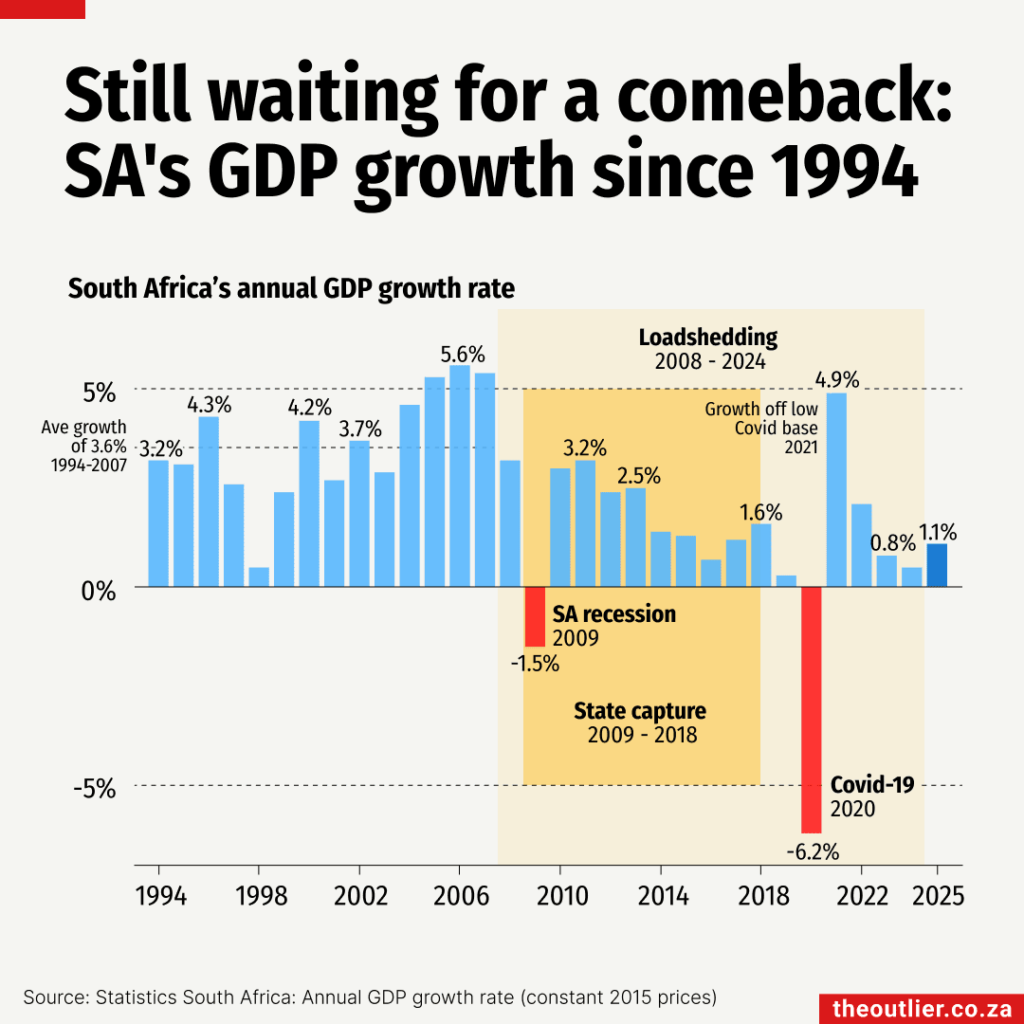
This led to South Africa reporting its best economic growth in three years in 2025 at 1.1%. While far better than the decade prior’s average of 0.8% per annum, it is not enough.
It falls short of the National Treasury’s predictions of 1.4%. It also lags well behind the IMF’s global estimate of 3.3% and Sub-Saharan Africa’s 4.2%, the Outlier noted.
South Africa’s current economic growth rate is also not enough to make a meaningful impact on the level of unemployment in the country.
The country’s economic growth was not always so poor, with the Outlier showing that between 1994 and 2007, South Africa averaged 3.6% growth thanks to a commodities boom, an expanding middle-class and a surplus budget in 2007/08.
But loadshedding, the 2008 global recession, and state capture dragged the 2008–2019 average down to 1.6%. Post-pandemic recovery has yet to restore those early highs.
This can be seen in the graph below, courtesy of the Outlier.
The rand suffers
South Africa’s currency was directly impacted by the period of poor economic growth and, in particular, by load-shedding.
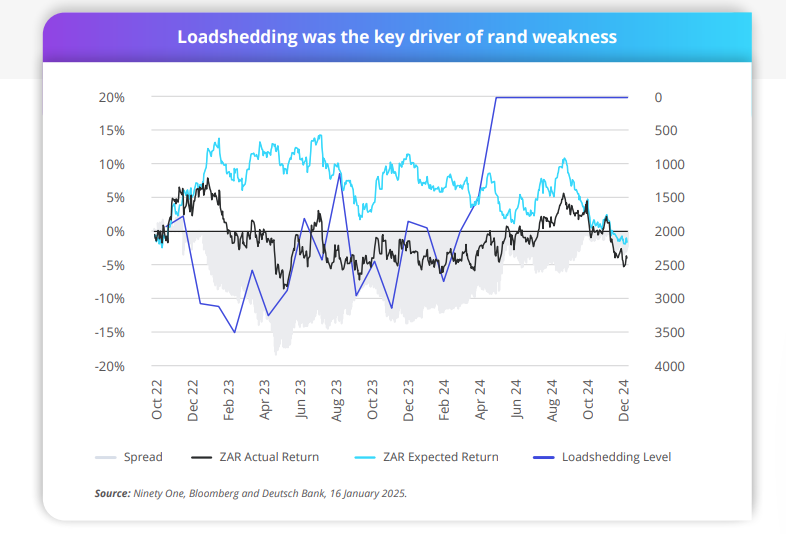
An analysis from Discovery Invest showed that load-shedding contributed to 75% of the rand’s weakness from October 2022 to the end of 2024.
This period includes 2023, when load-shedding was at its worst, and when the situation was just beginning to improve towards the end of 2024.
Load-shedding, as with many of South Africa’s challenges, is internal by nature and can be fixed regardless of what happens elsewhere in the world.
Not reliant on external factors to improve, load-shedding during its worst years acted as a permanent handbrake on the South African economy, Ninety One said.
The South African Reserve Bank repeatedly noted the severe impact of structural constraints on the local economy in the form of load-shedding and logistics bottlenecks.
While the constraint of load-shedding appears to have been removed, progress in the logistics sector is moving at a much slower pace.
South Africa’s private sector has successfully collaborated with the government to ensure that companies can invest heavily in alternative energy sources.
This has given Eskom room to work on intense maintenance at its coal-fired power plants, which have shown a dramatic improvement since the end of 2023.
In the logistics sector, however, the private sector is moving in at a much slower pace, with the private operation of Durban’s critical Pier 2 being bogged down by legal challenges.
International Container Terminal Services, Inc. (ICTSI) first won the contract to operate the container terminal in 2023. The court cases surrounding the award were only resolved in ICTSI’s favour in October 2025.
This represents the beginning of an era where the private sector plays a much bigger role in South Africa’s economy than ever before.
The private operation of Durban’s container terminal is aimed at reducing the delays and bottlenecks that have characterised it in the past.
In the most recent Container Port Performance Index, compiled by the World Bank and S&P Global Ratings, Durban came last among the 403 ports surveyed.
The graph below, courtesy of Discovery Invest, shows the role load-shedding played in the rand’s weakness from October 2022 to the end of 2024.




Comments